Electronic Batch Records: The Real Cost of Staying on Paper
Paper batch records compound hidden costs every quarter. EBR is harder than it looks — and the data integrity gap is widening.

20260805133210.webp&w=1920&q=75&dpl=dpl_DBpSA5K4vHC4UUGhboeG7FmE5z5L)
An Electronic Batch Record (EBR) is a digital version of the manufacturing batch record — the complete, regulated document that captures every step, parameter, material, and sign-off involved in producing a pharmaceutical batch. Where a paper batch record is a physical folder of forms, worksheets, and signatures assembled manually across a shift, an EBR captures the same data in real time, within a validated system, with an automatic audit trail attached to every entry.
Electronic batch records and paperless manufacturing get framed as a straightforward digitisation exercise — swap paper forms for digital ones, done. In practice, that framing understates both the difficulty and the cost of delay. The harder problem isn't digitisation. It's data integrity. And the cost of staying on paper doesn't arrive all at once — it compounds quietly, every quarter a plant delays the transition.
What Paper Batch Records Actually Cost
Manual batch records carry hidden costs that rarely show up as a single line item on anyone's budget — which is exactly why they're so easy to underestimate.
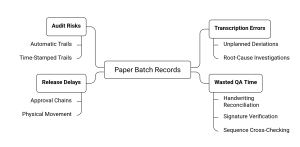
There's the transcription error that triggers an unplanned deviation, pulling QA, production, and sometimes regulatory affairs into a root-cause investigation for something a digital field validation would have caught instantly. There's the QA review time spent reconciling handwriting, cross-checking signatures, and flipping between pages to confirm a sequence of events actually happened in the order the record claims. There's the delay between batch completion and release, while a paper record physically moves through an approval chain that a connected system would close in a fraction of the time. And there's the audit risk baked into any process where a record can, in principle, be altered without an automatic, time-stamped trail showing exactly who changed what and when.
None of this shows up as "the cost of paper" in a plant's financials. It shows up as deviation rates, batch release cycle times, and QA headcount — scattered across line items that never get added back together into the one number that actually matters: what staying on paper is costing the plant, every quarter, compared to the alternative.
Why Electronic Batch Records Are Harder Than They Look
The instinct when evaluating an EBR project is to treat it like any other digitisation effort: take the paper form, recreate it on a screen, and call it done. This is also the most common way EBR projects underdeliver.
The real challenge is ensuring electronic batch records meet ALCOA++ data integrity principles — attributable, legible, contemporaneous, original, accurate, plus complete, consistent, enduring, and available — with the same regulatory rigour expected of paper, while the system is also faster and more usable for the people actually filling it out, shift after shift.
That second condition is where most of the difficulty lives. A digital form that simply replicates a paper form's layout, without rethinking the underlying workflow, tends to be slower and more frustrating than paper, not less. Operators end up clicking through more screens than they used to turn pages. Supervisors find themselves working around a system that technically satisfies the SOP but doesn't actually reflect how the floor operates. The result is a technically compliant EBR that nobody trusts — and a plant that has spent significant budget without solving the problem it set out to solve.
What Successful EBR Rollouts Get Right
Across the implementations that genuinely stick — where operators use the system because it's better, not because they're told to — three patterns show up consistently.
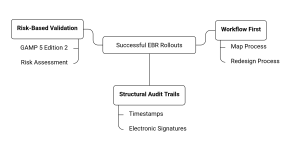
Workflow redesign before digitisation. The plants that get this right treat EBR as a process redesign project with a digital component, not a digitisation project with workflow as an afterthought. The sequence matters: map how the batch record process should actually work first, then build the digital system around that — rather than digitising the existing paper process and hoping efficiency follows automatically.
Audit trails built into the workflow, not bolted on. Every change, every timestamp, every signature should be a natural consequence of how the system works — not a separate compliance layer that operators have to remember to engage with on top of their actual job. When the audit trail is structural rather than additive, data integrity stops being something the team has to actively maintain and becomes something the system does by default.
Risk-based validation under GAMP 5 Edition 2. The EBR system itself gets classified and validated proportionate to its actual risk — not blanket-validated at maximum rigour regardless of function. A configuration element that affects batch release decisions gets the scrutiny that decision deserves. A cosmetic interface element doesn't get the same treatment it would have received under a uniform, one-size-fits-all CSV approach. This is the same risk-based logic reshaping computer software assurance more broadly, applied specifically to the batch record layer.
Risk-based validation is becoming the foundation of modern manufacturing systems.
See how GAMP 5 Edition 2 is helping pharma teams move beyond one-size-fits-all validation approaches.
Explore the GAMP 5 Edition 2 Guide
Where This Is Being Worked Out in Practice
This transition — from paper to validated, trusted, genuinely faster electronic batch records — isn't a theoretical conversation. It's the live agenda at the Pharma Manufacturing IT Summit (PMITS), taking place on 7 July 2026 at Le Méridien, Ahmedabad.
Gujarat alone manufactures roughly a third of India's pharma output, and most of it still runs on paper. PMITS is built around exactly the question this article raises: what does it actually take to bring the Indian pharma factory floor into the CSA, GAMP 5 Edition 2, and paperless-batch-record era — without losing the validated state regulators expect?
It's an invitation-only, 130-seat event with no vendor expo and a room that's over 70% end-users — meaning the people in the room have actually run these systems, not sold them. Confirmed speakers include Vikram Shukla (President, Zydus), Pramod Gokhale (Sr. President & Global CIO, Mankind Pharma), Dr. Bijender Mishra (Global IT Head & CISO, Alkem Laboratories), Ravi Kalla (CIO, Anthem Biosciences), Narinder Sagar (CIO, Corona Remedies), Rahul Songire (Sr. VP – Central Quality, Zydus Lifesciences), and Shyam Khante (former Director, GSK).
Delegates leave with a Manufacturing IT 2030 Blueprint, a CSV → CSA migration playbook covering exactly what to retire, retain, and defend in an inspection, and a GAMP 5 Ed.2 & Annex 22 readiness checklist — the precise questions inspectors are starting to ask about AI-in-GMP and paperless batch records.
Early bird pricing (₹4,990 + GST) closes 18 June 2026, with seats limited to 130 reviewed applications. The event is organised by Pharma Now × Yellow Hive Events & Media, as Wave 02 of the GPACTS 2026 Series. → Book your pass
The Real Decision Plants Are Facing
Twelve of India's top-20 pharma manufacturers run at least one Gujarat plant, and by 2026, none of them can validate the way they did in 2018. The paperless roadmap has stopped being a future-state conversation. It's an active, widening gap between what the factory floor produces and how digitally mature its record-keeping actually is — and every quarter that gap stays open, the hidden cost of paper keeps compounding quietly in the background.
Electronic batch records are only one piece of the digital manufacturing puzzle.
FDA CSA is reshaping how regulated software is assessed, tested, and defended during inspections.
Understand FDA Computer Software Assurance
FAQs
Q1. What does ALCOA++ mean for electronic batch records?
ALCOA++ stands for attributable, legible, contemporaneous, original, accurate, complete, consistent, enduring, and available. For EBR specifically, it means every entry must be traceable to who made it and when, without requiring a separate compliance step layered on top of the actual workflow.
Q2. Why do EBR rollouts sometimes end up slower than paper?
This usually happens when a digital form simply recreates a paper form's structure without redesigning the underlying workflow. Operators end up navigating more screens than they used to turn pages, which adds friction instead of removing it.
Q3. Does GAMP 5 Edition 2 require the same validation rigour for every part of an EBR system?
No. GAMP 5 Edition 2 supports risk-based validation, meaning higher-risk functions — like batch release logic — get more rigorous testing, while lower-risk elements don't require the same blanket-maximum-rigour treatment that older CSV approaches applied uniformly.
Q4. What is the single biggest mistake plants make when moving to electronic batch records?
Digitising the existing paper process instead of redesigning the workflow first. Sequence matters: map how the process should work, then build the system — not the other way around.
Q5. How can manufacturing IT leaders learn more about this transition?
The Pharma Manufacturing IT Summit (PMITS) on 7 July 2026 in Ahmedabad is specifically built around this exact transition, with senior practitioners from Zydus, Mankind Pharma, Alkem, Anthem Biosciences, and Corona Remedies sharing real implementation experience.
Reporting on the science, business and regulation shaping the pharmaceutical industry.
More in Pharma Manufacturing
All articles →
Compliance In Pharma Manufacturing 2025: Key Regulations And Best Practices You Need to Know

Improving Pharmaceutical Manufacturing Flexibility: Agile Manufacturing and Rapid Scale-Up

Discussion