LIMS Implementation In Indian Pharma: A Practical Guide
LIMS implementation in pharma fails on trust, not technology, why workflow mismatch creates hidden compliance risk.

Laboratory Information Management Systems exist at most mid-to-large Indian pharma companies today. Whether they're actually trusted and fully used by the analysts running them is a separate question entirely — and increasingly, the answer to that question determines whether a QC lab is carrying hidden compliance risk that doesn't surface until an export audit forces the issue into the open.
LIMS implementation in pharma labs has a reputation problem precisely because so many rollouts stall halfway. The system gets installed, validated, and signed off — and yet analysts quietly keep working the way they always have.
Why LIMS Implementation Is Harder Than It Looks On Paper
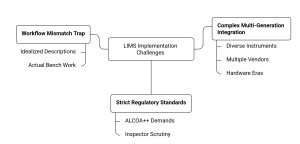
A pharmaceutical Laboratory Information Management System sits at a genuinely difficult intersection. It must integrate with laboratory instruments spanning multiple vendors and multiple generations of hardware. It must satisfy ALCOA++ data integrity expectations that regulators now scrutinize closely. And it must stay usable enough that analysts don't quietly default back to spreadsheets and paper notebooks the moment nobody is watching.
The most common failure pattern in LIMS implementation isn't technical at all. It's a workflow mismatch. The system gets configured around how validation documentation describes lab processes on paper, rather than how analysts actually move samples through testing, review, and release on the bench. When those two pictures diverge, the system becomes something analysts work around instead of something they work within.
This Is Not Just A Vendor Selection Problem
Two distinct conversations get conflated constantly in LIMS implementation discussions. "Which LIMS should we buy" is a procurement decision — a checklist exercise comparing features, pricing, and vendor reputation. "How do we actually get our analysts to trust and adopt this system" is a completely different problem: an implementation and change-management problem.
That second conversation is the one that actually determines whether the investment pays off. A validated, fully compliant LIMS that the lab works around rather than works within creates exactly the kind of shadow-process risk that QC digitisation was supposed to eliminate in the first place. The compliance gap doesn't show up in the validation package. It shows up later, usually during an inspection, when someone asks why a sample's testing timeline doesn't match what the system shows.
A LIMS analysts work around and a MES nobody trusts fail for the exact same reason.
→ Read: Why 7 of 10 Pharma MES Projects Fail | What the Survivors Do Differently
What Genuine Lab Systems Modernisation Actually Requires
Successful LIMS implementation in pharma depends on four things that rarely make it into a vendor's pitch deck, but consistently separate labs that achieve real digitisation from labs that simply own software nobody trusts.
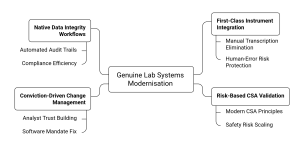
Instrument integration as a first-class requirement.
A LIMS that still requires manual transcription from key laboratory instruments hasn't modernised the lab at all. It has just relocated the transcription step from one place to another, while leaving the same human-error risk fully intact.
Risk-based validation applied to lab systems too.
The same Computer Software Assurance (CSA) principles that are reshaping Manufacturing Execution System validation apply directly to LIMS. Yet laboratories frequently default to heavier, older Computer System Validation (CSV) assumptions out of habit, validating every function with equal rigour regardless of actual risk to data integrity or patient safety.
Change management as the core workstream, not an afterthought.
Analysts who have run manual workflows for years need a genuine reason to trust a new system. A mandate to use it is not the same thing as a reason to believe in it. Without that trust, adoption stays surface-level even after go-live.
Data integrity built into the workflow itself.
Audit trails should be a natural consequence of how the system functions during normal use, not a separate compliance layer that analysts have to consciously remember to engage with. The moment data integrity feels like extra work, it becomes the first thing skipped under deadline pressure.
CSA isn't an MES-only concept.
The same risk classification logic is exactly what LIMS validation has been missing.
→ Read: GAMP 5 Second Edition for MES: A Practical Validation Guide
Where Lab Informatics Leaders Are Comparing Notes
PHARMA MANUFACTURING IT SUMMIT (PMITS) | AHMEDABAD | 7 JULY 2026
Le Méridien, Ahmedabad | Invitation-Only | 130 Seats | A GPACTS 2026 Series Event
Gujarat manufactures roughly 33% of India's pharma output. Most of it still runs on paper. PMITS is built around a single question: what does it take to bring the Indian pharma factory floor into the CSA, GAMP 5 Edition 2, and paperless-batch-record era — without losing the validated state regulators expect?
One day. 130+ of India's most senior pharma manufacturing IT, CSV, and plant IT decision-makers. No vendor expo. 70%+ end-users. Chatham House throughout.
Confirmed Speakers
- Vikram Shukla – President, Zydus (Delivering the Chief Guest address)
- Pramod Gokhale – Sr. President & Global CIO, Mankind Pharma
- Dr. Bijender Mishra – Global IT Head & CISO, Alkem Laboratories
- Ravi Kalla – CIO, Anthem Biosciences
- Narinder Sagar – CIO, Corona Remedies
- Rahul Songire – Sr. VP – Central Quality, Zydus Lifesciences
- Shyam Khante – Former Director, GSK
What You Leave With
- A Manufacturing IT 2030 Blueprint — ready for your next plant investment review
- A CSV → CSA Migration Playbook — what to retire, retain, and defend in an inspection
- A GAMP 5 Ed.2 & Annex 22 Readiness Checklist — the exact questions coming on AI-in-GMP and paperless batch records
- Unfiltered peer intelligence on real MES, LIMS, and Digital Twin deployments — Chatham House
- 12 months of Pharma Now manufacturing IT intelligence post-event
Organised by Pharma Now × Yellow Hive Events & Media | Wave 02 of the GPACTS 2026 Series. → Book your pass
Lab informatics rarely gets the same strategic attention as MES or enterprise AI in Indian pharma technology conversations. But a QC lab running on unreliable LIMS data carries compliance exposure just as material as a manufacturing IT failure — arguably more so, since lab data underpins every batch release decision downstream. The principles that already work for MES transfer directly to LIMS implementation. The industry's attention has simply lagged behind the risk.
FAQs
1. What is LIMS implementation in pharma?
LIMS implementation in pharma refers to the process of deploying a Laboratory Information Management System within a QC or R&D lab — covering instrument integration, workflow configuration, validation, and analyst training — so that sample testing, data capture, and release decisions happen within a single trusted digital system rather than across disconnected paper and spreadsheet workarounds.
2. Why does LIMS implementation in pharma labs often stall after go-live?
Most LIMS implementation failures trace back to a workflow mismatch rather than a technical defect. The system gets configured to match what validation documentation describes, not how analysts actually move samples through testing in practice. When the two don't align, analysts quietly revert to manual workarounds, leaving the LIMS technically validated but practically underused.
3. Is LIMS implementation primarily a vendor selection decision?
No. Vendor selection is a procurement exercise — comparing features, pricing, and integration capability. The harder and more consequential challenge is change management: getting analysts to genuinely trust and adopt the system day to day. A compliant LIMS that the lab works around still leaves the organisation exposed to the same data integrity risk that LIMS was meant to eliminate.
4. How does CSA apply to LIMS implementation in pharma?
The same risk-based Computer Software Assurance principles reshaping MES validation apply directly to LIMS. Rather than validating every system function with equal, document-heavy rigour, CSA allows labs to scale validation effort to actual risk — focusing scrutiny on functions that affect data integrity or patient safety, and reducing unnecessary burden elsewhere. Many labs still default to older, heavier CSV assumptions out of habit rather than genuine regulatory requirement.
5. What is the biggest compliance risk from a poorly implemented LIMS?
The biggest risk is shadow processes — analysts working around the system rather than within it, using spreadsheets or paper notebooks for parts of their workflow. This creates a gap between what the LIMS audit trail shows and what actually happened on the bench, a gap that typically stays invisible until an export audit or regulatory inspection specifically tests sample traceability end to end.
Reporting on the science, business and regulation shaping the pharmaceutical industry.
More in Pharma Manufacturing
All articles →
Compliance In Pharma Manufacturing 2025: Key Regulations And Best Practices You Need to Know

Improving Pharmaceutical Manufacturing Flexibility: Agile Manufacturing and Rapid Scale-Up
Discussion