Why 7 of 10 Pharma MES Projects Fail | What the Survivors Do Differently
7 of 10 pharma MES projects get worked around in two years. Here's why, what survivors do differently, and where it's discussed at PMITS, 7 July.

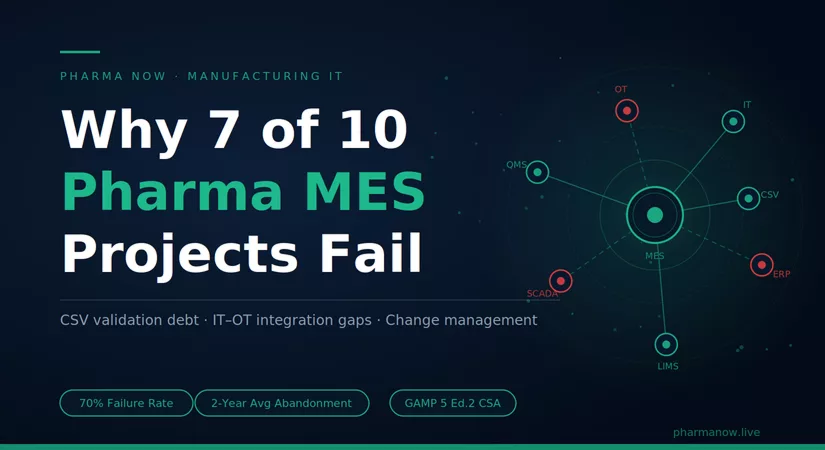
Manufacturing Execution Systems (MES) are pitched as the connective tissue of a modern pharma plant — the layer that links planning, execution, and quality data into one coherent system. For Indian pharma manufacturers under growing pressure to digitize, that pitch is compelling. It is also, in most cases, only half true.
A majority of MES implementations that launch successfully end up functionally abandoned, partially used, or quietly worked around within two years of go-live. The system is still technically running. The plant, however, has found ways to operate without depending on it. This is the uncomfortable reality that rarely makes it into a vendor's pitch deck — and it is the reality this article is built to address.
The Gap Between the Pitch and the Plant Floor
On paper, MES adoption looks like a straightforward technology decision: select a platform, configure it, validate it, go live. In practice, MES sits at the intersection of validation requirements, shop-floor behavior, IT-OT integration, and regulatory expectation — and it is precisely that intersection where most projects unravel.
The failure is rarely sudden. It is gradual. Operators find a workaround for a clunky screen. A supervisor reverts to a parallel paper log "just to be safe." A planned configuration update gets shelved because revalidating it is too heavy a lift. None of these individual decisions look like failure in the moment. Collectively, they describe a system that exists but no longer drives the plant.
Why MES Projects Actually Die on the Factory Floor
Four recurring patterns explain why so many MES rollouts quietly stall after a successful launch.
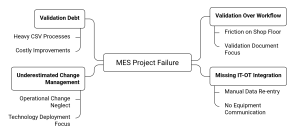
1. Configured for the validation document, not the shop floor
When an MES is built primarily to satisfy a Computer System Validation (CSV) checklist, it often creates more friction than the paper process it was meant to replace. The system technically passes validation. The operators using it every day find it slower, more rigid, or less intuitive than what came before — so they route around it wherever they can.
2. No real IT–OT integration
An MES that doesn't communicate cleanly with plant equipment, SCADA systems, or lab instruments becomes a manual re-entry exercise. Instead of automatically capturing data from the equipment it's meant to oversee, it depends on operators typing in numbers that already exist elsewhere — defeating the entire purpose of the system.
3. Underestimated change management
A new MES doesn't just change software; it changes how operators, supervisors, and QA teams work every single day. Treating the rollout as a technology deployment rather than an operational change consistently undermines adoption. Without genuine buy-in and training built around real workflows, the system becomes something people tolerate rather than rely on.
4. Validation debt from day one
Once an MES is configured and validated, it often gets frozen in place. Any subsequent change triggers a CSV process so heavy that teams avoid making it — even when the change is clearly needed. Over time, this validation debt accumulates, and the system drifts further from what the plant actually needs.
Validating every screen with equal rigour is exactly how MES projects die.
Here's the GAMP 5 Ed.2 framework survivor plants actually use.
→ Read: GAMP 5 Second Edition: Risk-Based CSV Guide for Pharma IT Leaders
What the Survivors Actually Do Differently
Not every MES rollout fails. Plants where MES has genuinely taken hold share three traits — and notably, none of them are primarily about which vendor was selected.
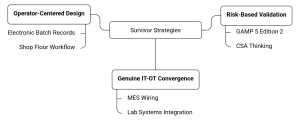
First: risk-based validation applied from day one.
Survivor plants apply the same GAMP 5 Edition 2 and Computer Software Assurance (CSA) thinking shaping the rest of the industry's regulatory shift. Instead of validating every screen and function with equal, exhaustive rigour, they classify MES changes by actual risk to product quality and data integrity — reserving heavy validation for what truly warrants it.
Second: genuine IT-OT convergence.
In these plants, the MES is wired directly into actual equipment and lab systems. It is not an isolated data-entry layer that operators must feed manually after the fact. Data flows in from the floor in real time, which is what makes the system worth using rather than working around.
Third: workflows designed around how operators actually move.
Electronic batch records and screen workflows in successful deployments are built around the real physical and procedural flow of the shop floor — not around how a validation document idealises the process on paper. This single difference often determines whether operators embrace the system or quietly abandon it.
CSV froze your MES the day it passed validation.
Here's what CSA changes and why it stops the debt from piling up.
→ Read: Computer System Validation (CSV) vs Computer Software Assurance (CSA)
The Honest Takeaway
MES is not failing in Indian pharma manufacturing because the technology doesn't work. It is failing because implementation approaches consistently underweight validation strategy, change management, and IT-OT integration relative to software selection.
Get the sequencing right — risk-based validation, real integration, and operator-centred design — and the technology delivers exactly what it promises. Get the sequencing backwards, and the project joins the seven out of ten that quietly fade into the background within two years.
Where This Gets Discussed With Named Practitioners, Not Vendors
PHARMA MANUFACTURING IT SUMMIT (PMITS) | AHMEDABAD | 7 JULY 2026 Le Méridien, Ahmedabad | Invitation-Only | 130 Seats | A GPACTS 2026 Series Event
Gujarat manufactures roughly 33% of India's pharma output. Most of it still runs on paper. PMITS is built around a single question: what does it take to bring the Indian pharma factory floor into the CSA, GAMP 5 Edition 2, and paperless-batch-record era — without losing the validated state regulators expect?
One day. 130+ of India's most senior pharma manufacturing IT, CSV, and plant IT decision-makers. No vendor expo. 70%+ end-users. Chatham House rules throughout.
Confirmed Speakers
- Vikram Shukla – President, Zydus (Delivering the Chief Guest address)
- Pramod Gokhale – Sr. President & Global CIO, Mankind Pharma
- Dr. Bijender Mishra – Global IT Head & CISO, Alkem Laboratories
- Ravi Kalla – CIO, Anthem Biosciences
- Narinder Sagar – CIO, Corona Remedies
- Rahul Songire – Sr. VP – Central Quality, Zydus Lifesciences
- Shyam Khante – Former Director, GSK
What You Leave With
- A Manufacturing IT 2030 Blueprint — ready for your next plant investment review
- A CSV → CSA Migration Playbook — what to retire, retain, and defend in an inspection
- A GAMP 5 Ed.2 & Annex 22 Readiness Checklist — the exact questions coming on AI-in-GMP and paperless batch records
- Unfiltered peer intelligence on real MES, LIMS, and Digital Twin deployments — Chatham House
- 12 months of Pharma Now manufacturing IT intelligence post-event
Organised by Pharma Now × Yellow Hive Events & Media | Wave 02 of the GPACTS 2026 Series. → Book your pass
Conclusion
The seven-in-ten MES failure rate isn't a verdict on the technology — it's a verdict on sequencing. Plants that treat validation, IT-OT integration, and change management as afterthoughts to vendor selection consistently end up with systems that exist on paper but not in practice. Plants that flip that priority — validating by risk, integrating genuinely, and designing for the operators who actually use the system — are the ones where MES becomes the connective layer it was always meant to be. For Indian pharma manufacturers weighing their next MES investment, the lesson isn't which platform to buy. It's which sequence to follow.
FAQs
1. Why do most pharma MES projects fail after a successful launch?
Most MES projects fail not at launch but in the months that follow, as operators quietly work around systems that were configured to satisfy validation checklists rather than real shop-floor workflows. Poor IT-OT integration and underestimated change management compound the problem, leading to functional abandonment within roughly two years.
2. Is MES failure primarily a vendor or technology problem?
No. The traits shared by successful MES deployments — risk-based validation, genuine IT-OT convergence, and operator-centred workflow design — are not tied to any specific vendor. Failure is driven by implementation sequencing, not platform choice.
3. How does GAMP 5 Edition 2 and CSA help prevent MES failure?
GAMP 5 Edition 2 and the Computer Software Assurance (CSA) approach allow validation effort to scale with actual risk to product quality and data integrity, rather than applying equal rigour to every system change. This prevents the validation debt that freezes MES platforms and makes necessary improvements too costly to implement.
4. What is validation debt in the context of MES?
Validation debt accumulates when an MES, once validated, becomes difficult to update because any change triggers a heavy CSV process. Over time, the system increasingly diverges from operational needs because teams avoid the cost of revalidating it — even when updates are clearly necessary.
5. What should pharma manufacturers prioritize before selecting an MES vendor?
Before vendor selection, manufacturers should establish a risk-based validation strategy, confirm a realistic plan for IT-OT integration with existing equipment and lab systems, and build a change management approach that treats the rollout as an operational shift — not just a software deployment.
Reporting on the science, business and regulation shaping the pharmaceutical industry.
More in Pharma Manufacturing
All articles →
Compliance In Pharma Manufacturing 2025: Key Regulations And Best Practices You Need to Know

Improving Pharmaceutical Manufacturing Flexibility: Agile Manufacturing and Rapid Scale-Up

Discussion