Real-Time Release Testing (RTRT): Replacing Traditional QC Models In Pharma
How Real-Time Release Testing is replacing traditional QC with faster, smarter, data-driven pharmaceutical manufacturing.


For many years, pharmaceutical quality control (QC) has followed a predictable process: a batch is produced, samples are collected, tests are carried out, and only after results are confirmed is the product released.
Although reliable, this approach is slow, heavily dependent on end-point testing, and often unable to detect problems early enough. When deviations surface late, the consequences include extended delays, high losses, and, in some cases, complete batch rejections.
The shift toward Real-Time Release Testing (RTRT) is changing this long-established model. Instead of performing all critical checks at the end of the production cycle, RTRT ensures quality throughout the process by relying on continuous monitoring, advanced process control, and real-time data.
Rather than waiting for laboratory confirmation after manufacturing, companies can verify product quality instantly and release batches far more efficiently. This shift represents a major step toward modern, intelligent, and responsive pharmaceutical manufacturing.
Understanding What Real-Time Release Testing Actually Means?
Real-Time Release Testing (RTRT) is a quality assurance method that allows a pharmaceutical product to be released based on real-time process data instead of relying solely on post-production laboratory testing.
In simpler terms, RTRT checks quality continuously while the product is being made. This approach uses a combination of continuous monitoring, in-process controls, and advanced analytical technologies to ensure that each unit meets defined specifications without waiting for traditional QC checks at the end.
RTRT does not replace QC; it transforms it into a predictive and proactive system. With strong scientific understanding, validated models, and automated controls, RTRT ensures that quality is built into the process instead of being tested afterward.

Why The Industry Is Moving Beyond Traditional QC?
Traditional QC methods have many limitations that make them less suitable for today’s manufacturing landscape. One of the biggest drawbacks is the long waiting period.
Batches often sit in quarantine while tests are completed in the QC laboratory, slowing down supply chains. Another challenge is sampling. Only a small portion of the batch is tested, which means results may not represent the entire batch’s quality.
In addition, traditional QC often identifies problems only at the end of production. By the time a deviation is discovered, correcting it is either costly or impossible. Batch failures at late stages are highly expensive and create significant waste.
With growing demand for faster production, strict compliance, and supply chain pressures, the industry needs an approach that is faster, more accurate, and more predictive. RTRT addresses each of these limitations by ensuring quality throughout the manufacturing process rather than merely checking it afterward.
The Core Principles Behind RTRT
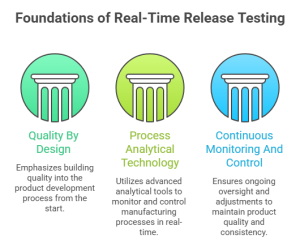
RTRT is built on several scientific and technological principles that allow manufacturers to monitor quality in real time and maintain consistent control over production processes.
a) Quality By Design (QbD):
RTRT depends heavily on a deep understanding of the manufacturing process. Quality by Design provides the framework for identifying critical quality attributes (CQAs) and critical process parameters (CPPs).
By understanding how these variables influence the final product, manufacturers can establish a well-defined design space that ensures consistent product performance. This scientific foundation makes it possible to predict product quality while manufacturing is still in progress.
b) Process Analytical Technology (PAT):
Process Analytical Technology enables continuous monitoring of important physical, chemical, and microbiological parameters throughout the production process.
Instead of relying on delayed laboratory tests, PAT tools collect real-time data that reflects the actual state of the product and the process. Techniques such as near-infrared spectroscopy, Raman spectroscopy, and particle size analysis allow manufacturers to detect even small changes that could affect product quality.
c) Continuous Monitoring And Control:
The third principle of RTRT is the use of automated systems that constantly monitor manufacturing conditions. Sensors and control systems track key parameters and immediately detect deviations.
When a variation occurs, the system can adjust process settings automatically to maintain stability. This continuous oversight ensures that the process stays within validated limits and that quality remains consistent.
How RTRT Works: A Simple Explanation
Although RTRT involves advanced technologies, the overall flow is straightforward. It begins with identifying what defines quality for a specific product. Manufacturers determine the critical quality attributes that must be controlled, such as assay, blend uniformity, moisture content, hardness, or dissolution rate.
Once these attributes are defined, the next step is to establish measurement methods that can track these parameters in real time. Using PAT tools such as NIR or Raman spectroscopy, the process is monitored at each stage.
The next part involves building prediction models that use these real-time readings to reliably estimate final product quality. These models must be validated to prove that real-time measurements correlate with traditional QC results.
After validation, the manufacturing process is equipped with automated controls capable of adjusting operating conditions whenever deviations appear. When the system consistently stays within the validated design space, the product can be released immediately based on the robust data generated during production.
The Role Of PAT In Enabling RTRT
Process Analytical Technology (PAT) is the technological backbone of RTRT. Without accurate, reliable, and real-time measurements, RTRT would not be possible. PAT tools allow non-destructive, in-line measurement of critical attributes such as chemical composition, particle size, moisture level, and coating thickness. They convert the production line into a smart system that continuously monitors every key parameter.
For example, NIR spectroscopy can measure moisture content during granulation, Raman spectroscopy can assess blend uniformity, and sensors on compression machines can track tablet hardness and weight. In coating processes, PAT can monitor coating thickness as it forms instead of relying on post-process sampling. These capabilities make PAT essential for maintaining tight control and ensuring quality throughout the manufacturing cycle.
RTRT In Continuous Manufacturing
RTRT plays a vital role in continuous manufacturing, an approach where production does not stop and products move through the process continuously rather than in batches. Continuous manufacturing cannot rely on end-point QC testing because the process never pauses long enough for traditional tests. RTRT provides the real-time control required to ensure the process runs within validated limits at every moment.
With continuous monitoring, any deviation can be corrected instantly, preventing defects from spreading through the production line. RTRT also allows products to be released continuously, eliminating long waiting times and enhancing responsiveness. As more companies shift toward continuous manufacturing to improve efficiency and flexibility, RTRT becomes an indispensable part of their quality strategy.

Key Advantages Of RTRT
- Faster Batch Release — RTRT significantly reduces the waiting time associated with traditional QC testing. Because quality data is collected continuously during manufacturing, products can be released much faster without waiting for lengthy laboratory testing cycles. This improves supply chain responsiveness and allows companies to deliver medicines to the market more quickly.
- Improved Consistency — Continuous monitoring provides a comprehensive understanding of the manufacturing process. Instead of relying on a limited number of samples, RTRT evaluates the entire process, which results in more consistent product quality and better process control.
- Early Detection Of Issues — One of the most valuable advantages of RTRT is the ability to identify problems as soon as they occur. Real-time monitoring helps detect deviations immediately, allowing corrective actions to be taken before the issue affects the entire batch.
- Reduced Waste & Rework — By detecting problems early and maintaining tighter process control, RTRT reduces the risk of batch failures. This leads to fewer rejected batches, lower production costs, and more efficient use of raw materials.
- Regulatory Alignment — Regulatory authorities increasingly support RTRT because it demonstrates strong scientific understanding of the manufacturing process. When properly validated, RTRT systems provide robust evidence that quality is built directly into the process.
- Support For Continuous Manufacturing — RTRT also plays a key role in enabling continuous manufacturing systems. Continuous production requires real-time monitoring and control, and RTRT provides the framework necessary to maintain consistent product quality in such environments.
Challenges In Implementing RTRT
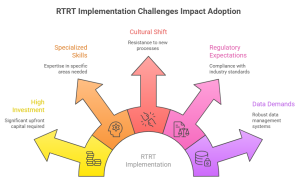
While RTRT offers clear advantages, implementing it successfully requires overcoming several technical and organizational challenges.
- High Initial Investment — Adopting RTRT often requires significant upgrades to manufacturing facilities. Companies need to install sensors, PAT instruments, automation systems, and data management platforms. These investments can be substantial, particularly for older facilities.
- Need For Specialized Skills — RTRT systems rely on advanced analytical tools and complex data models. As a result, companies must develop expertise in areas such as spectroscopy, chemometrics, automation engineering, and data analytics. Training and recruiting skilled professionals are therefore important steps in implementation.
- Cultural Shift — Moving from traditional laboratory-based QC to a real-time data-driven system requires a change in mindset across the organization. Manufacturing, quality assurance, and quality control teams must learn to trust predictive models and automated monitoring systems.
- Regulatory Expectations — Although regulatory agencies support RTRT, companies must demonstrate strong validation of models and analytical methods. Clear documentation and scientific justification are required to prove that real-time monitoring provides results equivalent to or better than traditional testing.
- Data Management Demands — RTRT generates large volumes of process data that must be stored, analyzed, and protected. Robust digital infrastructure and strict data integrity controls are necessary to manage this information effectively.
Steps For Pharma Companies To Transition Toward RTRT
Implementing RTRT requires careful planning and a gradual transition strategy that integrates technology, expertise, and regulatory compliance.
1) Identify Suitable Products
Companies should begin by selecting products with well-understood and stable manufacturing processes. Starting with simpler products helps organizations build confidence in RTRT systems before applying them to more complex formulations.
2) Strengthen QbD Foundations:
A strong Quality by Design framework is essential for RTRT. Manufacturers must clearly define CQAs, CPPs, and the design space that ensures consistent quality.
3) Invest In PAT Infrastructure:
The next step involves integrating advanced sensors and analytical tools into the production line. These instruments enable continuous monitoring of critical parameters during manufacturing.
4) Build & Validate Predictive Models:
Data collected through PAT systems is used to develop predictive models that estimate final product quality. These models must be validated carefully to demonstrate strong correlation with traditional QC results.
5) Upgrade Automation:
Manufacturing systems should be equipped with automated controls capable of responding to real-time data. Automation allows the process to adjust operating conditions immediately when variations occur.
6) Align With Regulatory Requirements:
Companies must ensure that their RTRT strategy complies with regulatory expectations. This includes preparing validation reports, documentation, and scientific justifications.
7) Train Cross-Functional Teams:
Successful RTRT implementation requires collaboration among manufacturing, QC, QA, engineering, and data science teams. Training programs help employees understand new technologies and workflows.
8) Pilot And Scale:
Finally, companies should begin with pilot implementations to test RTRT systems under real conditions. After successful trials, the approach can be gradually expanded to additional products and production lines.
In Conclusion
Real-Time Release Testing represents a major evolution in pharmaceutical quality control. By shifting from end-point testing to continuous, data-driven monitoring, RTRT enables faster batch release, improved consistency, and reduced waste.
Although the transition requires investment, expertise, and organizational change, the long-term benefits are substantial. As the industry moves toward automation, digitalization, and continuous manufacturing, RTRT will continue to grow as a central pillar of modern, high-performance pharmaceutical production.
FAQs
1) What Is Real-Time Release Testing (RTRT) In Pharma?
Real-Time Release Testing (RTRT) is a modern quality assurance approach that releases products based on real-time process data instead of waiting for traditional end-of-batch laboratory testing. It continuously monitors critical parameters during manufacturing to ensure that each unit meets defined specifications. This makes quality verification faster, more predictive, and more reliable.
2) Why Are Pharmaceutical Companies Moving Toward RTRT Instead Of Traditional QC?
Pharma companies are shifting to RTRT because traditional QC is slow, sample-based, and often identifies problems too late. RTRT eliminates long waiting times, reduces batch failures, improves consistency, and supports continuous manufacturing. It also provides stronger real-time control, helping companies meet rising demand for speed, accuracy, and regulatory alignment.
3) How Can Pharma Companies Successfully Transition To Real-Time Release Testing?
Companies can transition to RTRT by selecting suitable products, strengthening their Quality by Design (QbD) foundations, investing in PAT tools, building and validating predictive models, upgrading automation systems, ensuring regulatory compliance, training cross-functional teams, and running pilot implementations before scaling. These steps help build a strong, reliable RTRT framework that improves overall manufacturing performance.
Reporting on the science, business and regulation shaping the pharmaceutical industry.
More in Pharma Manufacturing
All articles →
Compliance In Pharma Manufacturing 2025: Key Regulations And Best Practices You Need to Know

Improving Pharmaceutical Manufacturing Flexibility: Agile Manufacturing and Rapid Scale-Up

Discussion