7 Challenges in scaling RNA Therapeutics Manufacturing
mRNA vaccines proved the science works. Scaling RNA therapeutics manufacturing is the real challenge, 7 bottlenecks the industry faces.


When the world watched mRNA vaccines move from laboratory concepts to billions of administered doses in record time, it felt like a scientific miracle.
For decades, RNA therapeutics had occupied the fringes of pharmaceutical innovation. Scientists understood their potential. Investors believed in the vision. Yet translating that promise into commercial reality remained an enormous challenge.
Then came the pandemic.
Almost overnight, RNA became a household term. Messenger RNA (mRNA) vaccines demonstrated that genetic medicines could be designed, manufactured, and deployed at unprecedented speed. The success sparked a surge of interest in RNA-based therapeutics for cancer, rare diseases, infectious diseases, cardiovascular disorders, and autoimmune conditions.
Yet behind every breakthrough headline lies a reality that receives far less attention. Manufacturing RNA therapeutics is extraordinarily difficult.
Unlike traditional small-molecule drugs, which rely on well-established production pathways, RNA medicines introduce an entirely different manufacturing paradigm. Every stage, from raw material sourcing and synthesis to purification, formulation, and storage, presents unique technical and operational challenges.
As the pipeline of RNA therapeutics expands, the industry's ability to manufacture these molecules at scale may determine how quickly the next generation of medicines reaches patients.
Why RNA Therapeutics Are Different
Traditional pharmaceuticals are typically built through chemical synthesis, creating stable molecules with relatively predictable manufacturing processes.
RNA therapeutics operate differently. Rather than delivering a therapeutic protein directly, RNA provides the instructions for cells to produce the desired protein themselves. This creates remarkable flexibility. A single manufacturing platform can potentially produce therapies for multiple diseases simply by changing the RNA sequence.
However, flexibility comes at a cost. RNA molecules are inherently fragile. Unlike conventional drugs that may remain stable for years, RNA is highly susceptible to degradation from enzymes, temperature fluctuations, and environmental conditions. Even minor manufacturing inconsistencies can compromise product quality, efficacy, or safety.
As a result, manufacturing RNA therapeutics requires an unprecedented level of process control.
1. Producing High-Quality RNA
At the heart of RNA therapeutic manufacturing lies a process known as in vitro transcription (IVT). This enzymatic process uses DNA templates, nucleotides, and specialized enzymes to synthesize RNA molecules.
While the concept appears straightforward, execution is far more complex. The manufacturing process must consistently generate RNA molecules with:
- The correct sequence
- Appropriate length
- High purity
- Minimal impurities
- Structural integrity
- Batch-to-batch consistency
Even slight variations can affect therapeutic performance. Impurities such as double-stranded RNA (dsRNA), truncated RNA fragments, residual DNA templates, enzymes, and reaction byproducts must be carefully controlled and removed.
The challenge becomes even greater during scale-up. Producing a few milligrams of RNA in a research laboratory differs significantly from manufacturing kilograms of material for commercial supply. Maintaining quality while increasing production volume remains one of the industry's most significant hurdles.
2.Purification Process
Many experts consider purification the most challenging step in RNA manufacturing. Following synthesis, the reaction mixture contains a complex combination of desired RNA molecules and unwanted contaminants.
These impurities can affect safety and trigger unintended immune responses. Removing them requires sophisticated purification technologies such as:
- High-performance liquid chromatography (HPLC)
- Tangential flow filtration (TFF)
- Affinity chromatography
- Ion-exchange chromatography
While these technologies are effective, they also increase manufacturing costs, processing times, and operational complexity.
As demand for RNA therapeutics grows, purification is increasingly viewed as a critical bottleneck in large-scale production. For manufacturers, achieving high purity without compromising yield remains a delicate balancing act.
3.Lipid Nanoparticle Challenge
Producing RNA is only part of the equation. The molecule must also reach its target within the human body. Naked RNA is rapidly degraded and struggles to enter cells efficiently. To overcome this limitation, most RNA therapeutics rely on lipid nanoparticles (LNPs) as delivery vehicles.
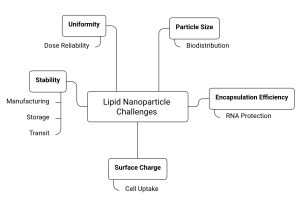
LNPs have become one of the defining technologies behind the success of mRNA medicines. These microscopic carriers protect RNA molecules and facilitate cellular uptake. However, manufacturing lipid nanoparticles introduces an entirely new layer of complexity.
Critical quality attributes such as Particle size, Encapsulation efficiency, Surface charge, Stability, and Uniformity must be tightly controlled. Small variations can significantly impact biodistribution, efficacy, and safety.
Manufacturers are effectively producing two complex products simultaneously: the RNA molecule and the delivery system. The success of the final therapy depends on both.
LNPs didn't just solve a delivery problem, they helped rewrite how fast pharma could move.
→ How mRNA Technology Redefined Speed and Innovation in Pharma
4.Raw Material Supply Chain Vulnerabilities
The rapid growth of RNA therapeutics has exposed vulnerabilities across the global supply chain. RNA manufacturing depends on highly specialized raw materials, including Modified nucleotides, Enzymes, Plasmid DNA, Lipid components, and Chromatography resins.
Unlike traditional pharmaceutical ingredients, many of these materials have limited supplier networks. During periods of increased demand, shortages can quickly emerge. The pandemic highlighted these risks as manufacturers competed for access to critical raw materials needed for vaccine production.
As RNA pipelines continue expanding, supply chain resilience is becoming a strategic priority for pharmaceutical companies, biotechnology firms, and CDMOs. Organizations are increasingly investing in supplier diversification, vertical integration, and regional manufacturing networks to reduce dependency risks.
5.Analytical Complexity
Manufacturing quality depends on measurement. For RNA therapeutics, measurement itself is challenging. Unlike small molecules, RNA possesses complex structural characteristics that require advanced analytical techniques.
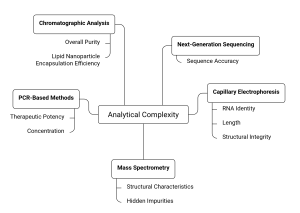
Manufacturers must assess RNA identity, Purity, Integrity, Sequence accuracy, Potency, Stability, and Encapsulation efficiency. Accomplishing this requires a combination of technologies such as:
- Next-generation sequencing (NGS)
- Capillary electrophoresis
- Mass spectrometry
- PCR-based methods
- Chromatographic analysis
Developing robust analytical methods capable of supporting regulatory submissions remains a significant undertaking. As regulatory expectations evolve, analytical characterization is becoming increasingly important for demonstrating product quality and consistency.
6.Scaling Manufacturing for Commercial Success
The RNA therapeutic industry is moving beyond emergency vaccine production into a future defined by chronic disease management, oncology, and personalized medicine. This shift introduces a new challenge.
Can manufacturing keep pace? Commercial success requires more than scientific innovation. It demands manufacturing platforms capable of delivering:
- Consistent quality
- Reliable supply
- Cost efficiency
- Global scalability
Facilities originally designed for traditional biologics may require significant adaptation to accommodate RNA production. At the same time, emerging therapies are driving demand for flexible manufacturing models capable of supporting smaller patient populations and personalized treatments.
The future of RNA manufacturing may depend on modular facilities, continuous manufacturing technologies, automation, and digital process control.
7.Regulatory Expectations Are Evolving
RNA therapeutics represent a relatively new therapeutic class, and regulatory frameworks continue to evolve alongside the science. Health authorities are increasingly focused on:
- Process understanding
- Critical quality attributes
- Impurity control
- Product consistency
- Supply chain integrity
- Data integrity
Manufacturers must demonstrate not only that their products are safe and effective but also that their processes remain robust throughout the product lifecycle. The challenge is particularly significant because many regulatory expectations for RNA products are still being refined.
Organizations that proactively invest in quality-by-design principles and advanced manufacturing controls will be better positioned to navigate future regulatory requirements.
The Future of RNA Manufacturing
The next decade is likely to witness substantial advances in RNA manufacturing technologies.
Artificial intelligence is beginning to support process optimization and predictive quality monitoring. Continuous manufacturing approaches may improve efficiency and scalability. Novel purification methods could reduce production costs, while next-generation delivery systems may enhance stability and performance.
Perhaps most importantly, the industry is moving toward platform-based manufacturing strategies that enable faster development across multiple RNA products. The goal is clear: transform RNA manufacturing from a specialized capability into a scalable industrial platform.
Achieving that vision will require collaboration among pharmaceutical companies, biotechnology innovators, equipment manufacturers, CDMOs, regulators, and academic institutions.
Predictive quality monitoring isn't theoretical anymore, pharma's already using AI to catch what manual QA misses.
→ How AI Is Transforming Quality Assurance in Pharma
Conclusion
RNA therapeutics have opened one of the most exciting chapters in modern medicine. Their ability to target diseases at the genetic level has created opportunities that were unimaginable only a decade ago. Yet the future of these therapies will depend not only on scientific discovery but also on manufacturing excellence.
From RNA synthesis and purification to lipid nanoparticle formulation, analytical characterization, supply chain resilience, and regulatory compliance, every stage presents unique challenges that demand innovation. For industry leaders, the question is no longer whether RNA therapeutics will transform healthcare. The question is whether manufacturing infrastructure can evolve quickly enough to support their growing promise.
Because in the world of RNA therapeutics, the next breakthrough may not come from the laboratory alone. It may come from the factory floor, where scientific potential is transformed into medicines capable of reaching millions of patients worldwide.
FAQs
1. What are RNA therapeutics?
RNA therapeutics are medicines that use RNA molecules, such as mRNA, siRNA, or antisense oligonucleotides, to influence protein production or gene expression within cells for therapeutic benefit.
2. Why is manufacturing RNA therapeutics more challenging than traditional drugs?
RNA molecules are highly fragile and susceptible to degradation. Their production requires specialized synthesis, purification, formulation, and storage processes that differ significantly from traditional pharmaceutical manufacturing.
3. What role do lipid nanoparticles play in RNA therapeutics?
Lipid nanoparticles (LNPs) protect RNA molecules from degradation and help deliver them into target cells. They are critical for the effectiveness of many mRNA-based therapies and vaccines.
4. What are the major manufacturing bottlenecks in RNA therapeutics?
Key bottlenecks include RNA purification, raw material availability, lipid nanoparticle formulation, analytical characterization, and scaling production while maintaining product quality and consistency.
5. How will AI impact RNA therapeutic manufacturing?
Artificial intelligence can support process optimization, predictive quality monitoring, anomaly detection, and manufacturing efficiency, helping companies improve scalability and reduce production risks.
Reporting on the science, business and regulation shaping the pharmaceutical industry.
More in Pharma Manufacturing
All articles →
Compliance In Pharma Manufacturing 2025: Key Regulations And Best Practices You Need to Know

Improving Pharmaceutical Manufacturing Flexibility: Agile Manufacturing and Rapid Scale-Up

Discussion