by Simantini Singh Deo
7 minutes
What To Look For In A 21 CFR Part 11 Compliant Document Management System?
21 CFR Part 11 compliant DMS guide, features checklist, 5 compliance steps, electronic signatures and EU Annex 11 comparison explained.
21 CFR Part 11 refers to Part 11 of Title 21 of the Code of Federal Regulations. The US FDA issued this regulation in March 1997, and it came into effect in August 1997. It governs the FDA's requirements for electronic records and electronic signatures.
Since its introduction, the regulation has been revised periodically with the goal of encouraging electronic submission of records and reducing the cost of compliance for organizations.
As more life sciences companies move away from paper-based systems, understanding and implementing this regulation has become an increasingly important part of building a robust quality management system.
Which Organizations Does This Regulation Apply To?
21 CFR Part 11 applies to all records in electronic form that are created, modified, maintained, archived, retrieved, or transmitted under any records requirement set out in US FDA regulations. It also applies to electronic records submitted to the FDA under the Federal Food, Drug, and Cosmetic Act and the Public Health Service Act, even when those records are not specifically identified in agency regulations.
Importantly, the term "electronic record" extends to records that were not originally created electronically but were later scanned and stored or sent to the agency in electronic format. As a result, all life sciences industries that maintain electronic records or submit information electronically for product approval in the US market are required to comply with this regulation.
This includes pharmaceutical manufacturers, medical device companies, biotechnology firms, clinical research organizations, and any other entity operating under FDA oversight. If your organization handles any form of electronic quality record as part of its regulatory obligations, 21 CFR Part 11 applies to you.
The Core Goals Behind 21 CFR Part 11
The core purpose of 21 CFR Part 11 is to ensure the security and protection of digitally managed quality records in the life sciences industry, including how those records are distributed, stored, and retrieved. The FDA is particularly concerned about several key risks associated with electronic records:
- Malfunctioning of computer systems and software
- Manufacturer practices for maintaining data safety and security
- Prevention of data corruption or loss
- Ensuring the integrity of approval and review signatures
- Traceability of any changes made to data
- Prevention and detection of falsified records
Beyond data security, 21 CFR Part 11 was also intended to accelerate digital transformation in the industry. By making electronic systems a viable and compliant alternative to paper-based filing, the regulation encourages organizations to adopt paperless systems, which generates significant cost savings over time.
Paper-based systems require physical storage space, manual handling, and considerable time for document retrieval and review. A well-implemented electronic system, when compliant with 21 CFR Part 11, eliminates most of these inefficiencies while simultaneously strengthening the overall integrity of quality records.
In this sense, the regulation serves a dual purpose, protecting public health through reliable data management while helping organizations operate more efficiently.
Why Your eQMS Must Meet 21 CFR Part 11 Standards?
One of the primary functions of a 21 CFR Part 11 compliant document management system is to electronically create, store, retrieve, and archive quality records. The process of electronically signing those records also takes place within a document management system that forms part of an eQMS.
For any organization selling life sciences products in the US market, having a 21 CFR Part 11 compliant eQMS is not optional, it is a requirement. If you are currently evaluating a new eQMS or are unsure whether your existing system meets the standard, it is worth reviewing the most important compliance features that a fully compliant eQMS should offer.
It is also worth noting that non-compliance with 21 CFR Part 11 can carry significant consequences. The FDA has the authority to issue warning letters, initiate product recalls, or take regulatory action against organizations that fail to maintain compliant electronic records.
Beyond the legal and financial risks, non-compliance can damage an organization's reputation and delay product approvals, both of which can have a lasting impact on business operations. Investing in a compliant eQMS from the outset is far more cost-effective than attempting to remediate compliance gaps after a regulatory inspection.
Key Compliance Features To Evaluate In An eQMS
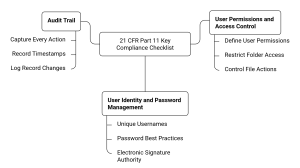
Understanding what 21 CFR Part 11 actually requires is the first step toward choosing the right eQMS for your organization. The checklist below covers the most prominent requirements and can help speed up your evaluation process. While reviewing an eQMS solution, ask the following questions:
a) User Permissions and Access Control:
- Can you define user permissions based on roles — for example, limiting audit trail access to QA personnel only?
- Can you restrict folder access to specific user roles — for example, allowing only QC personnel to access QC results folders?
- Can you control who has permission to delete, create, edit, review, and approve files — for example, limiting approval access to the QA head only?
b) User Identity and Password Management
- Does the system require a unique username for every user to ensure traceability?
- Does the system prompt users to follow best practices for password management?
- Does the system notify users that their username and password serve as the authorization for their electronic signature, and that these credentials must be kept confidential?
c) Audit Trail
- Does the system capture every action performed by a logged-in user in the form of a timestamped audit trail?
- Does the audit trail record when records were created, modified, deleted, or made obsolete and does it log these actions against the username, date, and time?
It is important to note that this checklist covers the most prominent requirements but should not be treated as a substitute for reading the actual legislation. We strongly recommend reviewing the full federal regulation and forming your own independent interpretation of its requirements.
5 Practical Steps For Maintaining Ongoing Compliance
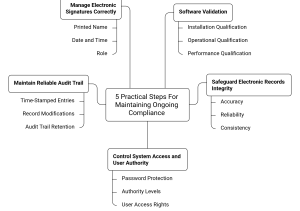
Once you have selected a compliant document management system, the next challenge is maintaining ongoing compliance. The following five steps cover all the major areas you need to address.
Step 1 — Software Validation
Even when a software provider offers a pre-validated solution, the responsibility for compliance ultimately rests with the manufacturer. You should verify the prominent requirements listed above, as well as any additional user requirements defined internally by your team.
A thorough compliance check can be done as part of the operational qualification stage of your software validation process. It is also important to document the validation process thoroughly, as this documentation itself may be subject to review during an FDA inspection. A typical software validation process includes three stages:
- Installation Qualification — verifying that the software has been installed correctly
- Operational Qualification — confirming that the software meets all regulatory and user requirements
- Performance Qualification — ensuring that the software performs consistently and reliably over time
Validation is not a one-time activity. Any significant changes to the software, such as upgrades, patches, or configuration changes may require revalidation to ensure continued compliance. Establishing a clear change control process for your eQMS is therefore an essential part of long-term compliance management.
Software validation for 21 CFR Part 11 compliance requires understanding CSV methodology and risk-based approaches to system qualification.
Learn how Computer System Validation (CSV) and Computer Software Assurance (CSA) differ and which approach fits your eQMS.
→ Read: CSV vs CSA: Computer System Validation & Software Assurance in Pharma
Step 2 — Safeguarding The Integrity Of Electronic Records
Maintaining the integrity of electronic records requires a set of clearly defined procedures and controls. Key responsibilities in this area include ensuring the accuracy, reliability, and consistency of records, and defining processes to detect any invalid or altered records on a periodic basis.
Records must be generated accurately and completely, kept suitable for inspection, review, and agency copying, and retrievable throughout the required retention period. Additionally, all personnel who develop, maintain, or use electronic record and signature systems must have the appropriate education, training, and experience for their assigned tasks.
Controls must be in place to protect the authenticity, integrity, and confidentiality of records from the point of creation to the point of receipt. Regular training refreshers and periodic internal reviews of record management practices help ensure that these controls remain effective over time and do not erode as personnel change or processes evolve.
Data integrity in 21 CFR Part 11 systems requires more than technology, it demands organizational capability, employee competence, and proactive quality culture.
Discover how capability building and compliance training ensure your team actually maintains electronic record integrity.
→ Read: Why Pharmaceutical Quality Systems Fail Without Capability Building
Step 3 — Controlling System Access and User Authority
Access to the system must be controlled and limited to authorized individuals only. This involves enabling password protection, creating different authority levels for different user roles, and ensuring that only the right people can sign records electronically, access input or output devices, alter records, or carry out specific operations.
Adequate controls must also be in place over the distribution of and access to documentation used for system operation and maintenance. User access rights should be reviewed and updated regularly, particularly when employees change roles, leave the organization, or when new team members join.
Leaving outdated access rights in place is a common compliance gap that can be identified during an audit and should be proactively managed as part of routine quality operations.
Step 4 — Maintaining A Reliable Audit Trail
A compliant audit trail must record all time-stamped operator entries as well as any actions that create, modify, or delete electronic records. Previously recorded information must never be obscured by record changes. Audit trail documents must be retained for at least as long as legally required for the relevant electronic records and must remain retrievable for agency review.
Revision and change control procedures should also be in place to maintain a chronological record of how system documentation has been developed and modified over time. The audit trail is one of the most scrutinized elements during an FDA inspection, so it is critical that the system generates audit trail entries automatically and that these entries cannot be altered or deleted by any user, including system administrators.
Step 5 — Managing Electronic Signatures Correctly
Signed electronic records must contain the signer's printed name, the date and time the signature was executed, and the role associated with the signature such as reviewer, approver, or author. Electronic signatures must be linked directly to their respective records so that they cannot be removed, copied, or transferred to falsify another record.
Written policies must be established and enforced to hold individuals accountable for all actions taken under their electronic signatures, serving as a deterrent against falsification.
Organizations should also ensure that employees understand the legal weight of an electronic signature, it carries the same binding authority as a handwritten signature, and signing on behalf of another person or sharing login credentials is a serious compliance violation that must be explicitly addressed in training and policy documentation.
What About Manufacturers Selling In The European Market?
The short answer is both yes and no. 21 CFR Part 11 itself does not apply to products sold exclusively in Europe — in that context, EU Annex 11 is the applicable regulation. However, EU Annex 11 covers essentially the same requirements for computerized systems as 21 CFR Part 11.
This means that if your organization is already compliant with EU Annex 11, transitioning to 21 CFR Part 11 compliance should be relatively straightforward, opening up the opportunity to enter the US market without significant additional effort. For organizations operating globally, aligning your eQMS to meet both standards simultaneously is a smart long-term strategy.
Building a single compliant system that satisfies both EU Annex 11 and 21 CFR Part 11 from the start reduces duplication of effort and ensures your quality infrastructure can support international market access as your business grows.
In Conclusion
21 CFR Part 11 compliance is not just a regulatory checkbox, it is a foundation for trustworthy, secure, and efficient management of electronic records in the life sciences industry. Choosing the right document management system means looking carefully at how it handles user access, electronic signatures, audit trails, and data integrity.
And once the right system is in place, staying compliant is a matter of following structured processes across validation, security, record protection, and accountability. Whether you are entering the US market for the first time or strengthening an existing quality system, building a solid 21 CFR Part 11 compliance framework is an investment that pays off in audit readiness, regulatory confidence, and long-term operational efficiency.
FAQs
1) What Makes A Document Management System Compliant With 21 CFR Part 11?
A 21 CFR Part 11 compliant system must ensure the security, integrity, and traceability of electronic records and signatures. This includes features such as role-based user permissions, secure password and identity controls, tamper-proof audit trails, validated software performance, and reliable electronic signature linking. It should also allow complete record retrieval during inspections and support long-term data preservation. A fully compliant system reduces the risk of data manipulation and strengthens overall regulatory readiness.
2) Why Is Software Validation Important For 21 CFR Part 11 Compliance?
Software validation proves that your document management system consistently performs as intended and meets both regulatory and internal user requirements. Even if your vendor supplies a validated platform, the FDA still requires your organization to verify installation accuracy, operational functionality, and long-term reliability. Validation also helps identify gaps before they become compliance issues during inspections. It ultimately ensures that your quality processes remain reliable, consistent, and audit-ready.
3) How Do Electronic Signatures Work In A 21 CFR Part 11 Compliant System?
In a compliant system, electronic signatures must be unique, secure, and permanently linked to the records they approve. Each signature must display the signer’s name, timestamp, and role, and the system must prevent any copying, removal, or alteration of the signature. These controls help ensure accountability for every approval and action taken within the system. They also provide a transparent review trail that supports regulatory decision-making.