21 CFR Part 11 vsEU GMP Annex 11: What Every Life Sciences Professional Must Know
Two frameworks, one goal, data integrity. Break down 21 CFR Part 11 and EU GMP Annex 11 before your next inspection.


If you work in pharmaceuticals, biotech, or medical devices, you have likely come across two regulatory frameworks that govern how computerised systems and electronic data are managed: 21 CFR Part 11 and EU GMP Annex 11.
These two guidelines often get confused because they overlap on themes such as electronic records, data integrity, and system validation. But they are not the same, and understanding where they differ is critical for any company that operates globally or is preparing for regulatory inspections.
Both frameworks exist for the same fundamental reason: to make sure that when organisations move away from paper-based processes toward digital systems, they do not compromise data accuracy, product quality, or patient safety. However, the two guidelines come from different regulatory bodies, apply in different geographies, carry different legal weight, and approach the subject from different angles.
This blog walks you through exactly what each framework covers, how they compare side-by-side, and the practical steps you can take to stay compliant with both.
What Is 21 CFR Part 11?
21 CFR Part 11 is a regulation issued by the U.S. Food and Drug Administration (FDA). The "21 CFR" stands for Title 21 of the Code of Federal Regulations, and Part 11 specifically addresses electronic records and electronic signatures.
The regulation was first published in March 1997 and was designed to encourage companies to adopt digital systems without creating loopholes that could compromise data reliability. In simple terms, it sets out the rules under which electronic records and electronic signatures are considered legally equivalent to paper records and handwritten signatures.
21 CFR Part 11 applies to all records that are created, modified, maintained, archived, retrieved, or transmitted under FDA regulations. This includes pharmaceutical manufacturers, biotech companies, and medical device makers who submit data electronically to the FDA or use electronic systems in their regulated operations.
The regulation is divided into three subparts:
- Subpart A – General Provisions: This section covers the scope of the regulation, definitions, and how it is implemented. It sets the foundation for everything that follows.
- Subpart B – Electronic Records: This is the most detailed section. It specifies requirements for closed and open computer systems, including audit trails, system access controls, operational checks, authority checks, device checks, and the protection of electronic records. It also outlines requirements for signature manifestations, meaning how an electronic signature is linked to an electronic record.
- Subpart C – Electronic Signatures: This section covers the general requirements for electronic signatures, including the use of at least two distinct identification components (such as an ID code and password), controls for identification codes and passwords, and requirements for non-biometric and biometric signatures.
One of the most important features of 21 CFR Part 11 is its level of specificity. It does not just tell you what to do in broad terms; it tells you exactly how to do it, which makes it easier to audit against but also more demanding to implement.
What Is EU GMP Annex 11?
EU GMP Annex 11 is a guidance document published by the European Medicines Agency (EMA) as part of the EU's Good Manufacturing Practice (GMP) guidelines. While 21 CFR Part 11 is a legal regulation, Annex 11 is a guidance supplement, meaning it is not legally binding in the same strict sense. Still, it is expected to be followed by any company operating within or exporting to the European Union.
Annex 11 was most recently updated in January 2011 and applies to all computerised systems used in GMP-regulated activities. It aims to ensure that when a computerised system replaces a manual process, there is no loss in product quality, process control, or quality assurance.
The guidance is structured into four sections:
- Section 1 – General Guidance: Covers risk management, personnel responsibilities, and the management of suppliers and service providers. It sets the tone for a risk-based approach throughout the document.
- Section 2 – Project Phase: Focuses on the validation of computerised systems, including user requirement specifications, system design, and the documentation needed during system development and implementation.
- Section 3 – Operational Phase: This is the largest section and covers day-to-day system use. It includes requirements for data accuracy checks, data storage, printouts, audit trails, change and configuration management, periodic evaluations, security measures, incident management, electronic signatures, batch release, business continuity planning, and archiving.
- Section 4 – Glossary: Defines key terms used throughout the document.
Unlike 21 CFR Part 11, which is narrowly focused on electronic records and signatures, Annex 11 takes a broader systems-based perspective. It looks at the entire lifecycle of a computerised system, from purchase and installation to decommissioning, and addresses organisational, procedural, and technical controls together.
Head-to-Head: Key Differences Between 21 CFR Part 11 and EU GMP Annex 11
The table below summarises the most critical differences between the two frameworks:
Where the Two Frameworks Converge
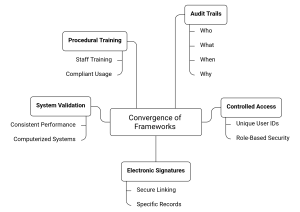
Despite their differences, 21 CFR Part 11 and EU GMP Annex 11 share a common goal: protecting data integrity and ensuring the reliability of electronic systems used in regulated environments. Both frameworks require:
- Audit trails that capture who did what, when, and why
- Controlled access to systems using unique user identification
- Electronic signature controls that link the signature to the corresponding record
- System validation to confirm that computerised systems perform consistently and as intended
- Procedures and training to support compliant use of systems
Companies that export products to both the U.S. and EU markets, which is the case for most large pharmaceutical manufacturers, need to satisfy both frameworks simultaneously. While there is significant overlap, gaps do exist, particularly around supplier qualification, business continuity, and the depth of validation documentation required.
Both frameworks demand audit-ready validation.
See how IQ OQ PQ builds the evidence trail that holds up under FDA and EMA scrutiny.
→ Read: IQ OQ PQ In Pharma | Essentials Of Equipment Qualification
Compliance Checklist: Meeting Both 21 CFR Part 11 and EU GMP Annex 11
Use this checklist as a starting point for evaluating your organisation's current compliance posture:
System Validation
- User Requirement Specifications (URS) documented for all computerised systems
- Validation plans and reports completed and approved
- Periodic review of validated systems conducted
Electronic Records and Signatures
- Electronic signatures are linked uniquely to individuals
- Two-factor authentication implemented where required (21 CFR Part 11)
- Signature manifestations include date, time, and the meaning of the signature
- Records protected against unauthorised alteration or deletion
Audit Trails
- Audit trails enabled for all critical data fields
- Audit trail review frequency is defined in procedures
- Audit trail records are retained per the applicable data retention policy
Access Controls
- Unique user IDs are assigned to all system users
- Role-based access controls are implemented and reviewed regularly
- Account management procedures in place (creation, modification, deactivation)
Data Integrity
- Data Integrity Risk Assessment (DIRA) completed
- Controls in place to prevent backdating or data manipulation
- Backup and disaster recovery procedures established and tested
Supplier and IT Infrastructure Management
- Supplier qualification conducted for computerised system vendors (Annex 11)
- IT infrastructure qualification completed
- Contracts with suppliers include GMP/data integrity expectations
Operational Controls
- SOPs in place for system use, change control, and incident management
- Personnel training records are maintained and up to date
- Business continuity plan documented and tested (Annex 11)
Why Global Companies Must Satisfy Both Frameworks
For a company that manufactures in Europe and sells in the U.S., or vice versa, compliance with only one framework is simply not enough. A company that is compliant with Annex 11 but has not addressed 21 CFR Part 11 specifics (such as the two-component electronic signature rule or the precise requirements for open system controls) may find itself at risk during an FDA inspection. Equally, a company that ticks all the 21 CFR Part 11 boxes but ignores Annex 11's requirements for supplier qualification, business continuity, and periodic system evaluation could face findings during an EMA-affiliated inspection.
The good news is that building a compliance program that addresses both is achievable. Because the two frameworks share more common ground than differences, a well-designed Quality Management System (QMS) that is built around data integrity principles, thorough validation, robust access controls, and strong documentation practices will naturally satisfy the core requirements of both.
Practical Tips for Staying Compliant with Both
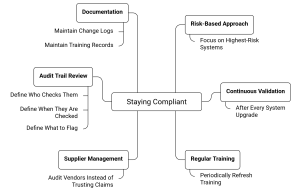
1. Take a risk-based approach. Both frameworks support the use of risk assessments to prioritise effort. Start by classifying your computerised systems by GMP criticality and focusing your most rigorous controls on the highest-risk systems.
2. Build validation into your system lifecycle. Do not treat validation as a one-time event. Both frameworks expect you to maintain a validated state throughout the system's life, including after changes and upgrades.
3. Train your people regularly. Your systems are only as reliable as the people using them. Training on data integrity, system use, and GMP expectations should be documented, role-specific, and refreshed periodically.
4. Manage your suppliers proactively. Annex 11 specifically requires that you assess and manage your computerised system suppliers. Do not assume a vendor's claims of compliance are sufficient; conduct audits and review their documentation.
5. Keep your audit trails meaningful. An audit trail that exists but is never reviewed adds little value. Define who reviews audit trails, how often, and what constitutes a reportable finding.
6. Document everything. Both frameworks reward well-maintained documentation. Your validation records, change controls, deviation logs, and training records are the evidence you will present during inspections.
Compliance without capability is a paper shield.
Here's why pharma quality systems fail when people aren't built to carry them.
→ Read: Why Pharmaceutical Quality Systems Fail Without Capability Building
Final Thoughts
21 CFR Part 11 and EU GMP Annex 11 are not interchangeable; they are complementary frameworks that serve the same ultimate purpose from two different regulatory perspectives. 21 CFR Part 11 is a detailed, prescriptive U.S. regulation focused specifically on electronic records and signatures. EU GMP Annex 11 is a broader, principles-based European guidance that covers the full lifecycle of computerised systems in GMP operations.
Understanding the similarities and differences between the two is not just an academic exercise. For life sciences companies operating in today's global market, it is a practical necessity. Getting both right protects patients, preserves product quality, and keeps your organisation inspection-ready on both sides of the Atlantic.
FAQs
Q1. What is the main difference between 21 CFR Part 11 and EU GMP Annex 11?
21 CFR Part 11 is a legally binding FDA regulation focused on electronic records and signatures in the U.S. At the same time, EU GMP Annex 11 is a GMP guidance document from the EMA covering the full lifecycle of computerised systems used in pharmaceutical manufacturing within the EU.
Q2. Is EU GMP Annex 11 legally mandatory?
Annex 11 is a guidance document, not a standalone legal regulation. However, EU regulatory authorities expect compliance, and deviations from its principles can result in inspection findings or import restrictions.
Q3. Do pharmaceutical companies need to comply with both frameworks?
Companies that manufacture or distribute products in both the U.S. and EU markets are expected to comply with both markets' requirements. Since the frameworks overlap significantly, a well-structured QMS can typically address both simultaneously.
Q4. What does "data integrity" mean in the context of these two regulations?
Data integrity refers to ensuring that electronic records are complete, accurate, consistent, and trustworthy throughout their lifecycle. Both frameworks require controls such as audit trails, access restrictions, and validation to protect data integrity.
Q5. How often should computerised systems be reviewed for compliance?
Both frameworks expect periodic reviews of computerised systems to confirm they remain validated and continue to meet regulatory requirements. The frequency should be risk-based and documented in your quality procedures.
Reporting on the science, business and regulation shaping the pharmaceutical industry.
More in Regulatory Intelligence
All articles →
The Pattern Behind FDA Warning Letters: What Startups & CDMOs Often Miss

ISO 14644 Cleanroom Classes for Pharma (with EM Implications)

Discussion