by Simantini Singh Deo
9 minutes
Cracking The SOP Compliance Problem: What Quality Leaders Must Know!
Uncover root causes of pharma SOP non-compliance, FDA 483 risks, and practical strategies to build compliance-friendly systems.
For quality and regulatory professionals in life sciences, few things are more frustrating than discovering that a carefully written procedure simply isn't being followed. Maybe it showed up during a batch record review, or maybe an internal audit revealed that an entire team had quietly been doing things their own way all along. Either way, it raises an uncomfortable question — why does consistent SOP compliance feel so hard to achieve, even when everything has been done by the book?
Here Is A Quick Overview Of What This Guide Covers:
- When employees don't follow SOPs, it is almost never about laziness or defiance. The problem typically lives in the document itself, the way training was handled, or a workplace culture that quietly rewards taking shortcuts.
- The stakes for poor SOP compliance are genuinely serious. "Procedures not fully followed" is one of the most frequently cited findings on FDA 483s, making it a direct path to significant regulatory trouble.
- The real solution requires a shift in approach, from enforcement to enablement. That means working alongside teams, making the purpose behind each rule clear, and using the right tools to make compliance the default, not the exception.
Why Employees Don't Follow Procedures?
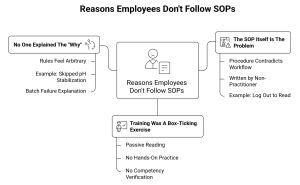
Getting to the bottom of an SOP compliance problem means looking past the surface. A deviation is rarely the whole story — It is a symptom of something deeper. After years of investigations across regulated environments, the root causes tend to cluster around a few consistent themes.
A) The SOP Itself Is The problem
A procedure can be technically well-written and still be completely impossible to follow in the real world. A common example is an SOP for lab equipment that instructs the operator to log out of the system to access the procedure, while simultaneously needing to be logged in to actually perform the steps.
It is a logical deadlock, usually written by someone who never sat at that workstation themselves. When a procedure is physically awkward or contradicts the actual workflow, people will find a workaround. And in most cases, it is entirely understandable that they do.
B) Training Was Treated As A Box To Tick
A familiar pattern in many organisations involves handing a new employee a stack of SOPs to read through, asking them to sign a training log, and calling it done. Expecting someone to absorb and retain critical procedural details from a passive reading exercise is simply not realistic.
Genuine learning requires hands-on practice and context. When that is missing, a training record proves only that someone sat in the room, not that they understood the procedure or could competently perform it. This gap between training on paper and actual competence is one of the most common and most overlooked reasons for SOP non-compliance.
C) No One Explained The Reason Behind The Rule
People are far more likely to follow a rule they understand than one that feels arbitrary. A well-known example involves a technician who routinely skipped a five-minute pH stabilisation step because it appeared to serve no purpose.
It was only after a batch failure and a proper explanation of why that step directly protects drug product stability, that the behaviour changed. When the reasoning behind a procedure is never communicated, employees have no way of judging which steps are genuinely critical. Without that understanding, shortcuts become almost inevitable.
The Consequences Of Poor SOP Compliance
The question of what happens when policies and procedures are not followed deserves a concrete answer. The consequences are not abstract, they are operational, financial, and regulatory.
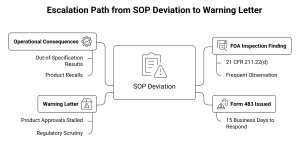
On the regulatory side, the picture is particularly clear. FDA inspection data consistently identifies "Procedures not in writing, fully followed" under 21 CFR 211.22(d) as one of the leading reasons for issuing a Form 483.
It is, in practice, low-hanging fruit for investigators. A Form 483 is serious enough on its own but it can escalate into a Warning Letter, which brings a very different level of scrutiny.
Warning Letters demand detailed written responses, can stall product approvals, and attract sustained regulatory attention that is difficult and costly to manage.
Note: Every time a procedure is not followed, an unknown variable is introduced into a validated process. In a regulated industry, that is not a small risk — It is a direct threat to product quality and patient safety.
Beyond regulatory consequences, poor SOP compliance creates process variability, which undermines quality in a more day-to-day sense. Out-of-specification results, deviation investigations, and in the most serious cases, product recalls, these are all downstream effects of inconsistent procedure adherence. The time and cost involved in managing those outcomes is significant.
There is also a broader context worth keeping in mind. The medical device industry, for instance, is projected to grow by more than five percent annually, with global sales expected to approach 800 billion dollars by 2030.
More products, more markets, and more complexity all mean more risk. The procedures that quality teams write and enforce are not bureaucratic overhead, they are the structural protection that keeps a growing, high-stakes industry safe and functional.
How To Ensure SOPs Are Actually Followed?
Sustainable SOP compliance cannot be achieved through enforcement alone. Standing over employees, issuing reminders, or treating every deviation as a disciplinary matter does not address the underlying problem. The goal is to build a system where following the correct procedure is also the easiest and most natural thing to do.
1) Involve The People Who Will Use The SOP In Writing It
One of the most effective practices is to take a draft SOP directly to the floor and work through it with the technician who will actually be performing the steps.
Watching someone talk through a process in their own environment reveals things that no desk review ever would such as small logistical issues, equipment quirks, sequences that create unnecessary friction.
More importantly, involving people in the development of a procedure creates a sense of ownership. When an employee has had a hand in shaping a document, they are far more likely to follow it consistently.
2) Write For The Person Doing The Job, Not For The Auditor
An SOP should function as a practical tool. The test of a well-written procedure is whether a qualified user can locate exactly the information they need in fifteen seconds or less. That standard demands:
- Plain language that does not require interpretation
- Short, focused paragraphs rather than dense blocks of text
- Clear numbered steps wherever a sequence matters
- Headings and bullet points to make navigation quick
- Visuals, diagrams, photographs, and more, wherever they can replace a paragraph of description
- A document that is genuinely easy to follow will be followed. One that requires effort to decode will be avoided or reinterpreted.
3) Focus On The Process, Not The Person
When a deviation occurs, the most productive first question is not "who did this?" but "how did the procedure allow this to happen?"
Shifting the focus from individual blame to systemic cause creates an environment where employees feel safe flagging problems in procedures without fear of consequences.
That kind of psychological safety turns the workforce into a genuine feedback mechanism for the quality system. No quality team can monitor everything but a team that trusts the process enough to speak up when something is wrong is an invaluable source of real-time intelligence.
4) Use technology To Remove Friction From Compliance
Manual systems like shared drives, printed binders, emailed document updates, create exactly the kind of version control problems that lead to people working from outdated procedures.
A modern electronic Quality Management System (eQMS) addresses this directly. It ensures that the only version of an SOP anyone can access is the current, approved one.
It can link training completion to specific procedure versions, meaning a person cannot be recorded as trained until they have demonstrated the required competency. When the right system is in place, compliance becomes the default path and that is ultimately what every quality team is trying to achieve.
Wrapping Up
SOP compliance is not a people problem — It is almost always a system problem. When procedures are written with input from the people who use them, when those people understand what is genuinely at stake with each step, and when the right tools make following the correct process easier than finding a workaround, the compliance picture changes significantly.
The aim is a quality system that functions reliably without constant firefighting. That is entirely achievable, but it starts with recognising that the solution lies in fixing the process, not just holding people accountable for the gaps it creates.
FAQs
1. Why Is SOP Compliance So Difficult In Life Sciences?
SOP compliance is challenging because the issue often goes deeper than employee behaviour and usually connects to training, unclear procedures, or workflow obstacles. Many SOPs look correct on paper but do not reflect real operational conditions, making them difficult to follow consistently. Employees may also miss critical context if training focused only on reading and signing documents instead of hands-on practice. When people don’t understand the “why” behind a step, they are more likely to improvise or skip it. All of these factors make compliance feel harder than it should, even when expectations are clearly defined.
2. What Are The Risks Of Employees Not Following SOPs?
When SOPs are not followed, companies face regulatory, operational, and financial consequences. The FDA frequently cites “Procedures Not Fully Followed” on Form 483s, which can escalate into Warning Letters and significant oversight. Poor compliance also introduces variability into validated processes, increasing the chances of deviations, rework, and batch failures. This can interrupt operations, extend timelines, and damage product quality. In regulated industries, even small inconsistencies can become major risks for patient safety and business continuity.
3. How Can Organizations Improve SOP Compliance Effectively?
Organizations can improve SOP compliance by involving frontline employees during procedure development to ensure that each step is realistic and aligned with daily workflows. Clear, simple, and user-friendly SOPs make it easier for teams to follow instructions without confusion or reinterpreting steps. Strong training programs focused on hands-on practice help employees understand both the procedure and its purpose. Creating a culture that focuses on fixing processes instead of blaming individuals encourages transparency and continuous improvement. Using technology like an eQMS ensures version control, easier access, and built-in training links that naturally support compliance.