EMA's 2025–2027 Quality Roadmap: What Pharma Companies Need To Know About The GMDP Work Plan
EMA's 2025 2027 GMDP Work Plan 10 GMP revisions, Annex 22 AI, supply chain resilience and what pharma must prepare for now.


If you work in pharmaceutical quality, compliance, or regulatory affairs, you've likely come across the term "EMA Quality Domain Work Plan." But what does it actually mean for your day-to-day operations? And why should it matter to your quality team right now?
The European Medicines Agency's (EMA) 3-year Work Plan for the Quality Domain is more than a regulatory document; it's a forward-looking strategy that shapes how medicines are manufactured, distributed, and inspected across Europe. The current version covers 2025 to 2027 and was published in March 2025 by the Good Manufacturing and Distribution Practice (GMDP) Inspectors Working Group (IWG).
This blog breaks down exactly what the plan contains, which GMP guidelines are being revised, and what actions pharmaceutical and biotech companies should take to stay ahead of the curve.
What Is the GMDP Inspectors Working Group?
To understand the work plan, you first need to understand who created it.
The GMDP Inspectors Working Group (GMDP IWG) is a group within the EMA made up of senior inspectors from GMP and GDP inspectorates across Europe. It was established in 1996 with a clear mission: to harmonise and strengthen quality inspection practices for pharmaceutical manufacturing and distribution throughout the region.
Its members come from a wide network that includes European Economic Area (EEA) member states, the European Commission, and the European Directorate for the Quality of Medicines and Healthcare (EDQM). Countries with Mutual Recognition Agreements (MRA) with the EU are also represented.
The group meets four times a year and works alongside several partner organisations, each playing a distinct role:
- Quality Working Party (QWP): Advises scientific committees within the EMA on all aspects of medicine quality, from reviewing existing guidance to providing input on new legal frameworks.
- GMP/GDP Steering Committee: An advisory body that provides strategic oversight for the GMDP IWG's work and helps shape the 3-year quality domain work plan.
- PIC/S (Pharmaceutical Inspection Co-operation Scheme): An informal, non-binding scheme where regulatory authorities cooperate to harmonise pharmaceutical inspection standards globally.
- EDQM (European Directorate for the Quality of Medicines and Healthcare): An organisation that protects public health by monitoring and supporting quality standards for medicines.
Together, these groups collaborate to produce work plans, guidance documents, and assessment tools that define how quality is regulated across Europe.
The EMA's work plan demands more than regulatory awareness it demands a quality culture that goes beyond audit readiness.
The difference between compliance and quality is exactly what separates inspection-ready companies from the rest.
→ Read: Compliance Vs Quality | Why Pharma Must Go Beyond Audits
What Is the Quality Domain Work Plan?
Every three years, the GMDP IWG, together with its partner groups, publishes a Quality Domain Work Plan. Think of it as a strategic roadmap that tells you where GMP and GDP regulations are heading over the next three years, including which guidelines will be revised, which inspection priorities will be, and how international collaboration will be structured.
The 2025–2027 work plan is aligned with the EMA's broader Network Strategy and Regulatory Science Strategy. It identifies five key strategic objectives that then translate into more specific tactical goals and activities, which is where the plan really becomes useful for the industry.
The plan is also deliberately flexible. It acknowledges that it may need to be updated as the EMA's Network Strategy 2028 review progresses.
The Five Strategic Objectives of the 2025–2027 Work Plan
The overall objectives of the plan include analysing the possible implications of new manufacturing technologies, enhancing inspector capacity building at the EU and international levels, enhancing traceability and oversight in the human and veterinary medicine supply chain, and encouraging supply chain resilience by reviewing long-term risks from dependency on a limited number of manufacturers and sites.
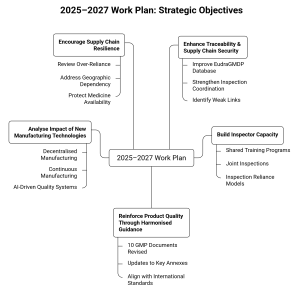
Here's a closer look at each of the five strategic areas:
1. Enhance Traceability, Oversight, and Security in the Medicine Supply Chain
One of the most prominent themes in the 2025–2027 plan is supply chain integrity. The plan outlines work to improve the EudraGMDP database, the EU's central repository for GMP and GDP certificates, manufacturing authorisations, and inspection data. By strengthening this database and improving inspection coordination, regulators aim to identify weak links in the global supply chain much earlier.
This is particularly relevant given that global pharmaceutical supply chains have become increasingly complex, with active pharmaceutical ingredients (APIs) and finished products often crossing multiple borders before reaching patients.
2. Build Inspector Capacity at EU and International Levels
There is a strong, deliberate focus on capacity-building for inspectors. This includes rolling out shared training programs, joint inspections, and inspection reliance models, especially through international partnerships with regulatory authorities in the US and Japan.
The goal is to make GMP and GDP oversight more consistent, more efficient, and globally aligned. When inspectors across different countries follow similar approaches and share knowledge, the entire inspection system becomes more reliable and less duplicative for industry.
3. Reinforce Product Quality Through Harmonised Guidance
A major part of the plan is the modernisation of the EU GMP regulatory framework. This involves targeted revisions to several key chapters and annexes of the GMP Guide. These updates are not cosmetic; they reflect real changes in manufacturing technology, data management practices, and alignment with international standards.
The planned revisions include:
- Chapter 1 (Pharmaceutical Quality System) and Chapter 4 (Documentation), with Chapter 4 being updated to address the increasing use of electronic records and digital documentation practices
- Annex 3 (Manufacture of Radiopharmaceuticals)
- Annex 4 (Manufacture of Veterinary Medicinal Products)
- Annex 5 (Manufacture of Immunological Veterinary Medicinal Products)
- Annex 6 (Manufacture of Medicinal Gases)
- Annex 11 (Computerised Systems), a critical revision for any company using electronic systems in GMP-relevant processes
- Annex 14 (Manufacture of Medicinal Products Derived from Human Blood or Plasma)
- Annex 15 (Qualification and Validation)
- New Annex 22 (Artificial Intelligence), a brand-new annex that reflects the growing use of AI in pharmaceutical manufacturing and quality systems
In total, 10 documents of the GMP Guide will be revised or newly launched. This is a significant scope of regulatory change that companies need to track and prepare for.
4. Analyse the Impact of New Manufacturing Technologies
The pharmaceutical industry is undergoing a fundamental shift. Decentralised manufacturing, continuous manufacturing, advanced therapy medicinal products (ATMPs), and AI-driven quality systems are no longer future concepts; they are present-day realities in many facilities.
The work plan emphasises the importance of supply chain integrity and resilience, product quality, and the potential impact of new manufacturing technologies on the supply chain. Inspectors are being trained and equipped to assess these technologies, and guidance documents are being developed to regulate them appropriately.
The introduction of a dedicated Annex 22 on Artificial Intelligence is especially significant. It signals that the EMA views AI not as a peripheral tool but as a core part of future pharmaceutical manufacturing and quality oversight, one that requires its own regulatory framework.
5. Encourage Supply Chain Resilience and Address Dependency Risks
Beyond immediate supply chain security, the plan takes a longer-term view on resilience. One area of concern is the over-reliance on a limited number of manufacturing sites or geographic regions for critical medicines. The plan includes reviewing long-term risks associated with reliance on a limited number of manufacturers and sites.
This reflects lessons learned from drug shortages, especially those that became visible during and after global disruptions in recent years. By building resilience into the system now, regulators aim to protect the availability of medicine in the future.
Key GMP Guide Revisions: What's Changing and When?
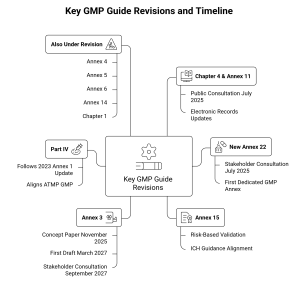
Some of the most practically important parts of the industry work plan are the planned revisions to the GMP Guide. Here's a breakdown of what's coming:
Chapter 4 (Documentation) and Annex 11 (Computerised Systems) are being revised together, and a public stakeholder consultation was launched in July 2025. These revisions will significantly update how electronic records, electronic signatures, and computerised systems are managed under EU GMP. If your company relies on software systems for batch records, laboratory data, or quality event management, this revision directly affects you.
New Annex 22 on Artificial Intelligence was also released for stakeholder consultation in July 2025. This is the first time a dedicated GMP annex for AI has been proposed, covering how AI tools can and should be used across the medicine lifecycle.
Annex 15 (Qualification and Validation) is being revised to reflect modern qualification approaches, risk-based validation strategies, and alignment with updated ICH guidance.
Annex 3 (Radiopharmaceuticals) has a detailed revision timeline: a concept paper was approved in November 2025, and the first draft of the revised annex is expected by March 2027, with stakeholder consultation planned for September 2027.
Part IV (GMP for Advanced Therapy Medicinal Products) is also under revision, following the 2023 update to Annex 1 for sterile medicinal products. The revision aims to align ATMP-specific GMP requirements with current sterile manufacturing standards and address new technologies in advanced medicine manufacturing.
The EMA's GMP revisions don't exist in isolation they align closely with international quality management standards.
ISO 13485 sits at the intersection of EU GMP expectations and global quality system requirements.
→ Read: ISO 13485 Quality Management System | A Pharma Leaders Guide
What Does This Mean for Pharmaceutical and Biotech Companies?
Any company that manufactures medicines, APIs, or pharmaceutical ingredients must comply with EMA quality standards to sell products in EU countries. The 2025–2027 work plan is therefore not optional reading; it directly affects your compliance obligations, your quality systems, and your inspection readiness.
Companies that navigate regulatory change most smoothly are usually those that prepare early and build adaptability into their quality systems. Here are the key areas to focus on:
Establish robust regulatory intelligence. You need tools and processes to monitor changes to GMP and GDP guidelines in real time. Waiting until a guideline is finalised before acting is too late. Track concept papers, stakeholder consultations, and work plan updates as they happen.
Review and update your quality documentation systems. The revisions to Chapter 4 and Annex 11 will likely require changes to how you manage electronic records, validation documentation, and data integrity controls. Start a gap assessment now, before the final texts are published.
Prepare for AI governance conversations. Even if your company is not currently using AI in manufacturing or quality, the introduction of Annex 22 signals where the industry is heading. Understand what AI tools are in use across your organisation and begin thinking about how they will be governed under the new framework.
Invest in training. Inspector capacity building is one of the five strategic objectives of the work plan. This means inspectors will be increasingly well-trained, globally aligned, and familiar with the latest technologies. Your own workforce should be equally prepared, not just on the updated guidelines, but also on how to communicate quality data and demonstrate compliance during inspections.
Use risk-based approaches for change management. As new guidance chapters and annexes take effect, a risk-based framework helps you prioritise which updates need immediate action and which can be phased in over time. Multidisciplinary teams should evaluate the potential impact of regulatory changes on product quality, safety, and compliance.
Conduct internal audits proactively. Once documentation and systems have been updated in line with the new guidance, run internal audits to identify any gaps before an external inspection.
Final Thoughts
The EMA's 3-year Work Plan for the Quality Domain for 2025–2027 is one of the most comprehensive regulatory roadmaps the GMDP IWG has published in recent cycles. With 10 GMP documents under revision or development, a new annex dedicated to AI, and a strong focus on supply chain resilience and inspector harmonisation, it represents a meaningful shift in how quality will be regulated across Europe over the coming years.
For pharmaceutical and biotech companies, the message is clear: start preparing now. Monitor the guidance revisions as they progress through consultation, assess your current systems against what's coming, and build the internal capacity to adapt. The companies that treat regulatory intelligence as an operational priority, not an afterthought, will be the ones best positioned when the new framework takes full effect.
FAQs
1. What is EMA's 3-year Work Plan for the Quality Domain?
It is a strategic roadmap published by the EMA's GMDP Inspectors Working Group that outlines priorities for GMP and GDP regulation, guideline revisions, and inspection activities over three years. The current version covers 2025 to 2027.
2. Which GMP Guide chapters and annexes are being revised under the 2025–2027 plan?
Revisions are planned for Chapter 1, Chapter 4, and Annexes 3, 4, 5, 6, 11, 14, and 15, along with the introduction of a new Annex 22 on Artificial Intelligence and updates to the ATMP GMP guidelines.
3. What is Annex 22 on Artificial Intelligence?
Annex 22 is a newly proposed annex to the EU GMP Guide that will provide regulatory expectations for the use of AI across the pharmaceutical manufacturing and quality lifecycle. It was released for public stakeholder consultation in July 2025.
4. How does the work plan affect companies selling medicines in the EU?
Any company manufacturing or distributing medicinal products in the EU must comply with EMA's GMP and GDP standards. Updates in the work plan directly affect quality documentation, computerised systems, validation, and inspection readiness.
5. How often is the Quality Domain Work Plan updated?
The GMDP Inspectors Working Group publishes a new version of the Quality Domain Work Plan every three years. The current plan runs from January 2025 to December 2027.
Reporting on the science, business and regulation shaping the pharmaceutical industry.
More in Regulatory Intelligence
All articles →
The Pattern Behind FDA Warning Letters: What Startups & CDMOs Often Miss

ISO 14644 Cleanroom Classes for Pharma (with EM Implications)

Discussion