by Dhanashree Akre
8 minutes
Data Integrity in Pharma QC: Why ALCOA Is No Longer Enough
ALCOA is the baseline, not the ceiling. Here's why data integrity in pharma QC now demands culture, governance, cybersecurity, and AI oversight.
Every batch of medicine released into the market carries an invisible promise: the data supporting its quality is trustworthy.
In pharmaceutical quality control (QC) laboratories, thousands of data points are generated daily. Most appear routine, yet a single unexplained result, missing entry, or undocumented intervention can determine whether a batch is released, rejected, or investigated. Behind every chromatogram, calculation, and test result lies a principle that extends beyond compliance: data integrity.
Consider a familiar scenario. A manufacturing team urgently requires raw material clearance to maintain production schedules. During routine testing, a QC analyst identifies an unexpected result. Under pressure to meet timelines, the easiest path might be to ignore the anomaly and move forward. Instead, the analyst reports the discrepancy, triggering a review and further investigation.
The decision affects far more than a production schedule. It reflects a culture where data is valued not merely as documentation but as the foundation of patient safety, product quality, and organizational credibility.
For decades, the pharmaceutical industry has relied on ALCOA principles to ensure data integrity. Yet as laboratories adopt cloud-based platforms, AI-enabled analytics, interconnected systems, and electronic records, the conversation has expanded far beyond ALCOA. Today, data integrity is no longer simply about recording data correctly. It is about governing data throughout its lifecycle.
ALCOA: The Foundation of Trustworthy Data
The ALCOA framework emerged as a cornerstone of data integrity in pharmaceutical operations. Regulatory agencies worldwide, including the FDA and European regulators, continue to emphasize its importance.
ALCOA stands for:
- Attributable: Data must be traceable to the individual, instrument, or system that generated it.
- Legible: Records must remain readable and understandable throughout their retention period.
- Contemporaneous: Data should be recorded at the time the activity occurs.
- Original: Records must preserve the first capture of data or its verified equivalent.
- Accurate: Information must faithfully reflect the actual observation or measurement.
As pharmaceutical operations became increasingly digital, regulators recognized that these principles needed to evolve. This led to ALCOA+, which expanded expectations to include data being Complete, Consistent, Enduring, and Available throughout its lifecycle.
The evolution reflected a simple reality: trustworthy data must remain reliable not only at the point of creation but throughout its journey from generation to archival.
Why Data Integrity Failures Persist Despite ALCOA Awareness
Most organizations understand ALCOA. Training programs reinforce its principles. Audit preparations frequently emphasize documentation practices.
Yet data integrity observations continue to appear in regulatory inspections.
Why?
The answer often lies not in systems but in culture.
Many organizations treat data integrity as a compliance requirement rather than a quality value. When operational pressures increase, quality decisions can become vulnerable to shortcuts, undocumented interventions, or selective interpretation of results.
A culture that truly values data integrity encourages employees to report anomalies, challenge assumptions, and escalate concerns without fear of repercussions. Conversely, when compliance is viewed primarily as a target to achieve, organizations risk creating environments where deviations remain hidden until discovered by regulators.
The difference is significant. One approach focuses on preserving truth. The other focuses on avoiding findings.
Data integrity failures don't happen in isolation, they happen inside broken compliance systems.
Here's the full picture of regulatory challenges hitting pharma manufacturing right now.
→ Read: Regulatory Compliance in Pharma Manufacturing: Key Challenges & CAPA
The Digital Transformation of Quality Control
Quality control laboratories have undergone a dramatic transformation over the past decade.
Laboratory Information Management Systems (LIMS), Chromatography Data Systems (CDS), electronic laboratory notebooks, and integrated quality management platforms have improved traceability, efficiency, and compliance capabilities.
Digitalization has transformed quality control laboratories by enabling automated data capture, reducing manual transcription errors, strengthening electronic audit trails, and providing real-time access to critical information. It has also improved traceability throughout the data lifecycle and streamlined review workflows, allowing organizations to make faster and more informed decisions.
Together, these advancements have significantly enhanced data governance while minimizing many of the risks traditionally associated with paper-based systems. However, technology alone cannot guarantee data integrity. While digital systems eliminate certain vulnerabilities, they also introduce new challenges related to governance, cybersecurity, access control, and system oversight.
In essence, digital transformation does not remove data integrity risks; it changes their nature and requires organizations to manage them differently.
Hidden Risks in Digital Systems
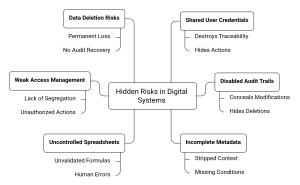
Many data integrity failures today occur within sophisticated digital environments. Regulatory observations frequently involve issues such as:
Shared User Credentials
Unique user accounts are fundamental to accountability. Password sharing undermines traceability and makes it impossible to determine who performed specific actions.
Disabled or Inadequately Reviewed Audit Trails
Audit trails provide visibility into data creation, modification, and deletion activities. When audit trails are disabled or insufficiently reviewed, critical information may remain hidden.
Incomplete Metadata
Data cannot be evaluated in isolation. Metadata provides the context necessary to understand how, when, and under what conditions information was generated.
Uncontrolled Spreadsheets
Spreadsheets remain widely used in laboratories. Without validation and access controls, they can introduce calculation errors and compromise data reliability.
Weak Access Management
Poorly defined user permissions increase the risk of unauthorized changes, accidental deletions, and inadequate segregation of duties.
Data Deletion Risks
Any system that permits unrestricted deletion of records presents a significant integrity concern. Reliable systems must ensure traceability and recovery of critical information.
In many warning letters, regulators have found that technology itself was not the problem. Governance failures were.
Cybersecurity and Data Integrity
As pharmaceutical laboratories become increasingly connected, cybersecurity and data integrity have become inseparable. A compromised system can affect not only business continuity but also product quality and regulatory compliance.
Protecting electronic records requires robust controls including:
- Encryption protocols
- Multi-factor authentication
- Regular vulnerability assessments
- Secure backup systems
- Disaster recovery planning
- Continuous employee awareness training
Cybersecurity is no longer solely an IT responsibility. It is a quality responsibility.
Building a True Data Integrity Culture
Technology provides controls. People sustain integrity.
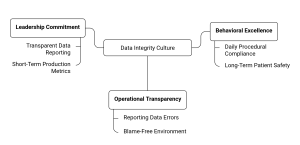
Organizations often invest heavily in systems while underestimating the role of culture. Yet many data integrity failures originate from human behavior rather than technical limitations. A strong data integrity culture rests on three interconnected pillars.
Behavioral Excellence
Employees must understand not only procedures but also the scientific and ethical reasons behind them. When individuals appreciate the impact of their decisions on patient safety, compliance becomes a shared responsibility rather than an imposed obligation.
Operational Transparency
Transparency ensures that issues are identified and addressed early. Employees should feel comfortable reporting discrepancies, deviations, and concerns without fear of blame.
Leadership Commitment
Data integrity culture starts at the top. Leaders set expectations through their actions, priorities, and responses to challenges. When management values transparency over short-term performance metrics, integrity becomes embedded within daily operations.
The most resilient organizations create environments where reporting a mistake is viewed as protecting the system rather than exposing weakness.
Training Beyond SOP Compliance
Training remains one of the most important safeguards for data integrity. However, training records alone do not guarantee competence. Many organizations fall into what may be called the "training illusion" where completion rates are mistaken for capability.
Effective training extends far beyond procedural instruction and compliance requirements. While understanding standard operating procedures is essential, truly effective training develops the capabilities needed to make sound decisions in complex situations. It strengthens technical competence, enhances scientific reasoning, fosters critical thinking, and builds risk awareness, enabling employees to understand not just what to do, but why it matters.
Equally important, it cultivates ethical decision-making, ensuring that individuals can navigate operational pressures while maintaining the integrity, quality, and reliability expected in pharmaceutical operations. Analysts must understand not only what to do but why it matters.
Real-world case studies, deviation investigations, and lessons learned from quality failures often provide stronger learning opportunities than routine procedural reviews.
A useful formula for modern quality organizations is:
Analyst Qualification = Training + Technical Skill + Experience + Continuous Learning
When training is treated as an ongoing capability-building process rather than a compliance exercise, data integrity becomes significantly more resilient.
Regulatory Expectations Continue to Evolve
Global regulators increasingly expect organizations to demonstrate robust data governance rather than simple procedural compliance.
Regulatory inspections increasingly focus on the effectiveness of an organization's data governance framework rather than solely on procedural compliance. Key areas of scrutiny include audit trail reviews to verify data traceability, controls over electronic records to ensure authenticity and reliability, and metadata management to provide the context necessary for interpreting data accurately.
Inspectors also evaluate system validation practices to confirm that computerized systems perform as intended, assess access management controls to ensure appropriate user permissions and accountability, and review data lifecycle governance to determine how data is created, maintained, archived, and protected throughout its retention period. Together, these elements help regulators assess whether an organization can consistently demonstrate trust in the integrity of its data.
Regulators are no longer evaluating whether organizations possess data. They are evaluating whether organizations can trust the data they possess. Frameworks such as FDA 21 CFR Part 11 and EU GMP Annex 11 continue to shape expectations for computerized systems, emphasizing validation, security, traceability, and accountability.
The direction is clear. Data integrity is becoming an enterprise-wide governance responsibility.
AI, Automation, and the Future of Data Integrity
Artificial intelligence is beginning to reshape pharmaceutical quality operations.
AI-driven platforms can support:
- Anomaly detection
- Trend analysis
- Predictive quality monitoring
- Compliance surveillance
- Risk identification
Rather than replacing human judgment, these technologies enhance visibility and support earlier decision-making. Blockchain technologies may further strengthen data traceability by creating immutable transaction records throughout the pharmaceutical supply chain. Yet even the most advanced technologies cannot eliminate risk entirely.
Poor governance, inadequate oversight, and weak quality culture can undermine even the most sophisticated systems. The future of data integrity will depend not only on technology adoption but also on how effectively organizations integrate technology with accountability, transparency, and scientific rigor.
AI isn't just flagging anomalies, it's rebuilding how pharma documents everything.
Here's how AI is already solving the audit trail and data integrity gaps in API manufacturing.
→ Read: 7 API Challenges Solved by AI in Pharma
Conclusion
Data integrity has evolved far beyond ALCOA. In modern pharmaceutical quality control, it encompasses culture, governance, technology, cybersecurity, training, and leadership accountability. The most advanced digital systems can strengthen compliance, but they cannot replace ethical decision-making and scientific responsibility.
Ultimately, data integrity is not a software feature or an audit requirement. It is a reflection of an organization's commitment to truth. Every batch released, every result reported, and every decision made depends on that commitment. In an industry where patient safety is the ultimate objective, trustworthy data remains the foundation upon which everything else is built.