by Michael Bani
5 minutes
From Paper To Digital: Why EDMS Is Transforming Pharma, Biotech, And Medical Devices?
Why electronic document management is transforming pharma, biotech and medical devices compliance, efficiency and quality explained.
GxP-regulated industries such as pharmaceuticals, biotechnology, and medical devices manage enormous quantities of documentation across every department. These documents drive core activities in quality assurance, research and development, supply chain processes, manufacturing operations, human resources, and laboratory workflows.
Because regulatory bodies require complete, accurate, and traceable documentation at every stage, managing this information securely and efficiently becomes a critical part of compliance. When documentation is well managed, companies establish consistency, reduce risk, avoid regulatory penalties, and maintain smooth operational processes across the product lifecycle.
However, despite the importance of structured documentation, many organizations continue to rely heavily on outdated, paper-based systems. These systems often produce information silos, where documents are scattered across various desks, file cabinets, and personal devices.
This makes it difficult for teams to access updated versions, leading to incomplete, duplicated, or outdated information. Studies have indicated that organizations lose one out of every twenty documents due to paper dependency. Recreating lost documents contributes substantially to operational expenses, with reproduction costs reaching nearly $220 per sheet.
In industries where documentation directly influences compliance, product quality, and patient safety, such inefficiencies can result in serious consequences. The financial impact is only one part of the challenge. When documentation goes missing or remains outdated, teams may struggle during review cycles, regulatory inspections, or internal audits.
This can cause process delays, discrepancies in decision-making, or audit observations that could have been avoided with better documentation practices. Given these risks, many companies are now transitioning toward more advanced digital solutions that promote efficiency, accuracy, and regulatory compliance.
What Is A DMS? DMS Explained!
To resolve documentation inefficiencies, organizations often turn to Document Management Systems (DMS). A DMS, often referred to as an Electronic Document Management System (EDMS), is specifically designed to optimize the creation, storage, organization, and tracking of documents in a centralized and secure digital environment. An EDMS replaces physical paperwork with a structured digital ecosystem where documents can be easily accessed, shared, and monitored throughout their lifecycle.
An EDMS is often cloud-based but can also be deployed on-premise. Regardless of the model, its primary purpose remains the same: to help organizations move toward paperless operations, improve documentation accuracy, strengthen compliance, and streamline collaboration across departments. The terms DMS and EDMS are used interchangeably because both refer to systems that centralize and control document workflows.
Here Are The Types Of EDMS Systems!
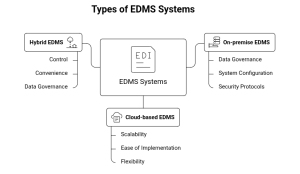
- On-premise EDMS systems operate within the organization’s internal servers, allowing complete control over data governance, system configuration, and security protocols. These systems can be customized to meet complex regulatory requirements but typically require significant investment in hardware, IT expertise, and long-term maintenance. They are often chosen by organizations with strict internal security policies.
- Cloud-based EDMS platforms are managed by external service providers, offering subscription-based, scalable solutions that eliminate the need for internal infrastructure. These systems allow organizations to focus on operational activities while relying on the provider for updates, data security, maintenance, and system availability. This model works well for companies seeking flexibility and ease of implementation.
- Hybrid EDMS solutions combine elements of both on-premise and cloud systems, allowing organizations to maintain sensitive data in-house while leveraging cloud capabilities for scalability and user accessibility. This approach provides a balance between control and convenience, making it suitable for companies requiring both flexibility and strict data governance.
What Is The Purpose Of An EDMS?
Although some companies use platforms such as shared drives, spreadsheets, JIRA, or SharePoint for document management, these systems often lack essential compliance features. Teams that depend on manual documentation may struggle with inefficiencies, errors, accessibility issues, and version confusion. An EDMS helps overcome these challenges by offering robust, structured workflows.
Common Challenges An EDMS Solves
- Ensuring data security and compliance is a constant requirement, especially in regulated industries where sensitive information must remain protected. An EDMS supports this by offering encrypted storage, controlled access, and audit trails that help organizations maintain compliance with privacy and regulatory standards.
- Manual processes consume excessive time, whether during document creation, approval, or retrieval. An EDMS reduces administrative burden through automated workflows, improving productivity and freeing teams to focus on strategic tasks.
- Lost, incomplete, or damaged documents are common in paper-based systems, increasing the risk of compliance issues and delayed decision-making. By digitizing and centralizing documents, an EDMS ensures that information remains accessible, intact, and traceable.
- Limited collaboration can disrupt workflows, especially in large organizations or teams spread across multiple sites. An EDMS allows authorized users to access documents in real time, reducing delays and promoting seamless collaboration.
- Poor change control can result in version discrepancies, causing confusion and inconsistencies during audits or project reviews. An EDMS ensures that all team members work with the most updated version while maintaining a full history of revisions for reference.
Key Features Of A Document Management System
An EDMS serves as a central pillar for documentation and quality operations. It not only stores documents but also supports transparency, accountability, and process efficiency across the organization.
Core EDMS Features
- Centralized collaboration improves efficiency, enabling authorized employees to work simultaneously, track updates, and access required information from a single source. This eliminates dependency on scattered files or manual sharing.
- Cloud accessibility enables remote and global teams to work seamlessly, allowing round-the-clock access to documents without requiring physical presence in the office. This increases operational consistency across all locations.
- Audit trails maintain complete traceability, capturing each document’s history from creation to retirement. This is essential in regulated sectors where auditors require clear evidence of compliance and control.
- Version control enhances accuracy and clarity, ensuring that only the most recent approved version is accessible while keeping previous versions available for reference. This improves decision-making and reduces errors.
- Role-based permission control protects sensitive information, allowing administrators to assign specific permissions that determine who can access, edit, approve, or share documents. This safeguards confidential data and supports regulatory compliance.
- Electronic signatures streamline authentication and approval, removing the need for physical documents and reducing delays associated with manual signing processes.
- Regulatory compliance is supported by built-in validation, as many EDMS platforms align with standards such as 21 CFR Part 11, EU Annex 11, and other GxP guidelines. This ensures that documentation is managed according to regulatory requirements.
Is An EDMS Enough For Regulated Industries?
While an EDMS offers powerful capabilities for managing documents, it does not encompass all quality-related processes. Organizations seeking holistic quality management often require an expanded system covering training, audits, CAPAs, risk assessments, and supplier oversight. An EDMS primarily manages documents but does not replace complete quality management tools.
An EDMS should be viewed as one component of a strong quality ecosystem. For organizations with growing needs or complex regulatory requirements, a broader solution may be necessary to support end-to-end quality operations.
What Is A DMS Compared To An eQMS?
An Electronic Quality Management System (eQMS) extends beyond document management by overseeing the full quality lifecycle. While an EDMS helps centralize documents, an eQMS integrates processes across the organization to deliver complete visibility and control over quality performance.
Key Differences Between EDMS And eQMS:
- An EDMS focuses solely on document organization and access, serving as the foundation for managing controlled documentation in a compliant manner.
- An eQMS integrates all quality processes, enabling teams to track audits, deviations, change controls, CAPAs, training, supplier management, and more within one unified system.
Most eQMS platforms already include EDMS functionalities but enhance them with advanced quality features.
Additional Features Of An eQMS:
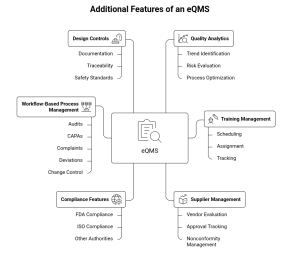
- Quality analytics support proactive decision-making, helping organizations identify trends, evaluate risks, and optimize quality processes through data-driven insights.
- Training management ensures personnel competency, allowing organizations to schedule, assign, and track training activities while maintaining verifiable training records.
- Supplier management strengthens relationships across the supply chain, enabling organizations to evaluate vendor performance, track approvals, and manage nonconformities.
- Built-in compliance features align with global regulatory standards, ensuring that processes meet requirements set by bodies such as the FDA, ISO, and other authorities.
- Workflow-based quality process management ensures consistency, enabling standardized procedures for audits, CAPAs, complaints, deviations, and change control.
- Design controls support product development, ensuring that life-science products and medical devices meet regulatory and safety standards through structured documentation and traceability.
In Conclusion
Choosing between an EDMS and an eQMS ultimately depends on an organization’s current operational maturity, documentation needs, and long-term quality strategy. An EDMS offers a reliable and cost-effective solution for managing centralized documentation, making it particularly suitable for emerging companies that need a structured system without the complexity of advanced quality functionalities.
However, organizations with broader quality requirements or plans for expansion can benefit significantly from implementing an eQMS, which provides comprehensive oversight across the entire quality lifecycle. By integrating processes such as training, CAPA management, supplier oversight, and audit tracking, an eQMS creates a unified framework that supports consistent compliance and operational excellence.
Whether choosing an EDMS or an eQMS, the goal remains the same: to strengthen documentation integrity, enhance efficiency, and maintain high standards of quality in regulated environments.
FAQs
1. What Is A Document Management System (DMS) Or EDMS?
A Document Management System (DMS), also known as an Electronic Document Management System (EDMS), is a digital platform used to store, organize, track, and manage documents in a centralized and secure environment. It replaces paper-based systems with structured digital workflows, making documents easier to access and control. This helps organizations improve efficiency, reduce errors, and maintain compliance with regulatory requirements. It also ensures that documents remain accurate, traceable, and readily available when needed.
2. Why Do GxP-Regulated Industries Need An EDMS?
GxP-regulated industries require strict documentation control to ensure compliance, product quality, and patient safety. An EDMS helps by centralizing documents, improving version control, and enabling secure access across teams. It reduces risks associated with lost, outdated, or duplicated documents while supporting audit readiness. This makes it easier for organizations to maintain consistency and avoid costly compliance issues. It also allows teams to collaborate more effectively without delays or confusion.
3. What Is The Difference Between An EDMS And An eQMS?
An EDMS focuses on managing and controlling documents, ensuring they are organized, secure, and compliant. An Electronic Quality Management System (eQMS) goes further by integrating all quality-related processes such as audits, CAPAs, training, and supplier management. While an EDMS is a foundational tool, an eQMS provides a complete system for managing quality across the organization. This makes eQMS more suitable for companies with complex quality and regulatory needs. Together, they help build a strong and efficient quality ecosystem.
.webp&w=256&q=75&dpl=dpl_2PE5h6SQim3wTUG2seKJD6HJ9hx3)