Choosing The Right GxP SaaS Provider: What You Need To Know!
A complete guide to evaluating GxP SaaS providers across compliance, security, validation, and SLA criteria.


The life sciences industry, comprising pharmaceuticals, biotechnology, and medical devices, is increasingly shifting toward cloud-based technologies to modernize operations, strengthen compliance, and enhance efficiency. Among these technologies, Software as a Service (SaaS) has emerged as one of the most impactful solutions due to its flexibility, scalability, and ease of use.
Unlike traditional on-premise systems that require complex installations, long deployment cycles, and significant IT resources, SaaS platforms offer instant accessibility through the internet and allow organizations to start using the software almost immediately.
In GxP-regulated environments, SaaS systems provide the added advantage of centralized control over data, automated updates, easier collaboration, and elimination of local system maintenance.
These capabilities support compliance with rigorous global regulations such as 21 CFR Part 11, EU Annex 11, GDPR, HIPAA, PCI DSS, and various ISO standards. However, selecting the right SaaS provider is not a simple task.
A provider may offer impressive features but still fall short in areas critical to GxP compliance, such as audit trail capabilities, validation support, data integrity safeguards, backup systems, or change control practices.
To maximize the benefits of GxP-compliant SaaS solutions, companies must understand both what the cloud enables and what responsibilities remain with them.
This article breaks down every important criterion organizations must assess before choosing a SaaS provider and explains how these factors align with regulatory expectations. With the right approach, SaaS can become a transformative tool that supports compliance, efficiency, and long-term operational success.
Why Choosing The Right GxP SaaS Provider Matters?
GxP-regulated organizations must operate within strict frameworks designed to protect data integrity, patient safety, and product quality. Cloud-based systems offer tremendous value, but they introduce shared responsibility: the SaaS provider manages the application and infrastructure, while the regulated company must ensure the system is suitable for its intended GxP use.
If the wrong provider is chosen, organizations may face data integrity gaps, audit observations, regulatory findings, unexpected outages, or security vulnerabilities. A strong provider, on the other hand, supports compliance from day one through robust security, transparency, proven development processes, and validated technology.
Selecting a SaaS provider is therefore not only a technological decision, it is a quality and compliance decision that affects nearly every aspect of GxP operations.
Moving to the cloud is one thing.
Migrating your quality system without compliance gaps is another.
→ Read: eQMS Migration in Pharma — A Step-by-Step Guide for Quality Leaders
Establishing Clear Evaluation Metrics
Before comparing different SaaS solutions, it is important to define internal evaluation metrics. Having predetermined criteria ensures consistency and reduces subjective decision-making. These metrics help assess whether the provider meets both operational needs and regulatory expectations.
Major Evaluation Categories Include:
- Cloud infrastructure
- Software development lifecycle (SDLC) and quality controls
- Data integrity and record management capabilities
- Audit trail controls
- Validation support
- Change management system
- Backup, restore, and disaster recovery
- Training and documentation
- Service Level Agreements (SLAs)
- Vendor management practices
Each of these categories reflects regulatory expectations and ensures that the software provider can support compliant, reliable operations.
GxP-Compliant Cloud Infrastructure Support
There are no specific GxP guidelines dictating the exact cloud infrastructure setup; however, regulators expect companies to choose infrastructure that protects data confidentiality, integrity, and availability.
Organizations must determine what deployment model aligns with their internal cloud policy and risk appetite:
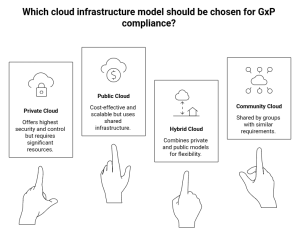
- Private Cloud: Highest security and control but requires significant resources
- Public Cloud: Cost-effective and scalable but shared infrastructure
- Hybrid Cloud: Combination of private and public models
- Community Cloud: Shared by groups with similar requirements
A private cloud is generally preferred in highly regulated environments, provided the organization can manage it. Key evaluation points include physical security of data centers, monitoring systems, encryption, access controls, and historical reliability.
GxP-Compliant Software Development Lifecycle
A SaaS solution must be built using good engineering and security practices. The provider should demonstrate a structured SDLC that includes design controls, testing, documentation, and change control.
Key Areas To Evaluate Include:
1) Physical & Environmental Security — Data centers and hosting environments must have strict physical protections, climate control, fire suppression, and monitored access.
2) Logical Security — There should be strong authentication, authorization, encryption, firewall systems, and intrusion detection to prevent unauthorized access.
3) System Monitoring & Maintenance — The provider must continuously monitor the system, track performance, detect anomalies, and deploy updates without disrupting operations.
4) Data Retention — Policies should define how long data is stored and how it is preserved to meet regulatory requirements.
5) Data Classification — Data must be categorized by sensitivity to apply the appropriate security and access controls.
6) Data Access Policy — Providers should not be able to delete or modify customer data without authorization. Preventing unauthorized data manipulation is essential for compliance.
7) Data Protection & Confidentiality — The provider should implement strong encryption and confidentiality mechanisms through each stage of the data lifecycle.
8) Software Development Practices — Coding standards, testing protocols, peer reviews, and quality assurance checkpoints must be implemented and documented.
9) Computer System Validation (CSV) — The SaaS provider must validate their software to ensure it functions as intended and satisfies regulatory expectations.
10) Change Management — All changes to the application including updates, patches, and new features must be controlled, documented, assessed for risk, and communicated.
11) Incident Management — The provider must have procedures for reporting and addressing system incidents, breaches, or failures promptly.
12) Risk Management — Risks must be identified, assessed, and mitigated throughout the development lifecycle.
13) Documentation & Training — Comprehensive documentation must exist for procedures, policies, workflows, and technical information, accompanied by sufficient user training.
14) Asset & Inventory Management — The provider must track software components, dependencies, and infrastructure assets.
15) Data Backup — Regular backups are essential to prevent data loss due to corruption, system failure, or cybersecurity incidents.
16) Disaster Recovery — There must be clear strategies to restore data and services in the event of a serious disruption.
17) Business Continuity — The provider must be able to continue delivering services during and after critical events.
18) Vendor Management — If the provider relies on third-party vendors, they must evaluate, monitor, and ensure compliance from all third parties.
GxP-Compliant Data Integrity & Record Management
For systems that store GxP electronic records, compliance with 21 CFR Part 11 and EU Annex 11 is essential. The SaaS provider must demonstrate that their system ensures data accuracy, completeness, protection, and traceability.
Because data integrity responsibilities are shared between the customer and provider, both parties must clearly define roles. A detailed roles-and-responsibilities matrix should specify ownership of processes such as data creation, review, approval, reporting, archiving, and retrieval.
Audit Trail Controls (Simplified Explanation)
Audit trails are a core requirement in any GxP-compliant system because they provide a complete and reliable history of all actions performed within the system. In simple terms, an audit trail acts like a “digital logbook” that records who did what, when it was done, and what exactly was changed.
For an audit trail to meet regulatory expectations, it must include several essential characteristics:
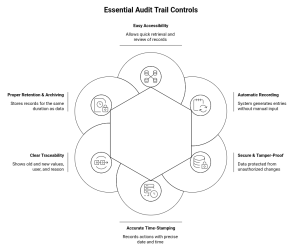
a) Automatically Recorded:
The system should generate audit trail entries on its own whenever a record is created, modified, or deleted. Users should not have to manually enter this information.
b) Secure & Tamper-Proof:
Once recorded, audit trail data must be protected so that no user can edit, overwrite, or delete it. This ensures the information remains trustworthy.
c) Time-Stamped Accurately:
Every action must be recorded with a date and time based on a controlled system clock. Users should not be able to change timestamps, and the time zone should be clearly defined.
d) Clearly Traceable:
The audit trail should show both the old and new values whenever data is changed. It should also capture who made the change and, where required, the reason for the change.
e) Properly Retained & Archived:
Audit trail records must be stored for the same duration as the original data, ensuring they are available for future reference.
f) Easily Accessible For Review:
During audits, inspections, or investigations, the audit trail should be easy to retrieve, review, and export without difficulty.
A well-designed audit trail ensures transparency, accountability, and data integrity. If audit trails are missing, incomplete, or editable, the system will not meet GxP compliance requirements.
Access To Pre-Production Environments
In many GxP-regulated SaaS applications, organizations need to configure workflows, adjust system settings, or customize features to match their internal processes.
To do this safely, the SaaS provider should offer access to a pre-production environment, a separate space where companies can test upcoming changes without affecting live data or daily operations.
This environment acts like a “practice zone” where teams can experiment, evaluate updates, and ensure everything works correctly before the changes are introduced into the production system.
A pre-production environment is essential for assessing the impact of new features, performing validation activities, and identifying issues early. It allows teams to carry out regression testing to ensure new releases do not disrupt existing functionalities.
It also provides a controlled area for user training so employees can become familiar with updates before they go live. This significantly reduces risk and improves system readiness.
When evaluating a SaaS provider, companies should carefully review how well this environment is managed. Important factors to consider include:
- Frequency of updates released by the provider
- Time provided to review, test, and validate changes
- Number of bugs or issues detected during pre-production testing
- Speed and reliability of update deployment
- Length of maintenance downtime during release cycles
- Availability of release notes and impact assessments for review
- Stability of the testing environment, especially during major releases
Overall, access to a well-supported pre-production environment ensures smoother transitions, helps maintain compliance, and minimizes the risk of unexpected disruptions when updates reach the production environment.
Service Level Agreements (SLA)
In GxP-regulated industries, a Service Level Agreement (SLA) is one of the most critical documents to establish with a SaaS provider.
Because compliance, data integrity, and system reliability are essential, the SLA acts as a legally binding contract that clearly defines what the provider is responsible for and how they will maintain the quality, performance, and security of the system.
It ensures that the SaaS provider meets the regulatory expectations of the regulated company and commits to delivering services that fully support GxP operations.
While the SaaS provider must outline their obligations, the regulated company is responsible for confirming that these commitments are sufficient. Both parties must agree on their shared and individual responsibilities to avoid gaps that could affect compliance.
A well-written SLA removes ambiguity, protects the company during audits, and ensures the software remains validated, secure, and properly maintained.
To ensure high service quality and continuous compliance, the SLA should cover several essential areas. These points help clarify expectations, define timelines, and ensure transparency in how updates, changes, and support activities are handled.
Key components that should be included in the SLA are:
- The SLA should clearly mention whether the software is already validated and what supporting documents are provided by the vendor.
- It should explain what environments are available, such as testing or production, and describe how updates and releases are managed.
- It should define how often updates will be released, ensure that detailed release notes are shared, explain what changes are being made, and provide enough time for the company to test and train users before updates go live.
- The provider should always inform the company in advance about any planned system downtime for maintenance.
- For major or medium updates, the provider should give a notice period of 45–60 days so that the company has enough time to test and validate the changes.
- Customer support should be available at all times, ideally 24 hours a day and 7 days a week, to handle any issues quickly.
- The provider should clearly explain how data is backed up, how it can be restored, and how the system will recover in case of failures or disasters.
- All data handling, transfer, and access should follow GDPR and other applicable data protection laws.
- There should be a clear process for deleting or returning data once the contract with the provider ends.
- The provider must ensure that all data is kept confidential and protected with proper security measures.
- The provider should be transparent and ready to support audits whenever required.
- Any shared responsibilities or dependencies between the provider and the company should be clearly defined in the agreement.
Overall, the SLA serves as a vital foundation for the partnership between the regulated company and the SaaS provider. It ensures expectations are aligned, risks are minimized, and all parties maintain a clear understanding of their responsibilities throughout the system’s lifecycle.
Validating Pre-Validated SaaS Solutions
Even when a SaaS provider claims their system is “prevalidated,” the regulated company remains responsible for ensuring the system is suitable for its intended GxP use. A prevalidated solution may significantly reduce workload, but it does not replace customer validation responsibilities.
A risk-based approach is recommended, aligned with GAMP 5:
- GAMP Category 3: Configured software
- GAMP Category 4: Configured with additional workflows
The regulated company must assess the system, verify intended use, test critical functions, document validation evidence, and confirm that regulatory expectations are met.
Pre-validated doesn't mean your job is done.
The FDA's CSA framework has changed the rules.
→ Read: CSV vs CSA — What the Shift Means for Your GxP System Validation Strategy
In Conclusion
Selecting a GxP-compliant SaaS provider is a critical decision that affects data integrity, compliance, operational efficiency, and long-term technological growth.
By establishing a clear evaluation framework, assessing infrastructure and development practices, examining data integrity controls, and insisting on strong SLAs, organizations can confidently choose a provider that supports regulatory expectations and business needs.
With the right partner and the right approach, SaaS technology becomes a powerful enabler of compliance, innovation, and sustainable success for companies in regulated industries.
Reporting on the science, business and regulation shaping the pharmaceutical industry.
More in Regulatory Intelligence
All articles →
The Pattern Behind FDA Warning Letters: What Startups & CDMOs Often Miss

ISO 14644 Cleanroom Classes for Pharma (with EM Implications)

Discussion