by Simantini Singh Deo
10 minutes
The EU AI Act And The Pharmaceutical Industry: What It Means, What It Requires, And What to Do Next?
High-risk AI, €30M penalties, August 2026 deadline. What the EU AI Act means for pharma leaders and how to build compliance now.
The EU AI Act — Regulation (EU) 2024/1689 — entered into force on 1 August 2024, becoming the world's first comprehensive legal framework governing the development and deployment of artificial intelligence. For pharmaceutical and biotech companies already managing GxP obligations, MDR and IVDR requirements, and evolving EMA guidance, it adds a significant new compliance layer.
The Act is not a general advisory. It carries real enforcement teeth: violations of high-risk AI provisions attract fines up to €30 million or 6% of global annual turnover, whichever is higher. Prohibited AI deployments risk penalties of up to €35 million or 7% of global turnover. With the primary compliance deadline arriving in August 2026, the window for preparation is narrowing.
What The EU AI Act Is And Why Pharma Cannot Treat It As Background Noise?
The AI Act is the final piece of the EU's broader digital legislative package, which also includes the Digital Services Act, the Digital Markets Act, the Data Governance Act, and the Data Act, all finalised between 2023 and 2024. It applies to any organisation that develops, deploys, or uses AI systems within the EU, or whose AI systems affect people in the EU. Geographic scope extends well beyond European-headquartered companies.
The pharmaceutical industry sits firmly within the Act's highest-priority perimeter. Drug development decisions, diagnostic outputs, manufacturing controls, and regulatory submissions all affect patient safety directly. The EU has been explicit: AI touching these areas will be held to the most stringent standards the Act defines.
Three aspects of the Act demand immediate leadership attention:
- Risk classification determines which compliance obligations apply and much of what pharma companies are doing with AI falls into the high-risk tier
- Enforcement timelines are firm as high-risk AI requirements become enforceable in August 2026, with device-embedded AI following in August 2027
- Financial penalties are substantial and calculated against global turnover, not local revenue
How The EU AI Act Classifies AI Systems And Where Pharmaceutical Applications Fall?
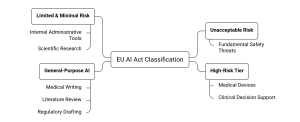
The Act establishes four risk tiers, each carrying different obligations. Knowing which tier applies to a given AI system is the foundation of every compliance assessment.
Unacceptable risk is equal to prohibited systems. AI applications that pose fundamental threats to safety or fundamental rights are banned outright. No legitimate pharmaceutical application falls here. High-risk means the tier that matters most for pharma. Compliance attention belongs here.
Two sub-categories apply:
- AI systems that are, or form a safety-critical component of, a product regulated under the Medical Device Regulation (MDR) or In Vitro Diagnostic Regulation (IVDR) are automatically classified as high-risk. This includes diagnostic imaging software, AI-powered patient monitoring tools, and Software as a Medical Device (SaMD).
- AI systems listed in Annex III of the Act, covering critical infrastructure, employment, essential services, and certain clinical decision-support applications, also fall here depending on design and context of use.
General-purpose AI models are a distinct and growing category. Large language models and foundation models used for medical writing, pharmacovigilance signal detection, literature review, or regulatory document drafting fall under a separate section of the Act with its own obligations for both model providers and deployers.
Limited and minimal risk requires transparency obligations only. Internal administrative tools, simple automation, and AI used purely for non-regulated scientific research generally fall here. Articles 2(6) to 2(8) of the Act include explicit exemptions for AI used solely for scientific research and development, meaning many early-stage drug discovery and pre-competitive research applications sit outside the Act's full scope.
AI in GxP environments needs more than classification, it needs validated governance from day one.
→ Read: How AI Is Transforming Quality Assurance In Pharma
The Four Core Compliance Obligations For High-Risk AI Systems In Pharma
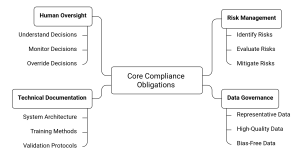
For any AI system classified as high-risk, the Act imposes mandatory obligations. These are legal requirements, not guidelines and demonstrating compliance with each is a condition of lawful deployment in the EU market.
- Risk management across the full AI system lifecycle: A documented risk management system must operate from initial design through decommissioning. It must identify foreseeable risks associated with the system's intended use, evaluate risks arising from both correct operation and misuse, implement and verify mitigation measures, and be updated regularly as the system evolves. This overlaps with ICH Q9 and GAMP 5 principles but extends explicitly to the AI system's algorithmic behaviour — not just the process environment around it.
- Training data governance and quality: Training, validation, and testing datasets must be subject to appropriate governance practices, be sufficiently representative and free from material errors, have appropriate statistical properties for the intended purpose, and be documented to show that known biases have been identified and addressed. For pharmaceutical companies, this intersects directly with GxP data integrity obligations and in most organisations, training data pipelines were not originally built to satisfy both standards simultaneously.
- Technical documentation before deployment: Before a high-risk AI system is placed on the market or put into service, comprehensive technical documentation must be produced and maintained. This must include a description of the system's intended purpose and design, the training methodology and validation process, risk management evidence, and details of the monitoring and human oversight mechanisms built into the system.
- Human oversight mechanisms embedded in system design: High-risk AI systems must be designed to allow human operators to understand the system's capabilities and limitations, monitor its operation, detect anomalous behaviour, and override or suspend outputs when necessary. In manufacturing, this means AI-based process analytical technology must include defined escalation protocols for unexpected outputs. In clinical or regulatory contexts, it means AI-generated analyses must be verified by qualified humans before they inform consequential decisions.
How The EU AI Act Interacts With MDR, IVDR, And GxP Frameworks?
The AI Act does not replace the Medical Device Regulation, the In Vitro Diagnostic Regulation, or GxP pharmaceutical quality frameworks. It adds to them, creating overlapping obligations that must be managed simultaneously.
Medical device manufacturers whose products incorporate AI face a dual compliance model: their AI components must satisfy both MDR or IVDR conformity requirements and the AI Act's high-risk provisions at the same time. The EU's Medical Device Coordination Group addressed this directly in its MDCG 2025-6 guidance, clarifying that:
- AI Act risk assessments, technical documentation, and data governance requirements should be integrated into existing MDR or IVDR Quality Management System processes rather than running as parallel systems
- Article 8 of the AI Act explicitly permits integration of AI-specific testing and documentation into existing MDR conformity processes to avoid duplication
- Notified bodies responsible for MDR or IVDR conformity assessment are expected to assess AI Act compliance simultaneously where AI components are present
For pharmaceutical manufacturers whose AI sits outside CE-marked devices, covering process analytical technology, manufacturing process control, pharmacovigilance, and regulatory document generation such as the MDR and IVDR interface does not apply, but GxP obligations do.
These organisations must assess their AI systems against the Act's requirements independently while maintaining alignment with EMA guidance, GAMP 5, and existing QMS obligations.
AI embedded in medical devices carries dual obligations under MDR and the EU AI Act. SaMD compliance starts here.
→ Read: SaMD In Pharma | Regulations, Risks & Compliance
Key Compliance Dates Pharmaceutical And Biotech Leaders Need To Track:
- 1 August 2024 — Act entered into force; AI portfolio assessments should have begun
- 2 February 2025 — Prohibited AI practices became enforceable
- 2 August 2025 — Obligations for general-purpose AI model providers became applicable
- 2 August 2026 — Primary high-risk AI compliance deadline for systems not embedded in CE-marked medical devices
- 2 August 2027 — Extended deadline for high-risk AI embedded in CE-marked devices under MDR or IVDR
A proposed legislative adjustment known as the Digital Omnibus, published in November 2025, signalled possible timeline extensions. Organisations planning around potential extensions rather than established dates are accepting regulatory risk that most compliance advisers caution strongly against.
A Practical Compliance Sequence For Pharmaceutical Organisations
An effective compliance programme cannot be built in weeks. These are the steps organisations with mature GxP compliance capabilities are prioritising:
1) AI system inventory and risk classification. Document every AI system in use or development. Classify each by the Act's risk tier. This exercise frequently reveals a larger and more varied AI portfolio than leadership is aware of, and immediately establishes where effort must focus.
2) Cross-functional governance structure with executive sponsorship. Assign AI compliance ownership across quality, regulatory affairs, legal, IT, and data science, with a direct reporting line to senior leadership.
3) Gap assessment of existing risk management processes. Map ICH Q9 and GAMP 5 risk management procedures against the Act's requirements. Extend them to cover AI-specific risks: model drift, training data bias, and explainability limitations.
4) Training data governance review. Assess whether data used to train and validate high-risk AI systems meets the Act's quality and documentation requirements. This is where the largest compliance gaps are most commonly found.
5) Technical documentation production.Begin building required technical documentation for each high-risk AI application, integrated into existing MDR or IVDR technical files where applicable.
6) Third-party AI supplier qualification review. Review supplier agreements and qualification records to confirm that third-party AI tools meet the Act's requirements and that ongoing compliance monitoring responsibility is clearly allocated.
Why EU AI Act Compliance Is A Strategic Advantage, Not Just A Regulatory Obligation?
Pharmaceutical companies that build genuine AI governance infrastructure in response to the Act will gain capabilities that extend well beyond compliance. They will be able to move AI tools from pilot to production faster, because the governance infrastructure to validate and release them will already be in place.
They will maintain a defensible position as EMA and other agencies formalise their own AI oversight expectations. And they will reduce the risk of costly AI failures in manufacturing, clinical, or regulatory contexts because the lifecycle monitoring the Act requires is the same discipline that prevents model drift and data quality problems from going undetected.
The companies that will derive the greatest long-term value from AI in regulated pharmaceutical environments are not those that moved fastest in lightly governed contexts.
They are those that built the compliance infrastructure early enough to deploy AI where it matters most in GxP environments, in patient-facing applications, and in regulatory submissions with the scientific and legal credibility to support every output.
The EU AI Act makes building that infrastructure necessary. Organisations that treat it as an investment rather than a burden are likely to find themselves significantly better positioned when the next wave of AI regulatory expectations arrives.
How The EU AI Act Classifies AI Systems And Where Pharmaceutical Applications Fall
In Conclusion
The EU AI Act represents a turning point for pharma and biotech, bringing clear obligations, strict timelines, and meaningful financial consequences that leaders can no longer treat as distant or theoretical.
The organisations that act now by remapping their AI systems, strengthening documentation, addressing data gaps, and aligning medical-device AI with dual regulatory requirements will be the ones best positioned to operate confidently under the new regime.
More importantly, proactive compliance is not just about avoiding penalties; it is fast becoming a marker of reliability, transparency, and long-term competitiveness.
Companies that establish strong, auditable AI governance today will not only meet regulatory expectations but also build the trust that drives market advantage in an increasingly AI-driven pharmaceutical landscape.
FAQs
1. Does The EU AI Act Apply To Pharmaceutical And Biotech Companies Outside The EU?
Yes. The Act applies to any organisation whose AI systems are used in the EU or impact individuals in the EU — regardless of where the company is headquartered. This means global pharma and biotech companies must comply if their AI tools support EU operations, clinical activities, regulatory submissions, or patient-facing services. In practice, this makes the Act a de-facto global standard for any company operating in regulated life sciences.
2. Why Are Most Pharmaceutical AI Systems Considered High-Risk Under The Act?
Pharma AI applications often influence patient safety, product quality, clinical decisions, or regulatory processes. Because of this impact, many fall into the high-risk category, especially AI embedded in MDR/IVDR-regulated medical devices, diagnostic tools, manufacturing control systems, and AI models supporting clinical or regulatory decision-making. High-risk classification triggers the Act’s most extensive compliance requirements. As a result, most AI use cases in pharma will require structured governance, documentation, and oversight to remain compliant.
3. What Should Pharmaceutical Organisations Do First To Prepare For The 2026 Deadline?
The essential first step is to create a complete inventory of all AI systems used across R&D, manufacturing, quality, clinical, and regulatory functions. Each system must then be classified by risk tier. This determines which ones fall under high-risk obligations and require new controls, documentation, data governance upgrades, and oversight mechanisms well before the August 2026 compliance deadline. Starting early helps teams avoid rushed remediation work and ensures compliance programmes can be scaled across the organisation.