by Vaibhavi M.
10 minutes
EU NIS2 Directive: A Practical Compliance Guide for Pharmaceutical and Life Sciences Organisations
EU NIS2 is live. Pharma's GxP systems are in scope, executives are personally liable, and the compliance clock is already running.

Cybersecurity has quietly become one of the most pressing compliance challenges in the pharmaceutical industry. Manufacturing systems get disrupted by ransomware. Clinical trial databases are targeted for intellectual property theft. Serialisation platforms go offline during an attack, breaking supply chains overnight. The EU recognised this growing risk and responded with the NIS2 Directive, a significant upgrade to the original Network and Information Security framework that has direct, far-reaching consequences for the pharma sector.
NIS2 (Directive 2022/2555) entered into force on 16 January 2023, and EU member states were required to transpose it into national law by 17 October 2024. For pharmaceutical manufacturers, biotech companies, medical device makers, and contract organisations operating in the EU, this is no longer a future consideration. Enforcement is active, obligations are binding, and senior management is personally on the hook.
This guide explains what NIS2 means specifically for the life sciences sector, from GxP system security to pharmacovigilance reporting obligations.
Why Pharma Cannot Treat NIS2 as Just Another IT Regulation
The pharmaceutical industry already operates under one of the most demanding regulatory environments in the world, with GMP, GCP, GDP, ICH guidelines, EMA expectations, and data integrity requirements placing significant demands on quality and IT teams. NIS2 adds a new layer, but it also intersects with obligations that pharma companies already hold.
A cybersecurity incident in a pharmaceutical organisation is not just an IT problem. It can trigger a GMP deviation if manufacturing execution systems (MES) are compromised. It can affect the integrity of electronic clinical trial data, raise GCP compliance questions, and, in the worst cases, impact patient safety if product release systems or cold-chain monitoring platforms are disabled. NIS2 formalises the duty to protect these systems and to report when something goes wrong.
Ransomware, IP theft, supply chain attacks, pharma is already a prime target. Here's what the threat landscape actually looks like.
→ Read: Cybersecurity In Pharma | 5 Threats You Can't Ignore
Which Pharma Organisations Fall Under NIS2?
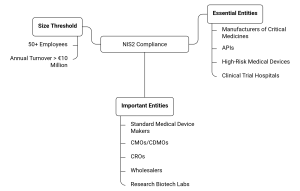
NIS2 classifies organisations into two tiers based on sector and size.
Essential Entities in pharma include:
- Manufacturers of pharmaceutical products and active pharmaceutical ingredients (APIs), particularly those whose disruption would have a significant public health impact
- Manufacturers of critical medical devices (Class IIa, IIb, and III under EU MDR)
- Healthcare providers, including hospitals, are running clinical trial sites
Important Entities in pharma include:
- Medical device manufacturers below the critical threshold
- Contract manufacturing organisations (CMOs) and contract development and manufacturing organisations (CDMOs)
- Contract research organisations (CROs) managing clinical data and trial operations
- Pharmaceutical wholesalers and distributors under GDP obligations
- Research institutions and biotech companies above the size threshold
The general size threshold is organisations with 50 or more employees and an annual turnover exceeding €10 million. However, for certain sectors, particularly those where disruption could have immediate public health consequences, national authorities may apply NIS2 regardless of size.
NIS2 vs Existing Pharma Regulatory Obligations: Where They Overlap
NIS2 Requirement | Pharma Regulatory Parallel |
|---|---|
Risk analysis of information systems | ICH Q9 — Quality Risk Management |
Incident detection and response | GMP Annex 11 — Computerised Systems; deviation management |
Business continuity and disaster recovery | GDP Guidelines — contingency planning for supply disruption |
Supply chain security (third-party risk) | EMA expectations on outsourced activities; ICH Q10 |
Access control and multi-factor authentication | Data integrity guidance (EMA, MHRA, FDA) |
Security of acquired systems and software | Annex 11 — Supplier Qualification and CSV/CSA |
Cryptography and data protection | GDPR; clinical data confidentiality under ICH E6 R3 |
Staff cybersecurity training | GxP training requirements across GMP/GCP/GDP |
This overlap is both an opportunity and a responsibility. Pharma companies that already run mature quality management systems have a foundation to build on. However, NIS2 requires formalised cybersecurity governance that goes beyond what most QMS frameworks currently demand.
Critical GxP Systems That NIS2 Directly Impacts
Pharmaceutical organisations rely on interconnected digital systems that are now explicitly in scope under NIS2. These include:
- Manufacturing Execution Systems (MES) — directly control batch manufacturing and are subject to GMP Annex 11; a ransomware attack affecting MES can halt production and trigger GMP non-conformances
- Laboratory Information Management Systems (LIMS) — hold analytical testing data and release decisions; the integrity of LIMS data is a direct concern for data integrity.
- Electronic Document Management Systems (EDMS) — contain SOPs, validation protocols, and regulatory submissions.
- Electronic Trial Master Files (eTMF) — clinical trial documentation that regulators can inspect at any time
- Pharmacovigilance Safety Databases — disruptions or breaches in PV systems can delay ICSR submissions and PSUR/PBRER reporting.
- Serialisation and Track-and-Trace Platforms — required under the EU Falsified Medicines Directive; a cybersecurity failure here has direct supply chain and compliance consequences
- ERP and Supply Chain Management Systems — govern procurement, distribution, and stock control
Each of these systems must now be assessed, protected, and covered by a documented incident response plan under NIS2.
Every GxP SaaS tool you rely on is now a NIS2 risk surface.
Here's how to evaluate vendors before they become your liability.
→ Read: Choosing The Right GxP SaaS Provider | Complete Guide
The Incident Reporting Obligation — What It Means for Pharma
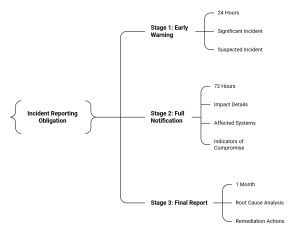
NIS2 introduces a structured, three-stage incident reporting process that pharma organisations must follow when a significant incident occurs:
Stage 1 — Early Warning (within 24 hours): Notify the relevant national CSIRT (Computer Security Incident Response Team) or competent authority that a significant cybersecurity incident has occurred or is suspected.
Stage 2 — Incident Notification (within 72 hours): Submit a full notification including the nature of the incident, affected systems, the initial assessment of impact, and indicators of compromise.
Stage 3 — Final Report (within one month): Provide a comprehensive incident report covering root cause, remediation actions taken, and any cross-border or public health implications.
For pharma, a significant incident is one that causes or risks causing severe disruption to operations — which in this sector could mean delayed batch release, compromised clinical data, or disrupted pharmacovigilance reporting. It is worth noting that NIS2 incident reporting runs parallel to, but does not replace, existing obligations such as ICSR submission timelines under pharmacovigilance law, GDP incident reporting, or GMP deviation management.
Management Accountability: What Pharma Executives Must Now Own
NIS2 places direct legal responsibility on governing bodies, which in a pharmaceutical company means the board of directors, the CEO, the Chief Quality Officer, and equivalent senior leaders. Under NIS2, these individuals must:
- Formally approve the organisation's cybersecurity risk management measures
- Oversee implementation and maintain ongoing awareness
- Undertake regular cybersecurity training relevant to their role
If a significant incident occurs and it can be demonstrated that senior management failed to implement adequate measures or ignored known risks, national authorities can hold those individuals personally liable. In serious cases, temporary bans on exercising management functions may be imposed.
For life sciences companies, this places cybersecurity alongside GMP and data integrity as a board-level governance matter, not something that can be entirely delegated to IT or the CISO.
Pharma-Specific NIS2 Compliance Checklist
- Determine whether your organisation qualifies as an Essential or Important Entity under your member state's transposition law.
- Register with the relevant national competent authority if required
- Assign board-level ownership of cybersecurity risk management
- Conduct a formal risk assessment covering all GxP-relevant computerised systems (MES, LIMS, eTMF, PV databases, ERP)
- Map NIS2 security requirements against existing Annex 11, ICH Q9, and QMS controls, identify gaps
- Establish or update a cybersecurity incident response procedure aligned with the 24-hour/72-hour/1-month reporting timeline
- Assess third-party and supply chain cyber risk, including CMOs, CDMOs, CROs, and cloud service providers
- Implement multi-factor authentication across all critical system access points
- Review CSV/CSA documentation to ensure security requirements are captured in validation life cycles
- Update your business continuity and disaster recovery plans to address cybersecurity-related disruptions specifically
- Deliver documented cybersecurity training to all staff, with role-specific content for senior management
- Consider the interaction between NIS2 incident reporting and existing pharmacovigilance, GDP, and GMP deviation reporting obligations
Penalties and Enforcement
National authorities now have active supervisory powers. Essential entities are subject to proactive (ex ante) supervision; audits and inspections can occur at any time without waiting for an incident. Important entities are subject to reactive (ex post) supervision, typically triggered by an incident or evidence of non-compliance.
Maximum administrative fines are:
- Essential entities: up to €10,000,000 or 2% of total global annual turnover (whichever is higher)
- Important entities: up to €7,000,000 or 1.4% of total global annual turnover (whichever is higher)
Beyond financial penalties, a regulatory finding of NIS2 non-compliance could raise concerns during GMP or GDP inspections, particularly where the cybersecurity gap directly affects data integrity or supply chain integrity.
The Practical Starting Point
For most pharmaceutical organisations, the most effective first step is a structured gap assessment that maps current cybersecurity controls against NIS2 requirements and cross-references existing GxP obligations. Many of the building blocks, risk management, change control, supplier qualification, validation and training, already exist within a well-run QMS. The task is to extend and formalise them to meet the specific demands of NIS2.
Engaging early with your national competent authority is also advisable. Several EU member states have published sector-specific guidance for healthcare and pharmaceutical organisations, and some offer self-assessment tools to help determine applicability and scope.
FAQs
1. Does NIS2 apply to pharmaceutical companies?
Yes. Pharmaceutical manufacturers, medical device makers, CMOs, CDMOs, and CROs operating in the EU are covered under NIS2 as either Essential or Important Entities, depending on sector and size.
2. How does NIS2 relate to GMP Annex 11 in pharma?
NIS2 and Annex 11 overlap significantly — both address computerised system security, access controls, and data integrity. NIS2 extends these obligations into formal cybersecurity governance, incident reporting, and board-level accountability.
3. What GxP systems are most at risk under NIS2?
Manufacturing execution systems (MES), LIMS, pharmacovigilance databases, eTMFs, serialisation platforms, and ERP systems are all in scope and must be covered by documented security and incident response measures.
4. What are the NIS2 reporting deadlines for a cyber incident?
Organisations must submit an early warning within 24 hours, a full incident notification within 72 hours, and a detailed final report within one month of detecting a significant incident.
5. Can pharma company executives be held personally liable under NIS2?
Yes. NIS2 introduces direct personal liability for senior management, including board members, who fail to approve and oversee adequate cybersecurity measures. In serious cases, temporary management bans can be imposed.