by Simantini Singh Deo
14 minutes
The QA Toolkit That Actually Matters: Risk Assessment And Quality Tools Explained
Pharma QA toolkit: nine quality tools with case study, build steps, regulatory grounding. Risk assessment, CAPA integration, FDA GMP compliance.

If you've spent any time in Quality Assurance, you already know the job isn't just about spotting problems — it's about understanding them deeply enough to stop them from coming back. That kind of understanding doesn't come from instinct alone.
It comes from having the right tools, knowing when to reach for them, and knowing how to read what they're telling you. This guide walks you through the twelve most important quality tools QA professionals keep coming back to, year after year.
But first, there's something more important to understand: why these tools exist, and what's at stake when organizations don't use them well!
Why Quality Tools And Risk Assessment Go Hand In Hand?
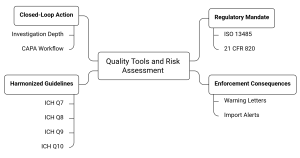
Quality risk management in the life sciences isn't just good practice — it's the law. If your organization operates under ISO 13485 or 21 CFR 820, demonstrating rigorous risk management is a requirement baked into the standard itself. And yet, life sciences companies receive formal warnings from regulatory bodies every single year.
The FDA in the U.S., the EMA in Europe, and the MHRA in the U.K. all send them. These warnings can escalate into import alerts as products get pulled from shelves or blocked entirely, leaving patients without medicines and devices they depend on.
Regulatory agencies began working together under the ICH — the International Council for Harmonisation of Technical Requirements for Pharmaceuticals for Human Use producing shared guidelines:
- Q7 — Good manufacturing practice for active pharmaceutical ingredients
- Q8(R2) — Pharmaceutical development principles and processes
- Q9 — Quality risk management frameworks and methodology
- Q10 — Pharmaceutical quality systems across the product lifecycle
And still, non-conformities accumulate. The reason isn't a lack of guidelines, it's poor risk assessment inside individual organizations. Quality tools give teams a structured way to trace the chain of events behind every non-conformity and build understanding that leads to lasting improvement.
One critical point: a risk assessment doesn't end when you assign a score. That score should directly shape how deep your investigation goes, what corrective actions you take, and what preventive measures you put in place. Connecting it to a CAPA — Corrective and Preventive Action, workflow is what turns a number on a page into real, regulator-aligned improvement.
Poor risk assessment doesn't just fail audits, it bleeds money quietly.
Here's the cost of quality problem pharma keeps ignoring until it's too late. → Read: The Hidden Tax on Pharma: Mastering the Cost of Quality Before It Masters You
Where It All Started?
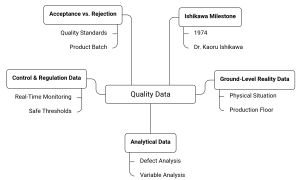
In 1974, Dr. Kaoru Ishikawa, a Japanese engineering professor, published Guide to Quality Control — written for factory workers who needed practical quality methods without needing a statistics degree. He organized quality data into five groups:
- Data to understand the actual situation on the ground
- Data for analysis
- Data for process control
- Regulating data
- Acceptance or rejection data
The seven basic quality tools he built from that framework now span automotive, pharmaceutical, medical device, and life sciences industries. Their staying power is simple: they reveal what ordinary observation misses. The tools below are organized into two categories — data collection and data analysis and illustrated using the same case study throughout.
The Case Study: Too Many Defective Tablets
A pharmaceutical tablet line is producing defects at 0.31%, more than three times the acceptable 0.1% tolerance. Something is wrong. These tools are designed to find exactly what.
Tools For Data Collection
1) The Check Sheet
Before you can analyze anything, you need data — and the check sheet is the simplest way to collect it. It's a structured table designed to make recording fast, consistent, and accurate right where events happen.
It handles quantitative data like counts and measurements, and qualitative data like defect descriptions. Items monitored sit on the left; frequency, severity, and timing go on the right. Patterns become visible without calculation. Common forms include:
- Production Process Check Sheets: tracking what happens at each manufacturing stage
- Defective Item Check Sheets: recording frequency and type of product defects
- Defective Cause Check Sheets: logging suspected or confirmed causes
- Confirmation Check Sheets: verifying required steps have been met
- Maintenance Check Sheets: documenting equipment servicing
- Sampling Check Sheets: recording data from statistical sampling
To create one:
- Establish your problem statement and objective
- Identify what data to collect and list key process variables
- Decide logistics such as who will collect data, when, how often, and for how long
- Design a clean layout that reveals patterns without complex calculations
- Label every category clearly
2) The Histogram
The histogram is often the first place check sheet data goes. It's a bar graph showing the frequency distribution of a dataset, how values spread across a range. Classes are plotted on the x-axis; bar height shows how many data points fall into each class. Building one:
- Record total observations (N), the largest value (XL), and smallest value (XS)
- Calculate the range: R = XL − XS
- Determine class count (K) — for N = 100, aim for 7–12 classes
- Calculate class interval: h = R ÷ K — e.g., 0.07 ÷ 8 = 0.009; round to h = 0.1
- Define non-overlapping boundaries — e.g., 0.280–0.289, 0.290–0.299, 0.300–0.309
- Count observations per class
- Draw equal-width bars, height matching each class's frequency
Tools For Data Analysis
3) The Cause-and-Effect Diagram (Fishbone Diagram)
Also called the Ishikawa, fishbone, herringbone, or Fishikawa diagram, this tool maps every possible cause contributing to a problem. The problem sits at the fish's head on the right; diagonal branches represent cause categories; smaller bones capture specific factors within each. The standard framework uses the 5 M's:
- Manpower — training levels, communication, staffing
- Methods — processes, procedures, documentation
- Machines — equipment condition, calibration, maintenance, automation
- Materials — raw inputs and their variability
- Measurement — testing systems, data collection, regulatory compliance
A sixth category, environment covers temperature, humidity, or workspace conditions when relevant. To build one:
- Write a clear problem statement
- Draw a horizontal arrow pointing right; place the problem at the head
- Draw and label diagonal branches for each category
- Brainstorm causes with your team for each branch
- Add sub-causes as smaller bones, pushing deeper for each factor
- Identify the most likely root causes for investigation
For the tablet problem, causes might include Manpower: insufficient training, poor communication; Materials: poor raw materials, incorrect storage, supply chain variability; Machines: malfunction, poor maintenance, inaccurate calibration; Methods: inadequate documentation, no real-time monitoring; Measurement: inaccurate testing, non-compliant QC methods.
4) The Pareto Chart
The Pareto chart solves the problem of not knowing where to start. Defect categories arrange along the x-axis in descending frequency, largest left, smallest right. The left y-axis shows count or percentage per category; the right shows cumulative percentage.
A line graph tracks the running total left to right. Built on the Pareto Principle, the 80/20 rule: 80% of problems stem from 20% of causes. To create one:
- Define your categories — defect types, failure modes, problem sources
- Choose a time period — week, month, or quarter
- Decide your measurement unit — frequency, cost, or time lost
- Tally and sort categories from most to least frequent
- Set up axes — x-axis for categories, left y-axis for frequency, right y-axis for cumulative percentage
- Draw descending bars, then plot cumulative percentage points and connect with a smooth line
- Apply the 80/20 rule — draw a horizontal line from 80% on the right axis to the cumulative line, then drop a vertical line to the x-axis. Everything left of it is your priority
5) The Flowchart
A flowchart, also called a flow diagram, maps how inputs move through a sequence of actions to produce outputs. It's the visual equivalent of a written work instruction, but understood far faster.
In QA, flowcharts define processes, identify where problems arise, and reveal the gap between how a process is designed to work and how it actually works, which is often where non-conformities hide. In order to build one, you must follow these steps:
- Define the purpose, scope, inputs, and outputs — and give it a meaningful title
- Determine the level of detail needed for the audience
- List every step in chronological order
- Identify the process owner, customers, and suppliers
- Map steps using standard symbols like ovals for start and end points, rectangles for process steps and diamonds for decision points
- Connect every element with directional arrows
6) The Control Chart
The control chart, also called a Shewhart chart or process control chart, is the core instrument of Statistical Process Control (SPC). It monitors a process over time and distinguishes normal variation from variation that signals something has changed. Three reference lines anchor every chart:
- Central Line (CL): The mean (x̄) of your data — solid line
- Upper Control Limit (UCL): Three standard deviations above CL — dotted line
- Lower Control Limit (LCL): Three standard deviations below CL, dotted line
These are not specification limits. Control limits come from process data; specification limits come from product requirements. Beyond watching for out-of-limit points, watch for these signals:
- Runs — consecutive points on the same side of the central line
- Trends — a steady upward or downward movement
- Periodicity — cyclical patterns at regular intervals
- Hugging — points clustered unusually close to the central line
To Build One:
- Collect 100+ data points, organized into subgroups by date, batch, or time
- Define subgroup size (n) and total subgroups (k)
- Calculate x̄ and R for each subgroup (R = largest minus smallest value)
- Calculate overall x̄̄ and average R̄
- Compute UCL and LCL using standard control chart constants
- Construct two charts: the x̄ chart (mean values) and R chart (range values)
- Draw CL solid, UCL and LCL dotted, and circle all points outside the limits
7) The Scatter Diagram
The scatter diagram, also called a scatter plot or scatter graph, answers: "is this connected to that?" One variable goes on the x-axis, the other on the y-axis; each data pair becomes a single plotted point. Three patterns emerge:
- Positive Correlation — cloud rises left to right; as x increases, y increases
- Negative Correlation — cloud falls left to right; as x increases, y decreases
- No Correlation — points scattered randomly; no relationship exists
To Build One:
- Identify the two variables to explore
- Collect 50–100 paired samples — both variables measured simultaneously
- Draw and label both axes
- Plot a point for each data pair
- Analyze the scatter like direction, tightness, and shape reveal whether the relationship is real
8) Brainstorming
Brainstorming is the only qualitative tool on this list. Its raw material isn't data, it's collective knowledge. Its purpose is to generate ideas openly and without judgment: possible causes, solutions, improvements, or risks. Some of the most important leads in quality investigations start as tentative observations from someone who wasn't sure it was worth mentioning. To run an effective session:
- Define the problem and objectives clearly
- Establish scope and boundaries to keep discussion focused
- Prepare an agenda and relevant materials
- Assemble five to ten participants, experts and those directly affected
- Assign an experienced facilitator
- Set ground rules like no criticism during idea generation
- Conduct the session and capture every idea
- Document outcomes such as ideas, consensus, plans, and next steps
9) The Five Whys
The Five Whys is the one technique every QA professional should have truly internalized. Ask "Why?" at least five times, using each answer as the basis for the next. It moves investigations past visible symptoms to the systemic failure underneath, where the real corrective action lives. Three non-negotiable principles:
- Every answer must be grounded in facts and data, not assumptions
- Focus on the process, not on individuals
- Review the full logic chain and gaps mean the analysis needs to go deeper
To Apply It:
- Assemble a small team with relevant knowledge
- Write a precise problem statement
- Describe the conditions under which the problem occurred
- Ask Why at least five times, grounding every answer in evidence
- Review the completed chain for gaps before moving to action
For the problem of out-of-specification results in Quality Control:
- Why did the test show an OOS result? → Ingredient concentration exceeded the limit
- Why was the concentration too high? → An incorrect formulation was used in manufacturing
- Why was the wrong formulation used? → There was an error in the batch formula
- Why was there an error in the batch formula? → The documentation author made a mistake
- Why wasn't that mistake caught? → There was no mandatory second-person verification step
The root cause isn't the OOS result or the wrong formulation, it's the absence of a system-level control. The corrective action writes itself: implement a mandatory two-person review and sign-off for all batch documentation.
Five Whys found the root cause.
Now you have to write the CAPA that survives an audit.
Here's exactly how to do it.
→ Read: How To Write a CAPA Report That Stands Up To Any Audit
In Conclusion
These nine tools are most powerful when used together. Brainstorming surfaces are suspected causes; the fishbone diagram structures them. Check sheet data feeds a histogram revealing defect distribution; that same data populates a Pareto chart identifying the top causes.
A scatter diagram tests whether the leading suspect actually correlates with the defect rate. Control charts confirm whether improvements have genuinely stabilized the process. The Five Whys runs underneath everything, keeping the team honest and ensuring corrective actions address real causes, not convenient ones.
Dr. Kaoru Ishikawa gave these tools to factory workers fifty years ago, confident that structured thinking beats intuition alone. He was right! These tools remain just as relevant now, because the fundamental challenge of quality assurance hasn't changed: understand what's going wrong, fix it, and make sure it doesn't come back.
FAQs
1. Why Do Quality Tools And Risk Assessment Need To Work Together In Life Sciences?
Quality tools turn raw observations into structured evidence, which is essential for accurate risk assessment in a regulated environment. Agencies such as the U.S. Food and Drug Administration, European Medicines Agency, and Medicines and Healthcare Products Regulatory Agency expect companies to demonstrate clear, traceable logic behind decisions that affect product quality and patient safety. When teams use quality tools consistently, risk scores become meaningful drivers of investigation depth, CAPAs, and long-term prevention. This alignment ensures that compliance is not reactive but rooted in a predictable, defensible system regulators can trust.
2. How Did The Seven Basic Quality Tools Become So Influential Across Industries?
Their origin traces back to the practical guidance developed by Dr. Kaoru Ishikawa, who designed the tools so that factory workers could solve quality problems without advanced statistical training. Over time, industries including pharmaceuticals, medical devices, and automotive adopted these tools because they make hidden trends, variations, and root causes visible. Their simplicity is what makes them powerful: they fit into everyday work, not just audits or investigations. Their continued relevance shows that clear data, structured thinking, and visual analysis remain the foundation of every effective quality system.
3. Why Do QA Teams Rely On These Tools When Investigating Defects Like The Tablet Case Study?
When a tablet line exceeds its defect tolerance, tools such as check sheets, histograms, fishbone diagrams, and control charts reveal patterns that intuition alone would miss. They help teams break down the problem, isolate variables, understand how processes drift, and prioritize which issues to solve first. This prevents teams from jumping to conclusions and ensures that corrective actions target the real root cause. Using these tools consistently creates a repeatable investigation framework that strengthens both compliance and operational excellence.