by Manish Bhatkar
9 minutes
PQS Explained: How Schedule M 2023 Strengthens Quality, Compliance & Patient Safety?
How Schedule M 2023 PQS strengthens pharmaceutical quality, compliance and patient safety through GMP and QRM.

The Pharmaceutical Quality System (PQS) defined under Schedule M 2023 is the foundational framework that ensures medicines are consistently safe, effective, and dependable. In a field as sensitive as pharmaceuticals, even small oversights can affect patient safety or regulatory trust.
This is why companies must operate within a system that is structured, controlled, and continuously improving. The PQS brings together Good Manufacturing Practices (GMP), Quality Risk Management (QRM), strong leadership, and a lifecycle-based approach to quality.
Together, these elements help maintain product integrity from development to discontinuation. This guide expands each component in a clear, practical way, based on training material developed by RedLotus Pharmtech Pvt. Ltd., and is meant to help professionals understand how the PQS should function in real pharmaceutical environments.
Learning Objectives
The purpose of PQS training is to provide professionals with more than theoretical knowledge; it aims to develop the practical ability to apply quality principles in everyday pharmaceutical operations.
By the end of the training, participants should feel confident explaining what the Pharmaceutical Quality System is, why it exists, and how it helps maintain consistent product quality across all processes.
They are expected to understand the responsibilities placed on senior management and the detailed requirements outlined in Schedule M 2023, along with how these requirements translate into real, operational practices on the shop floor.
A key part of the learning experience is recognizing that PQS, GMP, and QRM are interconnected components of a single system, not separate topics to be considered in isolation.
The training further helps participants develop the skills needed to contribute meaningfully to management reviews and support continuous improvement initiatives within their teams.
To Support This Understanding, PQS Training Focuses On Helping Participants:
- Understand the purpose and structure of the PQS.
- Learn how PQS, GMP, and QRM operate together as an integrated framework.
- Interpret Schedule M 2023 requirements and apply them in daily operations.
- Recognize the critical role of senior management in maintaining the PQS.
- Strengthen their ability to participate in management reviews and quality discussions.
- Build confidence in identifying opportunities for continual improvement.
Overall, the training aims to strengthen competence, increase confidence, and nurture a culture where quality becomes a shared responsibility across the entire organization.
What The Pharmaceutical Quality System (PQS) Means?
Schedule M 2023 describes the PQS as a comprehensively designed and correctly implemented system that integrates GMP and QRM to ensure pharmaceutical products remain fit for their intended use. This definition emphasizes that the PQS is not just a static set of documents.
It is a dynamic and evolving system that adapts as processes change, new scientific understanding emerges, or regulatory expectations shift. Every part of the organization contributes to the PQS, but senior management carries ultimate responsibility for its effectiveness. At the same time, suppliers, distributors, and service providers are also expected to operate within the quality standards defined by the organization.
The PQS acts as a continuous thread of quality linking development, manufacturing, supply chain, and final delivery to the patient. Its strength depends on how well it is implemented and how actively it is maintained.
Key Components Of An Effective PQS
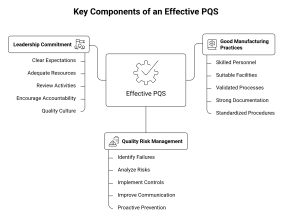
An effective Pharmaceutical Quality System (PQS) is built on three foundational pillars: Good Manufacturing Practices (GMP), Quality Risk Management (QRM), and strong leadership commitment. Each component plays a unique but interconnected role in ensuring consistent quality, regulatory compliance, and patient safety.
1. Good Manufacturing Practices (GMP)
GMP serves as the operational backbone of the PQS. It ensures that manufacturing and testing activities are carried out consistently and under well-controlled conditions.
Core Elements Of GMP Include:
- Skilled and well-trained personnel
- Suitable facilities and controlled environments
- Validated processes and qualified equipment
- Strong documentation and data integrity
- Consistent adherence to standardized procedures
These fundamentals ensure that quality is built into processes rather than tested at the end.
2. Quality Risk Management (QRM)
QRM provides the scientific basis for decision-making within the PQS. It involves structured assessments of risks by evaluating both likelihood and impact.
QRM Strengthens The PQS By Enabling Organizations To:
- Identify and predict potential failures
- Analyze risks using systematic, objective methods
- Define and implement effective controls
- Improve communication of risks across teams
- Move from reactive corrections to proactive prevention
A strong QRM approach enhances consistency, transparency, and quality-driven decision-making.
3. Leadership Commitment
Leadership commitment acts as the cultural engine that keeps the PQS effective and sustainable. When leaders actively model quality values, the rest of the organization aligns with those expectations.
Leadership Drives PQS Success By:
- Establishing clear quality expectations
- Allocating adequate resources and support
- Engaging in reviews and governance activities
- Encouraging accountability and open communication
- Building a culture where quality is everyone’s responsibility
Genuine leadership engagement transforms the PQS from a compliance requirement into a continuous, organization-wide commitment to quality.
A strong PQS is only as good as the risk management thinking behind it.
Go deeper into how QRM and Product Quality Review work together under Schedule M 2023.
→ Read: Quality Risk Management And Product Quality Review Under Schedule M 2023: A Complete Guide
Responsibilities Of Senior Management
Senior management plays a central role in the PQS, and their engagement determines how well the system functions. They are responsible for establishing, maintaining, and continuously improving the PQS.
This begins with providing the right resources — trained staff, qualified equipment, proper facilities, and adequate budgets. Management must also make sure that roles and responsibilities are clearly defined so that everyone knows how they contribute to quality.
Their involvement must go beyond signing documents. Effective senior management participates directly in quality meetings, reviews performance indicators, evaluates system gaps, and supports improvement initiatives.
They also promote a culture that encourages employees to speak up, report issues, and participate in solving problems. When leaders demonstrate genuine commitment, employees respond with stronger ownership and compliance.
PQS Across The Product Lifecycle
The PQS does not focus solely on manufacturing but spans the entire product lifecycle: development, technology transfer, commercial manufacturing, and discontinuation. Each stage presents unique risks and expectations, and the PQS ensures these are managed consistently and systematically.
During pharmaceutical development, the PQS strengthens scientific discipline. It ensures that products and processes are built on solid scientific principles and thorough experimentation. During technology transfer, the PQS guarantees that knowledge is transferred accurately between development teams and manufacturing teams, preventing misunderstandings or process gaps.
In commercial manufacturing, the PQS ensures that the process stays in a stable, controlled state. Monitoring systems detect variations early, enabling timely corrections. During discontinuation, the PQS ensures that the product is retired responsibly, with proper handling of materials, documentation, and regulatory formalities. This lifecycle approach ensures continuity and consistency from one stage to the next.
Comprehensive Requirements Of The PQS (Section 1.5)
Section 1.5 outlines nineteen specific requirements that ensure the PQS is complete and effective. These requirements guide everything from process design to batch release. The PQS must support product realization by establishing and maintaining processes that deliver consistent product quality. Product and process knowledge gathered during development must be maintained and used throughout the lifecycle.
All development activities must comply with GMP and relevant GxPs such as GLP and GCP. Clear documentation is essential, ensuring that operations are executed consistently. Responsibilities must be defined in job descriptions so that individuals understand their quality obligations. Material management includes supplier qualification, supplier monitoring, incoming material approval, and full supply chain verification.
The PQS must ensure robust process controls and validation activities so manufacturing operations remain consistent and reliable. Finished products must be processed and tested according to approved procedures, and no batch may be released until an authorized person certifies compliance with all requirements.
If activities are outsourced, they must be controlled through agreements, audits, and continuous oversight. Storage and distribution practices must preserve product quality from the warehouse to the point of use. The system must include self-inspections to evaluate effectiveness and identify weaknesses.
Monitoring systems must support investigations, trend analysis, and batch release decisions. Deviations must be thoroughly investigated using root cause analysis, followed by corrective and preventive actions (CAPAs) whose effectiveness is later verified. Change control must ensure that any modification is justified, evaluated, approved, and reviewed after implementation. Product quality reviews must be carried out to verify consistency and identify opportunities for improvement.
A state of control must be maintained at all times, supported by effective monitoring systems and proactive decision-making. Continual improvement must be built into the PQS so that processes evolve over time. Finally, QRM must be integrated fully into decision-making to ensure that risks are assessed, controlled, and communicated.
In Simple Terms, The PQS Must Ensure:
- Reliable documentation and well-defined processes
- Effective risk-based decision making
- Thorough investigations and scientifically justified CAPAs
- Strong supplier and material controls
- Regular monitoring and evaluation of process health
- Timely identification of improvement needs
Management Review Requirements
Management reviews are critical to maintaining an effective PQS. These reviews must be conducted periodically, generally at least once every year and must involve senior leadership. During these reviews, management examines key quality indicators such as process performance, product quality trends, deviations, CAPA effectiveness, customer complaints, and internal and external audit findings.
Management also reviews the outcomes of change controls, identifies new trends or risks, evaluates the effectiveness of previous action plans, and determines whether the PQS is meeting its intended objectives. They also assess whether additional resources are needed, whether new quality objectives should be set, and whether processes require improvement.
These reviews help keep the PQS aligned with organizational goals and ensure it remains responsive to internal and external changes. All decisions and actions from the review must be documented and followed through.
Documentation Requirements Within The PQS
The Quality Manual is the central document that describes the structure and functioning of the PQS. It explains the organization’s quality policy, the overall approach to quality, the responsibilities of management, the organizational structure, and the processes used to maintain product realization. It also describes how system performance is monitored and how continual improvement is achieved.
Good documentation ensures standardization, supports employee training, and provides transparency during audits. It also allows the company to demonstrate compliance with both internal controls and external regulatory requirements. The Quality Manual is not a static document; it must be updated regularly to reflect changes in processes, roles, or regulatory expectations.
Practical Examples Of PQS In Action
Practical examples make the PQS easier to understand. Consider a scenario where tablet weights begin trending outside acceptable limits. The PQS requires that an investigation be initiated immediately. Through root cause analysis, the team may find that the tablet punches are worn out.
The organization then establishes and implements a maintenance plan, increases monitoring frequency, and evaluates whether the corrective actions worked. These insights are later reviewed during management review meetings to ensure long-term improvement.
Another example is adding a new API supplier. Before approval, the PQS requires a thorough qualification process, which includes a risk assessment, documentation review, supplier audit, and trial batch manufacturing.
A formal change control process is initiated to document and evaluate the impact. Only after the supplier proves acceptable performance can they be approved. This ensures that the supply chain remains reliable and compliant.
Evaluating PQS Compliance
Organizations must periodically evaluate their PQS to ensure it meets Schedule M 2023 requirements. This evaluation considers the effectiveness of management involvement, resource availability, documentation accuracy, and employee competency.
It also reviews change control practices, deviation investigations, CAPA performance, internal audits, and supplier qualifications. Compliance evaluation is not only for identifying weaknesses, it is a tool for improvement.
The findings help the organization strengthen processes, prevent recurring issues, and maintain a consistent state of control. An effective evaluation program demonstrates that the PQS is functioning as intended.
Common PQS Challenges And How To Avoid Them
Implementing a Pharma Quality System (PQS) often comes with practical hurdles that can compromise effectiveness if not addressed early.
Many organizations struggle with inconsistent leadership involvement, outdated or poorly controlled documentation, insufficient integration of Quality Risk Management (QRM), or simply a lack of adequate resources.
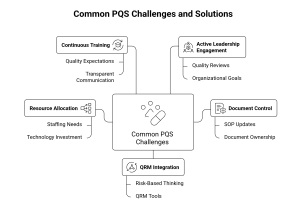
These gaps can weaken the entire system and increase vulnerability to compliance issues.
To avoid these pitfalls, organizations should focus on strengthening a few key areas:
1. Maintain Active Leadership Engagement
- Ensure leaders regularly participate in quality reviews and decision-making.
- Align quality objectives with organizational goals to maintain visibility and priority.
2. Strengthen Document Control
- Keep SOPs and records updated and version-controlled.
- Establish clear ownership for document creation, review, and approval.
3. Integrate QRM Into Daily Operations
- Train teams to apply risk-based thinking consistently, not just during audits.
- Use QRM tools to identify, assess, and mitigate risks proactively.
4. Plan And Allocate Resources Wisely
- Assess staffing, technology, and training needs early.
- Invest in systems and tools that support efficient PQS operations.
5. Foster Continuous Training And Communication
- Conduct ongoing training to reinforce QRM principles and quality expectations.
- Encourage transparent communication to build a culture of accountability.
Beyond these core practices, organizations benefit significantly from regular internal audits, cross-functional collaboration, and open discussions about system vulnerabilities. These activities provide fresh insights and help teams stay aligned with quality goals.
By addressing common challenges proactively and consistently, organizations can build a more resilient PQS, one that supports compliance, performance, and long-term operational success.
Building a PQS is only half the battle. The real challenge is building the people who can run it.
Understanding why quality systems fail without capability is what separates compliant organizations from truly quality-driven ones.
→ Read: Why Pharmaceutical Quality Systems Fail Without Capability Building
Conclusion And Next Steps
The Pharmaceutical Quality System outlined in Schedule M 2023 is essential for ensuring safe, effective, and consistent pharmaceutical products. It integrates GMP, QRM, leadership involvement, and lifecycle-based controls to create a system that protects both regulatory compliance and patient safety.
Senior management carries ultimate responsibility for making the PQS work, and each of the nineteen requirements in Section 1.5 plays a vital role in shaping a robust system.
Organizations should review their current PQS, update outdated documents, conduct necessary management reviews, evaluate compliance with Section 1.5, and plan further training in areas such as Quality Risk Management.
Strengthening the PQS leads to improved product quality, better regulatory outcomes, and long-term business success in the pharmaceutical industry.
FAQs
1. What Is The Pharmaceutical Quality System (PQS) Under Schedule M 2023?
The PQS is a structured framework defined under Schedule M 2023 that ensures pharmaceutical products are consistently safe, effective, and of high quality. It integrates Good Manufacturing Practices (GMP), Quality Risk Management (QRM), and strong leadership to maintain quality throughout the entire product lifecycle—from development to distribution. It acts as the backbone of a company’s quality culture and operations.
2. Why Is The PQS Important For Pharmaceutical Companies?
The PQS is important because it helps ensure patient safety, regulatory compliance, and product consistency. It creates a controlled and continuously improving system where risks are identified early, processes are standardized, and quality is built into every stage of manufacturing rather than checked at the end. This ultimately helps build trust in medicines among patients and regulators.
3. What Role Does Senior Management Play In The PQS?
Senior management is responsible for establishing, maintaining, and improving the PQS. They ensure proper resources, define responsibilities, participate in quality reviews, and promote a culture of accountability. Their active involvement is critical for the system to function effectively and achieve long-term quality goals. Their leadership sets the tone for how seriously quality is practiced across the organization.