Quality Risk Management (QRM) and Product Quality Review (PQR) Under Schedule M 2023 : A Complete And Simplified Guide
Complete guide to Quality Risk Management & Annual Product Quality Review per Schedule M 2023. Includes methodology & real-world examples.


In the pharmaceutical industry, quality assurance is not merely a regulatory expectation but a fundamental obligation owed to every patient. Medicines must be safe, effective, and reliable throughout their lifecycle, and this is only possible when manufacturers maintain systems that identify risks, control processes, and evaluate performance in a structured manner.
Schedule M 2023 strengthens this approach by placing Quality Risk Management (QRM) and Annual Product Quality Review (PQR) at the centre of modern Good Manufacturing Practice (GMP). Both systems work together to promote continuous quality improvement, ensure consistency, and enable companies to build a robust, science-driven quality culture.
This comprehensive article explains QRM and PQR in a simple yet detailed manner, providing clarity for professionals at all levels while retaining every key requirement of Section 2 of Schedule M 2023.
Understanding Quality Risk Management (QRM)
Quality Risk Management is defined in Schedule M as a systematic process used for the assessment, control, communication, and review of risks that could affect the quality of medicinal products. Its purpose is to support better decision-making, encourage preventive thinking, and strengthen patient protection. In essence, QRM provides a structured way to ask: What can go wrong? How likely is it? How serious is it? And what can we do about it?
The first fundamental principle guiding QRM is its science-based and patient-focused nature. Risk assessments must rely on scientific knowledge, technical understanding of processes, and data gathered through experience. Decisions cannot be based on guesswork or assumptions — they must reflect the real impact that a failure or deviation may have on product quality and patient safety.
The second principle highlights proportionality. Not all risks carry the same impact, so the level of effort, documentation, and investigation must match the seriousness of the risk. High-risk areas such as sterilisation or aseptic processing demand deeper analysis and stronger control measures, while low-risk decisions may require simpler tools and less extensive documentation.
The Four-Step QRM Process
The QRM process operates as a continuous cycle with four essential steps!
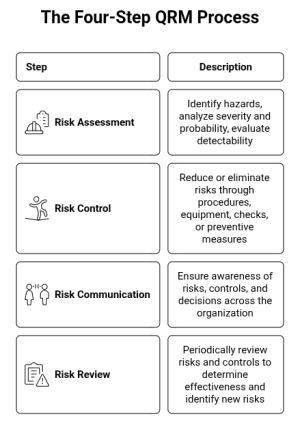
1) The 1st Step — Risk Assessment — It involves identifying potential hazards, analysing the severity and probability of each hazard, and evaluating how easily the issue can be detected. This stage helps organisations pinpoint weak areas and understand the potential consequences of failure.
2) The 2nd Step — Risk Control — It focuses on reducing or eliminating risks. This may include implementing new procedures, updating equipment, performing additional checks, or introducing preventive measures that stop problems before they occur. Effective risk control is grounded in scientific evidence and process knowledge, ensuring that the chosen controls truly address the identified hazards.
3) The 3rd Step — Risk Communication — It ensures that individuals across the organisation from production and engineering to quality and management are aware of risks, controls, and decisions. Communication strengthens accountability and ensures that everyone works with the same information.
4) The 4th Step — Risk Review — Risks evolve over time as processes change, equipment ages, or new data becomes available. Periodic reviews help determine whether existing controls remain effective and whether new risks have emerged. This continuous monitoring ensures that QRM remains a living, dynamic system rather than a one-time exercise.
Proactive And Retrospective Applications Of QRM
QRM can be applied either proactively or retrospectively, depending on when it is used. Proactive QRM occurs before an activity takes place and aims to prevent quality issues before they happen.
It is applied during product development, equipment qualification, supplier qualification, process validation, and whenever changes are introduced. Tools like FMEA, HACCP, risk matrices, and What-If analysis help teams think ahead, anticipate potential problems, and strengthen the process before any error occurs.
Retrospective QRM, on the other hand, is used after an event or issue has taken place. It plays a central role in deviation investigations, complaint handling, OOS results, CAPA processes, audit findings, and recalls.
Tools such as Root Cause Analysis, Fishbone diagrams, the 5 Whys technique, and Pareto analysis help teams understand why a problem occurred and ensure that corrective actions are not only implemented but also effective in preventing recurrence. Both proactive and retrospective QRM are essential to maintaining a complete and reliable quality system.
The Importance Of Annual Product Quality Review (PQR)
To complement QRM, Schedule M 2023 mandates an Annual Product Quality Review for every product manufactured, including export-only products. A PQR is a structured evaluation conducted once a year to confirm that each product remains within a state of control. It ensures that manufacturing processes are consistent, specifications are still appropriate, and any trends, positive or negative are identified early.
The PQR process helps manufacturers detect drift in processes, evaluate supplier performance, understand stability patterns, assess deviations, and review complaints, among other activities. By combining data from the past year, companies can make informed decisions about process improvements, revalidations, or specification updates. Importantly, the findings from previous years are also considered to create a meaningful, long-term view of the product’s behaviour.
The Twelve Mandatory Elements Of The PQR
Schedule M lists twelve specific components that must be included in every Product Quality Review. These elements ensure that all aspects of product quality are evaluated comprehensively!
Schedule M mandates twelve essential components that must be assessed in every Product Quality Review to ensure a complete and reliable evaluation of product quality and regulatory compliance.
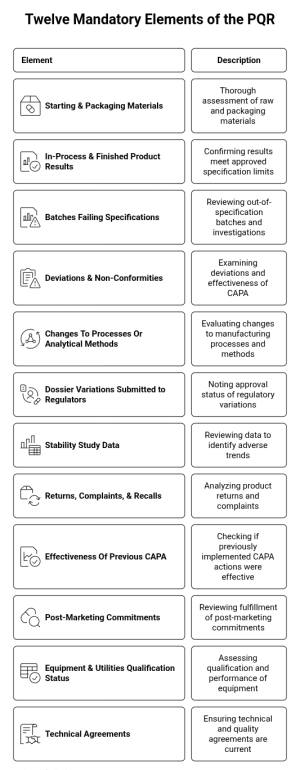
1) Review of Starting & Packaging Materials — The first element requires a thorough assessment of all raw and packaging materials used during the review period, with special emphasis on new suppliers and the traceability of active substances.
2. Evaluation Of In-Process & Finished Product Results — The second element focuses on confirming that all in-process checks and finished product results consistently meet approved specification limits.
3) Review Of Batches Failing Specifications — The third element involves reviewing all out-of-specification (OOS) batches and examining the investigations and conclusions drawn.
4) Assessment of Deviations & Non-Conformities — The fourth element examines significant deviations, non-conformances, and the effectiveness of the corrective and preventive actions (CAPA) implemented to address them.
5) Review of Changes To Processes Or Analytical Methods — The fifth element requires evaluation of any changes to manufacturing processes, equipment, or analytical methods, ensuring all were properly assessed, validated, and documented.
6) Review Of Dossier Variations Submitted to Regulators — The sixth element covers all regulatory variations submitted, noting whether they were approved, rejected, or remain under review.
7) Evaluation Of Stability Study Data — The seventh element reviews data from ongoing stability studies to identify any adverse trends or emerging risks.
8) Assessment Of Returns, Complaints, & Recalls — The eighth element analyses all product returns, complaints, and recalls to confirm that investigations were completed thoroughly and appropriate actions were taken.
9) Review Of Effectiveness Of Previous CAPA — The ninth element checks whether previously implemented CAPA actions were effective and whether any issues have recurred.
10) Evaluation Of Post-Marketing Commitments — The tenth element reviews all post-marketing commitments to ensure they have been fulfilled and are compliant with regulatory expectations.
11) Review Of Equipment & Utilities Qualification Status — The eleventh element assesses the qualification and performance status of critical equipment and utilities, such as HVAC, compressed air, and water systems.
12) Review Of Technical Agreements — The twelfth element ensures that all technical and quality agreements with manufacturers, suppliers, and partners are current and clearly outline respective responsibilities.
Evaluating Actions And Outcomes Of The PQR
Once all twelve elements have been reviewed, the manufacturer must decide whether any corrective or preventive actions are necessary. This step is crucial in ensuring that any emerging risks are addressed before they impact product quality.
The need for revalidation activities must also be assessed, especially if significant changes or trends have been observed. CAPAs must be documented, executed promptly, and verified during self-inspections or audits to ensure effectiveness.
Schedule M allows grouping PQRs by product type, such as solids, liquids, or sterile formulations, where scientifically justified. This flexibility can help reduce duplication without compromising quality.
The Authorized Person responsible for batch certification holds the final accountability for ensuring that the PQR is complete, accurate, and submitted on time.
Real-World Illustrations: Applying QRM And PQR
Understanding QRM becomes easier when seen through real-life scenarios. Consider a case where a company installs a new tablet compression machine. A proactive QRM assessment using FMEA may identify a risk of weight variation due to feeder inconsistency.
Based on the severity, probability, and detectability ratings, the company may decide to enhance the qualification protocol, add extra in-process weight checks during installation and performance qualification, introduce a preventive maintenance schedule, and provide specialised training.
After production begins, the first several batches may be monitored closely, confirming that the implemented controls were effective. The entire assessment is then included in the PQR.
Another scenario involves an out-of-specification (OOS) assay result for an active pharmaceutical ingredient. A retrospective QRM process may use tools such as Fishbone diagrams and 5 Whys to identify the root cause. In this case, the cause may be degradation of the HPLC column.
Corrective actions such as replacing the column, tightening system suitability criteria, implementing a column usage log, and training analysts may be taken. Preventive actions ensure no recurrence, and results may be monitored over six months before adding the findings to the PQR.
A broader example is the PQR for Paracetamol 500 mg Tablets. A detailed review may show stable results, effective CAPA implementation for minor deviations, packaging complaints resolved by changing suppliers, an updated analytical method from HPLC to UPLC, and no serious post-marketing concerns.
Based on stability trends, the company may even consider extending the shelf life. All observations and actions are documented and presented to management, ensuring transparency and continued control.
Compliance Monitoring Using Checklists
To ensure full compliance with Schedule M, companies may use a comprehensive checklist that covers all aspects of QRM and PQR. Such checklists confirm whether PQRs are completed annually, whether QRM assessments are science-based and documented, whether all twelve mandatory elements are included, and whether CAPAs are implemented and verified. They also ensure that risk communication occurs, technical agreements are up to date, and risk reviews are carried out regularly. This structured approach strengthens accountability and consistency.
Common Challenges And Best Practices
Despite clear guidelines, many organisations struggle with common pitfalls, such as using QRM only when failures occur, applying the same approach to all risks, delaying PQR activities, failing to act upon findings, or maintaining weak documentation. These challenges can be overcome by embracing QRM as a proactive tool, tailoring assessments to risk levels, ensuring punctual PQR completion, enforcing CAPA follow-up, and maintaining strong scientific justification behind all decisions.
In Conclusion
Quality Risk Management and Product Quality Review form the core framework of Schedule M 2023, reflecting a modern and science-driven approach to pharmaceutical quality. QRM helps companies identify, control, and communicate risks throughout the product lifecycle, while PQR ensures that products remain consistent, safe, and reliable year after year.
Together, they create a feedback loop that supports continuous improvement, regulatory compliance, and ultimately, patient protection. By embracing disciplined, data-based, and proactive practices in QRM and PQR, organisations can build a resilient quality system that promotes long-term excellence and trust.
FAQs
1. What Is Quality Risk Management (QRM) Under Schedule M 2023?
Quality Risk Management (QRM) is a structured process used to identify, assess, control, and review risks that may affect the quality of pharmaceutical products. Schedule M 2023 emphasizes using scientific data, process knowledge, and patient-focused decisions to ensure product safety. QRM helps manufacturers prevent problems, investigate issues effectively, and maintain strong control over all operations. It also ensures that resources and documentation are proportional to the level of risk involved.
2. Why Is The Annual Product Quality Review (PQR) Important?
The Annual Product Quality Review (PQR) ensures that each product remains consistent, stable, and compliant throughout its lifecycle. It involves evaluating materials, process data, deviations, complaints, stability results, and supplier performance over the entire year. PQR helps detect trends early, supports continuous improvement, and confirms whether any corrective or preventive actions are required. Schedule M 2023 makes PQR mandatory for every product, including export-only batches.
3. How Do QRM And PQR Work Together In A Pharmaceutical Quality System?
QRM and PQR complement each other by strengthening process control and long-term product consistency. QRM identifies and manages risks during development, manufacturing, investigations, and change control, while PQR reviews annual performance to confirm that controls remain effective. Insights from QRM feed into PQR, and PQR findings help refine future QRM assessments. Together, they support regulatory compliance, improve decision-making, and enhance patient safety.
Reporting on the science, business and regulation shaping the pharmaceutical industry.
More in Regulatory Intelligence
All articles →
The Pattern Behind FDA Warning Letters: What Startups & CDMOs Often Miss

ISO 14644 Cleanroom Classes for Pharma (with EM Implications)

Discussion