by Mrudula Kulkarni
12 minutes
Smart Quality Software vs. eQMS: Which is the Best?
Why pharma leaders choose Smart Quality Software | ROI metrics, implementation phases, organizational readiness, and complete comparison with eQMS.

The Quality Management Crossroads: A Story Every Pharma Leader Knows
Picture this: It is 2010, and your quality team is buried under mountains of paper binders. Regulatory audits mean frantic searches for the right version of a procedure. Training records are spreadsheets updated manually. Non-conformances are tracked in email threads.
Then came the eQMS and everything changed. Within a decade, digitalization swept through pharma, biotech, and medical device companies worldwide. Yet today, a new crossroads has emerged, and the most forward-thinking quality leaders are already navigating it.
The question is no longer "should we go digital?" The question is: "Are we ready to go Smart?"
From Paper to Digital: A Transition Already Made
The shift from paper-based Quality Management Systems (QMS) to electronic Quality Management Systems (eQMS) is now table stakes in life sciences. According to a 2023 report by Grand View Research, the global quality management software market was valued at USD 11.5 billion and is projected to grow at a CAGR of 10.6% through 2030, driven primarily by GxP compliance demands and increasing regulatory scrutiny from the FDA and EMA.
Every major pharma and medtech organization has completed this transition. It is no longer a competitive differentiator.
What is differentiating leaders from laggards today is the leap to Smart Quality Software.
"Quality must evolve from a compliance function into a value-creating engine. That is the promise of Smart Quality." McKinsey & Company, Life Sciences Practice, 2022
What Is the Smart Quality Concept?
The Smart Quality framework was introduced by McKinsey & Company in a landmark 2022 publication titled "Smart Quality: Reimagining the Way Quality Works." The concept argued that quality management in pharma and life sciences had been locked in a reactive, siloed compliance posture for too long.
Smart Quality proposes a fundamentally different model: one where quality ownership is distributed across every function and level of the organization, not just the Quality Assurance (QA) department. Compliance becomes a byproduct of culture, not a burden imposed upon it.
The four pillars of Smart Quality as defined by McKinsey are:
Pillar | Description |
|---|---|
Predictive Intelligence | Leveraging data analytics to anticipate quality failures before they occur |
Radical Transparency | Real-time visibility into quality KPIs across the entire organization |
Ownership at Every Level | Embedding quality responsibility into all roles, not just QA |
Continuous Learning | Building a workforce that actively improves quality knowledge over time |
Source: McKinsey & Company, "Smart Quality: Reimagining the Way Quality Works," 2022
eQMS: What It Does and Where It Stops
An electronic Quality Management System is cloud-based software that centralizes and digitalizes all quality-related processes. It is a robust, proven tool that solves the fundamental problems of paper-based quality management.
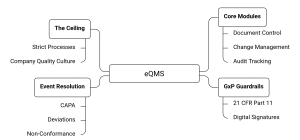
A standard eQMS typically includes:
- Document control and version management
- Electronic signatures compliant with 21 CFR Part 11
- CAPA management (Corrective and Preventive Actions)
- Change control management
- Non-conformance and deviation tracking
- Training management and records
- Audit management
- Automated data reports and compliance trail
The goal of an eQMS is to formalize, streamline, and centralize quality processes so that organizations can consistently meet FDA, ISO 9001, ISO 13485, and GxP standards. It reduces the cost of compliance and makes quality management accessible from anywhere.
But here is the critical limitation pharma leaders must understand: an eQMS is fundamentally a tool for managing quality. It does not actively cultivate quality ownership, nor does it engineer the behavioral shifts needed to embed quality into organizational culture.
"Most eQMS implementations solve the documentation problem. They rarely solve the culture problem." Journal of Pharmaceutical Innovation, Vol. 18, 2023
Smart Quality reduces audit findings by 30-50%.
Learn audit readiness frameworks that support quality transformation.
→ Read: Audit Management Systems In Pharma | A Leadership Guide
Smart Quality Software: The Next Evolution
Smart Quality Software is not simply an "advanced eQMS" with more features or a better user interface. The distinction runs much deeper. Smart quality management software is architecturally and philosophically engineered to achieve something an eQMS cannot: it catalyzes a quality mindset shift across the entire organization.
According to McKinsey's original research, organizations that adopted Smart Quality principles reported:
Metric | Improvement |
|---|---|
Quality-related cost reduction | 20 to 40% |
Reduction in customer complaints | 50 to 70% |
Reduction in audit findings | 30 to 50% |
Speed to market improvement | 15 to 30% |
Employee quality engagement | Significantly increased |
Source: McKinsey & Company, Life Sciences Practice, 2022
These outcomes are achieved through three core mechanisms unique to Smart Quality Software:
1. Behavioral Design and Gamification
Smart Quality platforms embed behavioral science principles directly into the user experience. Gamification elements such as progress tracking, achievement recognition, and peer benchmarking make quality tasks intrinsically motivating rather than obligatory.
Research published in the Journal of Medical Systems (2022) demonstrated that gamification in healthcare compliance increased task completion rates by up to 48% compared to standard digital workflows.
2. Embedded Continuous Learning
Unlike an eQMS, which stores documents and records, Smart Quality Software integrates educational content directly into workflows. Articles, video guides, quizzes, and contextual learning resources help users understand why they are performing each quality activity, not just how.
This is consistent with findings from a study in Quality Management Journal (Vol. 30, 2023), which showed that organizations embedding learning into QMS workflows experienced a 35% improvement in quality procedure adherence within 12 months.
3. Predictive Data Intelligence
Standard eQMS platforms generate reports based on historical data. Smart Quality Software leverages real-time and predictive analytics to surface future risk trends, anticipate CAPA bottlenecks, and benchmark performance against industry standards.
A predictive QMS can flag, for instance, that a rising pattern in minor deviations is likely to produce a major non-conformance within a defined timeframe, allowing leaders to act before a regulatory event occurs.
The Goal Difference: Compliance vs. Value Creation
This is the clearest strategic distinction pharma leaders must internalize:
Dimension | eQMS | Smart Quality Software |
|---|---|---|
Primary Goal | Achieve and maintain compliance | Catalyze value beyond compliance |
User Orientation | Accessibility for QA teams | Company-wide quality ownership |
Data Use | Historical reporting | Predictive intelligence |
Learning | Not embedded | Integrated continuous learning |
Behavioral Design | Functional workflows | Gamification and engagement |
Compliance | Achieved through process | Baked into platform architecture |
Customer Focus | Meet customer requirements | Exceed customer expectations |
Cultural Impact | Minimal | Transformative |
Quality as strategic asset, not just compliance.
Understand QMS frameworks that drive organizational transformation.
→ Read: Quality Management | QMS Strategy & Implementation
Finding the Right Fit: A Decision Framework for Pharma Leaders
Choosing between an eQMS and Smart Quality Software is not primarily a technology decision. It is a strategic one.
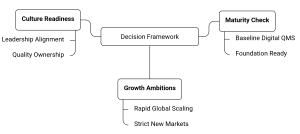
Pharma leaders should begin the evaluation process by answering three questions:
1. What is your quality maturity level? Organizations early in their digitalization journey may benefit most from establishing a robust eQMS foundation first. Attempting to implement Smart Quality Software without baseline digital quality processes can create confusion.
2. What are your strategic growth ambitions? If your organization is targeting rapid market expansion, accelerated product development cycles, or entry into highly regulated new markets, smart quality management becomes a strategic enabler, not just an operational upgrade.
3. Is your workforce ready for a quality culture shift? Smart Quality Software works best when leadership is committed to embedding quality ownership beyond the QA function. Without this commitment, even the most sophisticated platform will underperform.
"Technology alone does not transform organizations. Culture does. Smart Quality Software is the catalyst for that cultural shift, but leadership must strike the match." Quality Progress Magazine, ASQ, 2023
The Research Case for Smart Quality
Peer-reviewed literature increasingly supports the Smart Quality approach. A 2023 study in the International Journal of Pharmaceutical Sciences found that pharma companies implementing integrated smart quality systems reduced batch release cycle times by an average of 22%, while simultaneously reducing CAPA recurrence rates by 31%.
A separate analysis published in PLOS ONE (2022) examining quality culture in life sciences organizations found that companies with high employee quality engagement scores had 2.4 times fewer major audit findings than those with low engagement, independent of the technology platform used.
These findings reinforce the foundational argument of Smart Quality: the technology platform matters, but the mindset shift it enables matters even more.
Key Takeaways
The transition from paper-based QMS to eQMS is complete for most major life sciences organizations. The next frontier is the transition from eQMS to Smart Quality Software, and the leaders making this move today will define the quality benchmarks of the next decade.
Smart Quality Software delivers measurable improvements in quality cost reduction, speed to market, audit performance, and employee engagement by embedding predictive intelligence, continuous learning, and behavioral design directly into quality workflows.
The decision to pursue Smart Quality is ultimately a decision about organizational ambition. If passing audits and meeting baseline customer requirements is sufficient, a well-implemented eQMS remains a sound choice. If exceeding customer expectations, accelerating growth, and embedding quality as a genuine competitive advantage is the goal, then Smart Quality Software is the path forward.
FAQs
Q1. Is Smart Quality Software just a rebranded eQMS?
No. While Smart Quality Software includes all standard eQMS capabilities, the fundamental difference lies in its design philosophy. An eQMS is engineered to manage quality processes. Smart Quality Software is engineered to cultivate a quality culture, embed learning, and generate predictive intelligence. It is a conceptually distinct category, not a product refresh.
Q2. Can a small or mid-size pharma company benefit from Smart Quality Software?
Yes. In fact, smaller organizations often see faster cultural impact because they have fewer organizational layers to shift. The key consideration is readiness: does the leadership team understand that implementing Smart Quality Software requires commitment to behavioral and cultural change, not just technology adoption?
Q3. How does Smart Quality Software support FDA 21 CFR Part 11 and GxP compliance?
True Smart Quality platforms have GxP compliance and FDA 21 CFR Part 11 requirements built into their architecture, including electronic signature controls, full audit trails, data integrity safeguards, and validation documentation. This is distinct from an eQMS that offers these as configurable add-ons.
Q4. How long does it take to see ROI from Smart Quality Software?
McKinsey's original research indicated that pharma organizations implementing Smart Quality principles began to see measurable quality cost reductions within 12 to 18 months of implementation. However, the full cultural and performance transformation typically manifests over a 2 to 3 year horizon.
Q5. What is the biggest implementation risk for Smart Quality Software?
The single greatest risk is technology-first thinking. Organizations that deploy Smart Quality Software without simultaneously investing in change management, leadership alignment, and employee communication often fail to achieve the promised outcomes. The software is an enabler of smart quality culture, not a substitute for it.
References and Citations
- McKinsey & Company. (2022). Smart Quality: Reimagining the Way Quality Works. Life Sciences Practice.
- Grand View Research. (2023). Quality Management Software Market Size, Share & Trends Analysis Report.
- Journal of Pharmaceutical Innovation, Vol. 18. (2023). Quality Culture and eQMS Implementation Outcomes in Pharma.
- Journal of Medical Systems. (2022). Gamification in Healthcare Compliance: A Systematic Review.
- Quality Management Journal, Vol. 30. (2023). Embedded Learning in Quality Management Systems.
- International Journal of Pharmaceutical Sciences. (2023). Smart Quality Systems and Batch Release Cycle Times in Pharmaceutical Manufacturing.
- PLOS ONE. (2022). Quality Culture, Employee Engagement, and Audit Performance in Life Sciences Organizations.
- Quality Progress Magazine, American Society for Quality (ASQ). (2023). Technology and Culture in Quality Transformation.