by Sussanah James
10 minutes
Why Strong Science Isn't Enough
Discover why exceptional science alone doesn't secure biotech partnerships and what pharma BD teams actually evaluate beyond data.

Strong science is expected in biotech, but it's not the lever that secures partnerships.
We've spent decades operating on an almost sacred assumption that exceptional data is the currency of collaboration.
Get the science right, and everything else will fall into place.
But this is almost never the case, because:
- the story around the science is unclear,
- the fit is never demonstrated,
- and the execution path is left to the imagination of people who have already seen a hundred decks that week.
Every year, biotech conferences are filled with extraordinary science.
Novel therapies, first-in-class mechanisms, and platforms capable of reshaping entire therapeutic landscapes are presented to rooms full of investors and potential partners. And yet, most of these innovations fail to generate meaningful traction.
The issue is not scientific quality, but translation. Clarity of what the science can become in reality is often the limiting factor.
The Belief That Persists And Why It Makes Sense
Biotech companies live and die by milestones. Funding cycles reward measurable progress: an IND filing, a phase one clearance, a clean interim readout. The entire ecosystem is calibrated to treat data as the primary signal of value. When every stakeholder has rewarded you for producing compelling data, it becomes almost instinctive to lead with it when you walk into a partnership conversation.
There's a cognitive dimension to this, too. "Strong data" is a clean narrative hook for non-experts. It compresses complexity into something legible. For a team that has spent three years inside a program, the significance of those results feels self-evident. The preclinical models are rigorous. The clinical hypothesis is sound.
Why would any of that need to be explained?
Because the person across the table is not inside your program.
This is the translation gap that quietly undermines so many promising conversations.
Biotech operates in a language of precision, but investors and strategic partners do not operate the same way. They think in terms of risk, timelines, scalability, and return.
Companies present knowledge. What stakeholders need is understanding. It’s a subtle distinction, but decisive: knowledge informs, understanding drives decisions.
Even a perfectly identified target still needs the right context around it before a partner can see where they fit. The context here is:
- the translational path,
- impact on patients
- and competitive positioning.
None of this can be communicated by data alone.
What Partnership Decisions Actually Look Like
This is rarely admitted in biotech pitches, but pharma BD teams are not evaluating your science.
They are evaluating your program, and those are two meaningfully different things.
A program is not just a dataset. It is a coherent answer to a set of interdependent questions.
- Is the mechanism well understood, and does it focus on a disease that matters to us?
- Is there a credible translational path (real milestones, defined endpoints, patient populations) we can map to our portfolio?
- Does this science translate into a clinical or commercial advantage that we don't already have, or accelerate something we're already building?
- What are the risks (scientific, regulatory, manufacturing, IP), and does this team see them clearly?
These criteria don't replace data quality. But they fundamentally reframe how data is presented and received.
Where Strong Science Falls Short
Four patterns appear with remarkable consistency in failed partnerships despite strong science.
Each one is fixable and preventable.
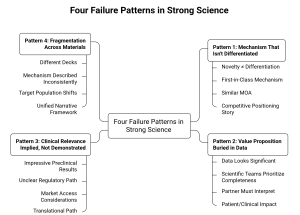
1.The Mechanism That Isn't Differentiated
Two programs can share a similar mechanism of action and produce very different partnership outcomes, not necessarily because one works better in the lab, but because one team has done the work of competitive differentiation and the other hasn't.
Novelty is not differentiation. A first-in-class mechanism that cannot be distinguished from three others is a mechanism without a value narrative.
Biotech needs to build an explicit competitive positioning story that goes beyond novelty and speaks directly to differentiated patient impact.
2.The Value Proposition Buried in Data
This is perhaps the most common failure mode, and the most invisible to the teams experiencing it. There's data and the significance looks obvious.
But the reader cannot see the therapeutic or market relevance without someone making the linkage explicit, whether it's a BD director, a medical affairs lead, or a scientific committee.
In many biotech organizations, communication is driven primarily by scientific teams. The intention is correct, but the outcome is not.
Scientific rigor tends to prioritize completeness and accuracy. Effective communication requires prioritization, structure, and narrative.
With scientific teams, the result is a message that is technically correct but strategically ineffective; data-rich decks that ask the audience to do interpretive work that the presenting team should have already done.
The fix is a discipline of translation: every data point should be accompanied by a clear positioning about what it means for a patient, a clinical endpoint, or a competitive landscape. The narrative arc comes first; the data validates it.
3.Clinical Relevance That's Implied, Not Demonstrated
Preclinical results that are genuinely impressive in animal models most times don’t translate into meaningful patient impact or show a clear regulation path.
And this gap is almost never addressed proactively in partnership materials.
What makes this failure pattern particularly costly is that it extends beyond the partnership conversation into the commercial lifecycle of a product.
Leaving market access considerations until after the clinical trial phase is the riskiest of all strategies.
The implication for BD teams is direct. When a partner evaluates your translational path, they are not only asking whether your preclinical data will be reproducible in humans.
They are asking whether you have already thought about the clinical endpoints that will matter to payers, to prescribers, and to regulators and whether your development plan reflects that thinking.
4.Fragmentation Across Materials
The fourth failure is structural, and it tends to be the last one a team notices. Different materials tell slightly different stories.
The mechanism is described differently in each. The target population shifts. The value claim is sharper in one document than another.
The result is cognitive dissonance in the reader, who is left to synthesize a coherent picture from inconsistent inputs.
A unified narrative framework is both a partnership readiness requirement and a signal of organizational maturity.
The more complex and valuable an innovation is, the harder it is to make it understood.
This is the paradox that sits at the heart of the sector and it explains why the companies that consistently succeed in partnership conversations approach communication differently.
They do not attempt to explain everything. They own how their science is perceived. They frame the problem before introducing the solution. They guide the audience through the mechanism instead of presenting it all at once.
What does this clarity look like in practice?
It means:
- a reader can easily understand why this program matters.
- the link between the mechanism and impact on patients is stated in two sentences, not inferred across twelve slides.
- the competitive positioning is explicit, not just "we are differentiated" but how, against whom, and for which patient population.
- the execution path has real milestones, real go/no-go criteria, and real contingency thinking.
The Four Pillars of a Credible Partnership Story
How can biotech build the kind of partnership readiness that turns strong science into closed deals?
The following are the pillars a strong narrative should have:
Pillar One: Clarity of Mechanism and Impact
The mechanism is the foundation of everything, and it must be expressed in terms that connect directly to patient benefit.
Not "we modulate pathway X", but "we modulate pathway X, which drives disease progression in population Y, and blocking it produces outcome Z that patients and clinicians care about."
What attracts willing industry partners is relevance, not novelty.
Pillar Two: A Coherent and Consistent Value Narrative
The value narrative is the single thread that runs through every piece of material you produce.
It connects mechanisms to patient benefit, patient benefit to market need, market need to competitive advantage, and competitive advantage to what your specific partner is looking for.
Your program needs an identity, a clear, repeatable story that is the same in the one-pager as it is in the executive summary.
A compelling value story means identifying the unmet need, communicating the burden of the disease, and showcasing the effectiveness of the therapy through value-based, outcome-oriented messaging.
Pillar Three: Alignment with Partner Priorities
This is where most biotechs underinvest.
Strategic alignment means demonstrating, that you understand your potential partner's portfolio, their therapeutic area focus, their near-term gaps, and how your program accelerates their roadmap or fills a space they haven't yet addressed.
Pharma companies looking to survey proposals from across the academic landscape are not looking for interesting science. They are looking for interesting science that fits into a specific strategic context.
Before any outreach, build an explicit picture of what this partner has, what they've said they need, where their pipeline has gaps, and where your program is the most credible answer. Then show that mapping as a central element of the pitch. Make the strategic fit visible.
Pillar Four: Confidence in the Execution Path and the Proof to Back It
A partner is not just buying science. They are buying a team's ability to execute a development plan and they are asking for more than a plan.
They are asking for documented evidence that you have already been executing against it.
This is the lesson that emerges from the legal record of failed biotech partnerships. Deals crumble when success metrics aren't clearly defined upfront, or when companies can't definitively prove they've hit those marks.
The Market Is Watching What You Signal
The competitive landscape is the external pressure that shapes how every one of your partnership conversations is evaluated.
The appetite for investment in biotech has not diminished. But it has become more selective.
Pharma is not short of interesting science. It is short of interesting science that comes with a clear strategic narrative, a credible execution plan, and a team that understands where their contribution ends and the partner's begins.
Partners are navigating their own data clarity crisis. Biotechs that arrive with a clean, well-structured evidence package are not just communicating more effectively. They are reducing the cognitive and operational burden on the partner's own team.
Promising programs are sometimes set aside because they don’t fit a partner’s focus or commercial priorities.
A digital therapeutic designed for major depressive disorder may be shelved when a new cardiometabolic drug promises higher returns. And a novel mechanism may struggle to move forward simply because there’s no clear benchmark to compare it against in late-stage trials.
These decisions may make business sense in isolation, but they are also decisions that a well-prepared biotech team can anticipate, and position against.
If you know a potential partner is building an oncology franchise, lead with the oncology implications of your platform. If you know the field lacks a robust clinical comparator, build one into your proposed trial design.
The competitive context is not just an impressive banner. It is the external frame within which your program's value is evaluated and it should inform every choice you make about how to tell your story.
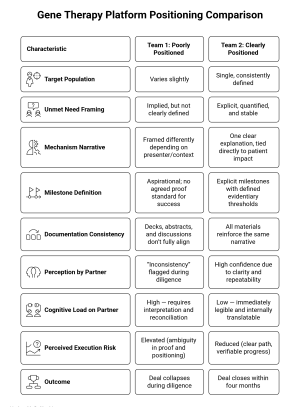
Theory is useful. Cases are better.
Let's compare two team's positioning.
Conclusion
There is a tendency in biotech to treat communication as something that happens after the science is done.
You run the experiments, generate the data, validate the mechanism and then, at some point near the end, you build a deck.
While your science is the product, communication is the packaging.
Clarity of mechanism, a coherent value narrative, milestone documentation, alignment with partner priorities are the difference between a program that fits a roadmap and one that is deprioritized.
When these elements are in place, there's a change in the way your science is received. It stops being impressive data that requires interpretation and becomes a program that a partner recognizes as a strategic fit.
Partnerships are not secured when science is merely impressive.
They are secured when science is understood, trusted, and actionable.
FAQs
Q1: Why Isn't Strong Science Enough To Secure Biotech Partnerships?
Strong science is necessary but not sufficient because data doesn’t make decisions; people do, and they require context to act. Pharma BD teams are not simply evaluating scientific quality; they are evaluating whether a program fits their strategy, carries manageable risk, and has a credible path to execution. When the narrative around the science is unclear, when competitive positioning is absent, and when the translational path is left to imagination, even exceptional data gets deprioritized. The gap is rarely scientific. It is always a failure of communication and strategic framing.
Q2: What Do Pharma BD Teams Actually Look For When Reviewing A Biotech Program?
They are looking for a coherent program, not just a compelling dataset. They want a well-understood mechanism relevant to a disease they care about; a defined translational path with clear milestones and patient populations; a program that fills a genuine gap or accelerates something already in their pipeline; and a biotech team that clearly understands the risks. Data that answers all of these questions is worth far more than superior science that leaves a partner to do the interpretive work themselves.
Q3: How Can Biotech Companies Improve Their Chances Of Closing Partnership Deals?
By treating communication as a core strategic function, not an afterthought. This means building a single, consistent value narrative that runs through every piece of material, explicitly connecting the mechanism to patient benefit and market relevance. It means doing the homework on a potential partner's portfolio before any outreach and making the strategic fit visible in the pitch. And it means documenting a credible execution path with defined milestones and verifiable proof of progress. When these elements are in place, strong science stops requiring interpretation and becomes something a partner can immediately recognize, trust, and act on.