When AI Gets It Wrong: The Real Patient Safety Risk of AI Hallucinations in Healthcare
AI hallucinations in pharma are a real patient safety risk. Wrong doses, false data, missed signals here's what governance looks like.


Healthcare is in the middle of an AI revolution. From clinical decision support tools to AI-assisted drug discovery, artificial intelligence is advancing rapidly in medicine. But there is one problem that does not get enough attention in hospital boardrooms or regulatory discussions: AI hallucinations. And in healthcare, a hallucination is not just a technical glitch. It can be the difference between a correct diagnosis and a missed one, between a safe drug dose and a fatal one.
This guide explains what AI hallucinations are, why they occur, and how serious the patient safety risk really is.
What Exactly Is an AI Hallucination?
The term "hallucination" in AI refers to outputs generated by a large language model (LLM) that are factually incorrect, fabricated, or completely disconnected from reality, but presented with full confidence, as if they were true.
Unlike a simple calculation error, AI hallucinations are deceptive. The model does not flag uncertainty. It does not say "I am not sure." It produces the wrong answer in the same tone and format as a correct one. In a general-purpose context, this might mean a chatbot recommending a restaurant that does not exist. In healthcare, it can mean something far worse.
Examples of AI hallucinations in medical contexts include:
- Generating a drug interaction warning for two medications that actually have no known interaction
- Fabricating a clinical trial citation that does not exist
- Recommending a dosage that exceeds safe limits for a specific patient population
- Misidentifying a drug name by confusing it with a similar-sounding one
- Summarising a patient record inaccurately by inserting details that were never documented
Why Do AI Hallucinations Happen?
To understand the risk, you first need to understand the cause. LLMs are trained on massive amounts of text data. They learn to predict the most statistically likely next word or phrase based on patterns in that data. They do not "understand" medicine the way a trained clinician does; they simulate understanding through pattern matching.
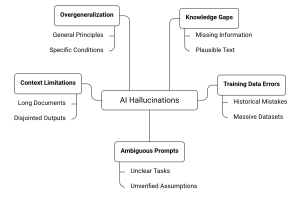
Hallucinations happen when:
- The model encounters a knowledge gap and fills it with plausible-sounding text rather than admitting it does not know
- Training data contains errors that the model has learned and reproduced
- The prompt is ambiguous, and the model makes assumptions to complete the task
- Context window limitations cause the model to lose track of earlier information in long documents
- The model overgeneralises from one domain to another — for example, applying general medicine principles incorrectly to a rare paediatric condition
The underlying architecture of most LLMs makes hallucination an inherent risk, not a fixable bug that will disappear with the next software update.
Where Does the Patient Safety Risk Come In?
The concern is not theoretical. As AI tools are deployed more widely across clinical settings, the opportunities for hallucination-related harm multiply. Below is a breakdown of the key risk areas.
Each of these areas carries real patient risk. A pharmacist relying on an AI prescribing assistant that hallucinated a safe dose range. A clinician reviewing an AI-generated discharge summary with a made-up allergy entry. A patient following chatbot advice based on a fabricated medical claim. The scenarios are not hypothetical; near-miss incidents linked to AI outputs have already been documented in early adoption settings.
The Regulatory Landscape Is Catching Up — But Slowly
Global regulators are taking AI in healthcare seriously, but the specific challenge of hallucination has not yet been fully addressed in formal guidance.
The U.S. Food and Drug Administration (FDA) has been developing its regulatory framework for AI-based Software as a Medical Device (SaMD) under its Digital Health Center of Excellence. The FDA has acknowledged that AI/ML-based tools require ongoing post-market surveillance, partly because model outputs can degrade or behave unpredictably in real-world settings.
The European Medicines Agency (EMA) released a workplan in 2023–2024 that includes AI use in regulatory submissions and pharmacovigilance. The EMA has flagged accuracy and transparency of AI outputs as key concerns.
The EU AI Act, which began phased enforcement in 2024, classifies AI systems used in clinical decision-making as high-risk and requires conformity assessments, human oversight, and clear transparency obligations. Notably, high-risk AI must include mechanisms for human review, a direct countermeasure to the hallucination problem.
The gap right now is that most existing frameworks were not built with LLM hallucination as a specific failure mode in mind. Most regulations reference "accuracy" in a general sense. As LLMs move from administrative tasks into clinical decision support, this gap will need to be closed quickly.
FDA's CSA guidance isn't optional reading anymore it's the rulebook.
Know exactly what it demands before your AI tool faces scrutiny.
→ Read: FDA Computer Software Assurance (CSA): A Definitive Guide for Pharma Leaders
High-Risk Scenarios: Where Hallucinations Are Most Dangerous
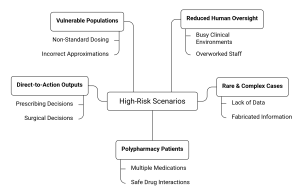
Not all AI use in healthcare carries equal risk. The danger is greatest where:
- Human oversight is reduced — Busy clinical environments where AI outputs are trusted without verification
- Rare diseases or complex cases are involved — LLMs often have sparse training data for rare conditions, increasing the chance of fabrication
- Polypharmacy is present — Patients on multiple medications are at higher risk from hallucinated drug interactions
- The output feeds directly into action — When an AI summary directly drives a prescribing or surgical decision without independent review
- Vulnerable populations are involved — Paediatrics, geriatrics, and patients with renal or hepatic impairment often require non-standard dosing that models may approximate incorrectly
What Good AI Governance Looks Like in Healthcare
Managing hallucination risk is not about abandoning AI. It is about building the right guardrails. Here is what responsible deployment looks like in practice.
AI Safety Checklist for Healthcare Organisations
- Has the AI tool been validated on a representative clinical dataset before deployment?
- Is there a defined human review step before AI-generated outputs are acted upon?
- Are clinicians trained to recognise and flag potential AI errors?
- Does the AI system provide confidence scores or uncertainty indicators?
- Is there a clear incident reporting pathway for suspected AI-related errors?
- Is the AI tool subject to regular post-deployment accuracy monitoring?
- Are high-risk use cases (e.g., dosing, diagnosis) separated from lower-risk ones (e.g., scheduling, administrative summaries)?
- Is the tool compliant with applicable regulatory requirements (FDA SaMD guidance, EU AI Act, MHRA guidance)?
- Has the vendor disclosed the training data sources and known limitations?
- Is there a process for continuous revalidation when the underlying model is updated?
Compliance theatre won't stop an AI hallucination from reaching a patient.
Here's the epistemic contract GxP pharma actually needs.
→ Read: The New Epistemic Contract For Artificial Intelligence In GxP Environment: Stepping Beyond Compliance Theatre
The Human Oversight Imperative
One of the most important lessons from early AI deployment in healthcare is that automation bias is real. Clinicians who interact regularly with AI tools can begin to trust outputs without critically evaluating them, especially when workloads are high and time is short.
This is not a technology problem. It is a human factors problem. And it is exactly the kind of issue that patient safety frameworks are designed to address. Regulatory bodies, hospital accreditation bodies, and pharmacy councils are increasingly requiring documented human oversight protocols for clinical AI tools.
The goal is not to treat AI as an infallible authority, but as a sophisticated assistant that requires professional supervision, much like any other tool in clinical practice.
What the Pharma Industry Specifically Needs to Watch
For pharmaceutical companies, the hallucination risk extends beyond direct patient care into the drug development and regulatory process itself.
Regulatory submissions that use AI-generated summaries carry the risk of fabricated citations or inaccurate clinical data being submitted to health authorities. This is not just a safety risk; it is a regulatory compliance risk with serious legal consequences.
Pharmacovigilance is another critical area. AI tools used to analyse adverse event reports or detect safety signals could, if they hallucinate, either miss real signals or generate false ones. Both outcomes carry patient safety implications.
Medical information, including responses to healthcare professional queries about drug dosing, interactions, or indications, must be accurate and traceable. AI-generated medical information responses that contain hallucinated content could expose patients to direct harm and companies to significant liability.
The Path Forward
AI hallucinations are a known, documented, and technically understood risk. What the healthcare and pharmaceutical industries now need is not alarm but action, systematic, structured, and proportionate to the level of clinical risk involved.
The technology will keep improving. Retrieval-augmented generation (RAG), model calibration, and specialised medical LLMs trained on curated clinical data are all active areas of development that aim to reduce hallucination rates. But until hallucination rates reach clinically acceptable levels, and until those levels are formally defined by regulators, human oversight must remain the non-negotiable backstop.
AI has genuine potential to improve patient outcomes, speed drug development, and reduce clinician burnout. Realising that potential safely means taking the hallucination problem seriously, building robust governance frameworks now, and never allowing speed of adoption to outpace the quality of the evidence base.
FAQs
Q1: What is an AI hallucination in healthcare?
An AI hallucination in healthcare is when an artificial intelligence tool generates medical information that is factually incorrect or fabricated — such as a wrong drug dose, a false citation, or an inaccurate patient summary while presenting it confidently as fact.
Q2: Can AI hallucinations harm patients?
Yes. If clinicians act on AI-generated errors without verification, such as a hallucinated drug interaction or incorrect dosing recommendation, there is a direct risk of patient harm, including adverse drug reactions or missed diagnoses.
Q3: Are AI tools in healthcare regulated?
Yes. The FDA regulates AI-based Software as a Medical Device (SaMD) in the U.S., and the EU AI Act classifies clinical decision-support AI as high-risk. However, specific regulations around AI hallucination are still evolving.
Q4: How can hospitals reduce AI hallucination risks?
Hospitals can reduce risk by requiring human review of AI outputs before clinical action, validating AI tools on representative datasets, training staff to critically evaluate AI responses, and implementing structured incident reporting for AI-related errors.
Q5: Which medical areas carry the highest AI hallucination risk?
The highest-risk areas include AI-assisted prescribing, clinical documentation, pharmacovigilance, medical information responses, and any AI use involving rare diseases, polypharmacy, or vulnerable patient populations such as children or the elderly.
Reporting on the science, business and regulation shaping the pharmaceutical industry.


Discussion