Agile In The Pharmaceutical Industry: From Rigid Pipelines To Adaptive Innovation
How Agile methodologies are transforming pharmaceutical R&D, clinical development, manufacturing, and regulatory workflows.

For decades, the pharmaceutical industry has been defined by long development cycles, sequential decision-making, and heavily regulated workflows. Traditional drug development models, often described as rigid pipelines, were built to manage risk, ensure compliance, and maintain scientific rigour.
While effective in ensuring patient safety, these linear approaches have struggled to keep pace with today’s rapidly evolving scientific, technological, and market landscapes. Improving pharmaceutical manufacturing involves adopting flexible and responsive practices that shorten development cycles and enhance operational efficiency.
The convergence of biologics, personalised medicine, real-world evidence, digital health, and accelerated regulatory pathways has forced pharmaceutical organisations to rethink how they deliver innovation.
Examples of agile methodology in pharma show how organisations are reshaping decision-making and collaboration across R&D, manufacturing, and regulatory functions.
In this environment, Agile methodologies, long associated with software development, are emerging as a powerful framework to drive adaptability, speed, and cross-functional collaboration across the pharmaceutical value chain.
Agile in pharma does not mean sacrificing compliance or scientific discipline. Instead, it represents a shift from rigid, sequential execution to adaptive, iterative, and data-driven innovation, enabling companies to respond faster to scientific insights, regulatory feedback, and patient needs.
Understanding Agile Beyond IT in Pharma
Agile is often misunderstood as a purely digital or IT-focused methodology. In reality, Agile is a mindset and operating model centred on flexibility, continuous learning, and customer or, in pharma’s case, patient centricity.
At its core, Agile emphasises:
- Iterative development rather than linear execution
- Early and continuous feedback loops
- Empowered, cross-functional teams
- Rapid decision-making supported by real-time data
In pharmaceutical organisations, this translates into breaking down traditional silos between R&D, regulatory affairs, clinical operations, manufacturing, quality, and commercial teams. Instead of waiting for one phase to be fully completed before moving to the next, Agile enables overlapping activities, hypothesis-driven experimentation, and faster course correction.
The Limitations of Traditional Pharma Pipelines
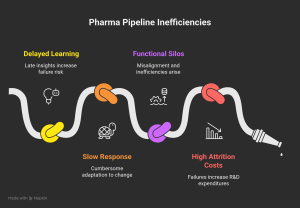
Conventional pharmaceutical development follows a waterfall model: discovery, preclinical studies, clinical phases, regulatory submission, approval, and commercialisation, executed largely in sequence. With average drug development timelines exceeding 10–12 years and costs surpassing USD 2 billion per approved molecule, the industry can no longer rely solely on rigid pipelines.
While this approach provides structure and control, it introduces several limitations:
- Delayed learning: Critical insights often emerge late in development, increasing the risk of late-stage failures.
- Slow response to change: Adapting to new regulatory guidance, emerging biomarkers, or competitive shifts can be cumbersome.
- Functional silos: Teams operate independently, leading to misalignment and inefficiencies.
- High attrition costs: Failures in Phase II or Phase III trials significantly increase R&D expenditures.
Where Agile Fits into Pharmaceutical R&D
Agile adoption in pharma is most visible in early-stage research, clinical development, and digital enablement, but its influence is expanding across the entire lifecycle.
In discovery and preclinical research, Agile supports rapid hypothesis testing, enabling scientists to pivot quickly based on emerging biological data. Pharma marketing strategies increasingly align with agile principles to iteratively test and refine approaches based on market and patient feedback.
Modular experimental designs, combined with AI-driven analytics, allow research teams to refine targets and mechanisms of action earlier in the process.
In clinical development, principles are increasingly applied through:
- Adaptive trial designs
- Seamless Phase I/II or II/III studies
- Decentralised and hybrid clinical trials
- Real-time data monitoring using digital endpoints
These approaches reduce patient burden, accelerate recruitment, and improve decision-making during trials, without compromising regulatory compliance.
Agile And Regulatory Affairs: A Cultural Shift
Regulatory functions have traditionally been viewed as incompatible with Agile due to strict documentation and compliance requirements. However, this perception is changing.
Modern regulatory agencies, including the FDA, EMA, and MHRA, now support adaptive pathways, rolling submissions, and real-time scientific advice. Agile regulatory teams work closely with clinical, CMC, and quality functions from the outset, enabling:
- Earlier alignment on regulatory strategy
- Continuous engagement with health authorities
- Faster incorporation of regulatory feedback
- Improved dossier quality through incremental updates
Rather than being a gatekeeper at the end of development, regulatory affairs becomes an integrated strategic partner throughout the lifecycle.

Manufacturing and Quality in an Agile Framework
Agile adoption in pharmaceutical manufacturing does not imply bypassing GMP or quality systems. Addressing HR challenges in pharma is essential to build cross-functional agile teams capable of delivering sustained transformation. Instead, it enhances operational responsiveness while maintaining compliance.
In manufacturing, Agile principles support:
- Modular and flexible production lines
- Rapid scale-up and tech transfer
- Continuous process verification (CPV)
- Real-time quality monitoring using PAT tools
When embedded within Agile teams, quality functions shift from reactive deviation management to proactive risk mitigation. Continuous feedback loops allow quality-by-design (QbD) principles to be implemented more effectively across development and manufacturing.
Digital Transformation as an Agile Enabler
Digital technologies are critical to making Agile viable in pharma. Advanced analytics, cloud-based platforms, and AI-driven decision support systems enable faster data interpretation and collaboration.
Key enablers include:
- Electronic lab notebooks and digital twins in R&D
- Clinical data lakes and real-world evidence platforms
- Automated regulatory publishing tools
- Smart manufacturing systems and digital quality management
Without digital maturity, Agile risks becoming superficial. Successful pharma organisations invest in both cultural change and technological infrastructure to sustain agility at scale.
Organisational and Cultural Challenges
Despite its benefits, Agile adoption in pharma faces significant barriers. Understanding pharmaceutical manufacturing processes is foundational to integrating agile methods with compliance obligations. Deeply entrenched hierarchies, risk-averse cultures, and functional silos can slow transformation.
Common challenges include:
- Resistance to decentralised decision-making
- Misalignment between Agile teams and traditional governance structures
- Limited Agile expertise beyond IT functions
- Concerns about compliance and inspection readiness
Leading organisations address these challenges through executive sponsorship, targeted training, and pilot programs that demonstrate measurable value before scaling.
420260123115124.svg)
Measuring Success in an Agile Pharma Model
Unlike traditional KPIs focused solely on milestones, Agile success is measured by learning velocity, decision quality, and patient impact.
Key indicators include:
- Reduced cycle times in development and submissions
- Improved probability of technical and regulatory success
- Faster response to regulatory or safety signals
- Enhanced cross-functional collaboration
Ultimately, Agile enables pharma companies to fail faster, learn earlier, and invest smarter, an essential capability in an era of increasing complexity.
The Future: From Pipelines to Innovation Networks
The pharmaceutical industry is transitioning from rigid pipelines to adaptive innovation ecosystems. Agile methodologies will increasingly underpin how pharma collaborates with CROs, CDMOs, technology providers, and academic partners.
As personalised medicine, cell and gene therapies, and digital therapeutics continue to evolve, the ability to adapt quickly will become a competitive necessity rather than a strategic choice. AI in pharma manufacturing accelerates adaptive innovation by enabling data-driven decisions across complex development and production workflows.
Agile is not a shortcut; it is a disciplined, patient-focused approach to innovation. For pharmaceutical companies willing to embrace cultural change while preserving scientific rigour, Agile offers a path toward faster, smarter, and more resilient drug development.
FAQs
1. What does Agile mean in the pharmaceutical industry?
Agile in pharma refers to adaptive, iterative ways of working that improve speed, collaboration, and decision-making while maintaining regulatory compliance.
2. Can Agile be used in regulated pharma environments?
Yes. Agile complements regulatory frameworks by enabling continuous feedback, early alignment, and data-driven compliance strategies.
3. How does Agile improve clinical development?
Agile supports adaptive trial designs, real-time data analysis, and faster responses to safety or efficacy signals.
4. Is Agile limited to pharma IT and digital teams?
No. Agile is increasingly applied across R&D, regulatory affairs, manufacturing, quality, and commercialisation.
5. What are the biggest challenges in adopting Agile in pharma?
Cultural resistance, siloed structures, and balancing agility with compliance are the primary challenges.
Reporting on the science, business and regulation shaping the pharmaceutical industry.
More in Leadership
All articles →
Essential Leadership Skills for Success in the Pharmaceutical Industry
Pharmaceutical Regulatory Affairs: Roles, Skills, and Roadmap

Discussion