Where Is The Money Going? Tracking Biotech AI Seed Funding In Cancer Research
AI cancer seed funding is surging despite a tighter market. Here's where the money flows, who backs it, and what the bets signal for pharma.

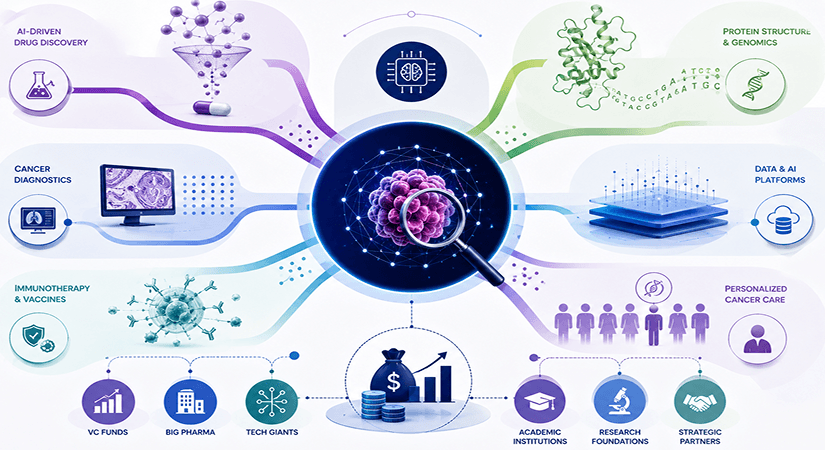
Cancer has always attracted serious attention in medicine — and today, it is also attracting some of the most serious money in technology. The convergence of artificial intelligence and cancer research has created an entirely new category of investment, sitting at the crossroads of biology, computing, and venture capital.
Biotech startups using AI to understand, detect, and treat cancer are raising seed funding at a pace and scale that would have seemed extraordinary just a decade ago. But the real question is not just how much money is flowing — it is where exactly that money is going, what problems it is trying to solve, and whether it is being placed in the right hands for the right reasons.
This article takes a clear-eyed look at the current state of AI-focused seed funding in cancer research. It traces where investors are placing their early bets, which scientific approaches are attracting the most capital, which companies are leading, and what the funding landscape signals about the future of cancer care.
The Scale Of The Bet Being Made
To understand where the money is going, it helps to first grasp how much is in play. In 2024 and 2025, seed and Series A fundraising in biotech accounted for billions in early-stage capital, even as the broader venture market tightened.
Overall early-stage rounds dropped from $10.6 billion in 2024 to $8.7 billion in 2025, reflecting investor caution and a preference for clinically validated assets but the AI-focused segment remained remarkably resilient.
The reason is simple: investors believe AI can fundamentally change the economics of drug discovery. Consider what the traditional model looks like without it:
- An average of 10 to 15 years from initial research to regulatory approval
- Development costs of upward of $2 billion per drug candidate
- A clinical failure rate of over 90% across all areas, with oncology among the highest
- Years spent on target identification and screening that AI can compress into months
AI offers the promise of shortening that timeline, cutting costs, and improving the odds of success. That promise keeps early-stage capital flowing even in a tighter market.
Although the broader biotech sector is near a twenty-year low for early-stage financing, the number of companies using AI for drug discovery is surging, with half of all investment dollars in diagnostic and tool companies now going to AI-enabled organizations.
Where The Seed Money Is Flowing: The Key Therapeutic Areas
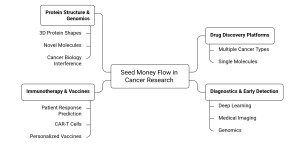
Not all cancer research is funded equally. Investors at the seed stage are placing calculated bets on specific scientific areas where AI can most dramatically accelerate progress. Understanding these areas reveals the strategic logic behind where early-stage capital is concentrated.
1) AI-Driven Drug Discovery Platforms
The largest share of seed funding is going to companies building AI platforms for molecule design and drug candidate identification. These are not companies working on a single drug — they are building infrastructure to discover many drugs across multiple cancer types. Isomorphic Labs, founded by scientists from Google DeepMind, closed a landmark $600 million seed round in Q1 2025, backed by Alphabet, with the mission of building fully automated AI-guided drug discovery laboratories.
Manas AI, co-founded by LinkedIn's Reid Hoffman and cancer historian Dr. Siddhartha Mukherjee, raised $24.6 million in seed funding to target breast cancer, prostate cancer, and lymphoma, with an explicit goal of reaching previously unreachable molecular targets. Bioptimus, a French startup, raised a $35 million seed round to build foundational AI models for biology.
2) Cancer Diagnostics And Early Detection
A significant stream of seed funding is also flowing into AI-powered diagnostics tools that detect cancer earlier, more accurately, and more affordably. Deep learning models trained on medical imaging, pathology slides, genomic sequences, and blood biomarkers are enabling detection capabilities that surpass traditional methods.
Companies in this space attract investor attention because early detection remains one of the most powerful levers in improving cancer survival rates. Sentinal4D, a UK-based startup, uses AI for cancer drug discovery and personalized tumor diagnosis at the single-cell level. PathAI, which applies deep learning to pathology slides, has raised over $255 million, including a strategic partnership with Quest Diagnostics.
3) Immunotherapy & Cancer Vaccines
Seed investors are also funding a new wave of AI-enhanced immunotherapy companies. The logic is compelling: immunotherapy has transformed cancer treatment, but its effectiveness remains inconsistent across patients. AI is being used to predict which patients will respond to which approaches, design more targeted cancer vaccines, and engineer smarter CAR-T and TIL (tumor-infiltrating lymphocyte) cell therapies.
Dispatch Bio debuted with $216 million in combined seed and Series A funding backed by Arch Venture Partners, the Parker Institute for Cancer Immunotherapy, Bristol Myers Squibb, and leading universities aiming to create a universal treatment for solid tumors. Evaxion, an AI-powered cancer vaccine company, raised $10.8 million in January 2025 to advance its personalized neoantigen vaccine programs.
4) Protein Structure & Genomics
AI's ability to predict protein structures, made famous by DeepMind's AlphaFold, has opened a new frontier in cancer drug discovery. Proteins are the molecular machinery of cancer biology, and understanding their three-dimensional shapes is critical to designing drugs that precisely interfere with cancer processes.
EvolutionaryScale, a San Francisco startup designing novel proteins using machine learning, raised an exceptional $142 million seed round in mid-2024, led by Lux Capital. DISCO Pharmaceuticals, based in Germany, raised a $21.75 million seed round to map the surfaceome of small cell lung cancer, a scientific foundation that could yield entirely new therapeutic targets.
Seed rounds name the bet. These 19 startups are already delivering on it.
Here's who is actually building the AI drug discovery infrastructure investors are backing.
→ Read: 19 Pharma Startups Shaping AI-Driven Drug Discovery
The Investors Driving Early-Stage AI Cancer Funding
The investor profile for AI cancer seed rounds is worth examining closely, because it reveals how the market is structured and who is shaping scientific priorities with their capital.
The key players currently active in this space include:
- ARCH Venture Partners — one of the most active deep science seed investors, with positions in Xaira Therapeutics and Dispatch Bio
- Andreessen Horowitz (a16z) — backing AI-native drug discovery platforms with a focus on computational biology
- Lux Capital — leading rounds in protein AI and genomics companies like EvolutionaryScale
- Parker Institute for Cancer Immunotherapy — a mission-driven investor focused specifically on immunotherapy breakthroughs
- Alphabet (Google) — through Isomorphic Labs, making one of the largest AI biotech seed bets in history
- Bristol Myers Squibb and other Big Pharma, increasingly co-investing at the seed stage to secure early access to breakthrough science
A distinguishing trend in this investor class is the insistence that a biotech startup have significant AI and computational expertise embedded in its founding team, not bolted on as an afterthought. Funds like Dimension and Lux Capital evaluate not just the therapeutic hypothesis but the depth of machine learning capability behind it.
What this investor mix ultimately reveals is that AI cancer seed funding is no longer the exclusive domain of traditional life science venture capital. Big Tech, corporate pharma, and mission-driven funds are all at the table, each bringing a different strategic lens and collectively driving round sizes to new heights.
The Risks Behind The Excitement
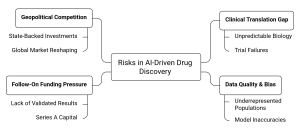
The funding enthusiasm is real, but so are the risks. Not every dollar invested in AI cancer seed companies will produce a working drug, a validated diagnostic, or a meaningful improvement in patient outcomes. The history of biotech is full of well-funded ideas that failed at the clinical stage, and AI does not immunize any company against biology's inherent complexity.
Several specific risk factors deserve attention:
- The clinical translation gap: An AI model that performs brilliantly in silico may still fail when predictions meet the unpredictability of human biology in a trial.
- Data quality and bias: AI systems are only as good as the data they are trained on. Cancer datasets that underrepresent certain populations can produce models that work well for some patients and poorly for others.
- Follow-on funding pressure: Startups that cannot show concrete biological results beyond impressive algorithms are finding it harder to raise the next round.
- Geopolitical competition: China committed $48.5 billion to biotech deals in just the first half of 2025, more than all of 2024 combined, reshaping the competitive landscape in ways Western seed investors cannot ignore.
The bifurcation this creates is stark: well-capitalized companies with institutional backing on one side, and underfunded newcomers struggling to bridge the gap between algorithm and clinic on the other.
Seed money flows on promise.
ROI is where the real story gets told.
Here's whether pharma's AI investment is actually paying off, and what the numbers say.
→ Read: Is Pharma's AI Investment Actually Paying Off? Here's What the Numbers Say
What The Funding Map Tells Us About The Future?
Taken together, the pattern of seed funding in AI cancer research tells a coherent story about where progress will come from in the next decade. The money is concentrated in areas where AI has a demonstrable edge: designing molecules faster, reading images more accurately, predicting patient response more reliably, and modeling protein behavior more precisely.
It is flowing to teams combining deep biological expertise with genuine computational capability, united by the belief that the old model of cancer drug development is ready to be disrupted. The medicines that will treat cancer in 2035 are likely being designed right now, in AI-powered laboratories funded by today's seed rounds.
Whether the science translates into better patient outcomes remains the most important question. But the money has found its direction, pointing squarely at the intersection of artificial intelligence and the oldest enemy in medicine.
FAQs
1) Why Is AI Attracting Significant Seed Funding In Cancer Research?
AI has the potential to accelerate drug discovery, improve cancer diagnostics, and reduce the time and cost associated with developing new therapies. Investors see AI as a tool that can help researchers identify promising drug candidates, analyze complex biological data, and improve decision-making throughout the development process. This potential for greater efficiency and innovation continues to attract strong interest from venture capital firms, pharmaceutical companies, and technology investors. As a result, AI-focused cancer startups remain a major area of investment despite broader market challenges.
2) Which Areas Of Cancer Research Are Receiving The Most AI-Driven Seed Funding?
A large portion of funding is being directed toward AI-powered drug discovery platforms, cancer diagnostics, immunotherapy development, cancer vaccines, and protein structure research. Investors are particularly interested in technologies that can accelerate molecule design, improve early detection, and identify new therapeutic targets. These areas offer opportunities to address some of the biggest challenges in oncology while potentially delivering meaningful clinical impact. Companies working at the intersection of biology, data science, and artificial intelligence are attracting significant attention.
3) What Risks Do Investors Consider When Funding AI Cancer Startups?
While AI offers exciting possibilities, investors recognize that strong algorithms alone do not guarantee successful medical outcomes. Challenges such as data quality, biological complexity, clinical validation, and regulatory requirements can affect the success of AI-driven programs. Startups must demonstrate that their computational predictions can translate into meaningful scientific and clinical results. Investors therefore look for teams that combine deep expertise in both life sciences and artificial intelligence to increase the likelihood of long-term success.
Reporting on the science, business and regulation shaping the pharmaceutical industry.
More in Leadership
All articles →
Essential Leadership Skills for Success in the Pharmaceutical Industry

Pharmaceutical Regulatory Affairs: Roles, Skills, and Roadmap

Discussion