Your Research Is Powerful. Is Anyone Listening?
Personal branding and communication skills now drive funding, hiring and career growth for scientists in pharma and biotech.


Science has never been more visible, or more misunderstood. Across pharma, biotech, and life sciences, researchers are publishing more, collaborating more, and competing harder for funding, jobs, and recognition than ever before. Yet most scientists graduate with no training in how to communicate their work to the people who matter most: peers, employers, investors, journalists, policymakers, and the public.
Personal branding is not about self-promotion. It is about ensuring that your expertise, values, and contributions are visible and understood by the right audience. For modern scientists, that is no longer optional.
The Landscape Has Changed, And Scientists Must Adapt
The traditional model of scientific credibility was simple: publish in high-impact journals, attend conferences, and let citations do the talking. That model still matters, but it is no longer enough.
Hiring managers now search LinkedIn before they read a CV. Grant committees Google investigators. Biotech investors review a PI's public profile before backing a platform. Patients and advocacy groups want to understand who is doing the research and why it matters. This is the new scientific environment, and it rewards those who can communicate, not just those who can compute.
A 2022 Nature survey found that early-career researchers who actively communicated their work on digital platforms reported stronger professional networks, more collaboration opportunities, and faster career progression than peers who relied solely on publications. The signal is clear.
What Personal Branding Actually Means for a Scientist
Personal branding is the deliberate process of shaping how others perceive your professional identity. For a scientist, this includes:
- Your area of expertise and the problems you are trying to solve
- Your values around research integrity, patient outcomes, or sustainability
- Your communication style, whether you simplify complex data, mentor others, or bridge disciplines
- Your track record: publications, patents, clinical outcomes, or regulatory approvals
It is not about performing a version of yourself. It is about ensuring your real expertise reaches the people who need it.
Why Communication Skills Are Now Equally Important
Strong communication is no longer a soft skill. In the pharma and life sciences industries, it is a professional requirement. Here is why it shows up in almost every critical career function:
Poor communication costs the pharmaceutical industry significant time and money. FDA 483 observations frequently cite unclear or incomplete documentation. Clinical site failures are often tied to protocol misunderstandings. These are not abstract problems; they have a direct impact on timelines and patient outcomes.
Communication isn't just career visibility.
In quality teams, it's also what determines whether deviations get reported honestly at all.
→ Read: Emotional Intelligence In Quality Management: The Most Important GMP Skill Nobody Talks About
Building Your Brand: A Practical Starting Point
Scientists often delay personal branding because they assume it requires constant content creation or a large following. It does not. A focused, consistent presence beats high volume every time.
Personal Branding Checklist for Scientists
- Define your niche: what specific problem do you work on, and for whom?
- Update your LinkedIn profile with a clear headline, summary, and recent work
- Write one post per month about something you learned, observed, or published
- Engage with peers: comment on papers, share findings, or summarise a conference
- Build a simple professional bio you can adapt for grant applications, conference listings, and institution websites
- Identify two or three platforms relevant to your audience (LinkedIn, ResearchGate, Twitter/X, or a lab blog)
- Ask a colleague to describe your work in one sentence , if they cannot, your messaging needs work
This does not require hours per week. Thirty minutes of intentional communication every week compounds significantly over a year.
The Science of Scientific Communication
Good scientific communication is not just about simplifying jargon.
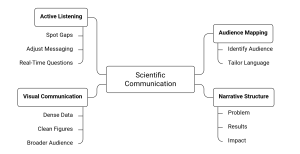
It involves several distinct skills that can be learned and practised:
Audience mapping means identifying who needs to understand your work and what they already know. A payer audience needs health economics framing. A patient community needs outcome language. A co-investigator needs methodology.
Narrative structure is the ability to organise information so it tells a clear story: what is the problem, what did you do, what did you find, and why does it matter? This structure works equally well in papers, presentations, grant applications, and LinkedIn posts.
Visual communication is increasingly important in an era of dense data. Researchers who can translate a complex dataset into a clean figure or infographic reach far more people than those who cannot.
Active listening is often overlooked. Strong scientific communicators ask better questions, pick up on what audiences do and do not understand, and adjust in real time.
Narrative structure and audience mapping aren't just LinkedIn skills. They're becoming a core strategic discipline across pharma.
→ Read: Scientific Communication: A Strategic Skill, Not A Soft One
The Long-Term Career Impact
Scientists who invest in personal branding and communication skills do not just get more likes on social media.
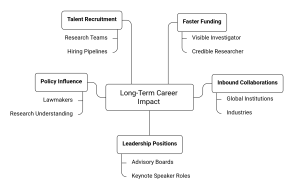
The professional returns are measurable:
- Faster funding cycles, because reviewers recognise credible, visible researchers
- More inbound collaboration requests from other institutions and industries
- Higher likelihood of being invited to advisory boards, editorial roles, and keynote positions
- Greater influence on policy, when policymakers can find and understand your work
- Stronger recruitment pipelines for those leading research teams
In an increasingly competitive research environment, the scientist who can explain their work clearly and build a trusted professional identity holds a meaningful advantage, not because they are louder, but because they are understood.
FAQs
1. Why do scientists need personal branding?
Personal branding helps scientists build visibility, attract collaborators, secure funding, and advance their careers by making their expertise accessible to the right audiences.
2. What communication skills are most important for researchers?
The most valuable skills are audience mapping, narrative structure, scientific writing, visual data communication, and the ability to simplify complex findings for non-specialist audiences.
3. How can a scientist build a personal brand without social media?
Through a strong institutional bio, published articles, conference presentations, a professional headshot and an updated profile on ResearchGate or LinkedIn and consistent clarity in all written outputs.
4. Does personal branding conflict with scientific objectivity?
No. Personal branding is about making your real expertise visible, not about overclaiming results. Scientific integrity remains the foundation of a credible professional identity.
5. How long does it take to build a recognisable scientific brand?
A consistent, focused effort over six to twelve months typically produces noticeable results in profile views, collaboration requests, and professional recognition.
Reporting on the science, business and regulation shaping the pharmaceutical industry.
More in Leadership
All articles →
Essential Leadership Skills for Success in the Pharmaceutical Industry
Pharmaceutical Regulatory Affairs: Roles, Skills, and Roadmap
Discussion