by Vaibhavi M.
9 minutes
From Checklists To Boardrooms: 7 Core Skills That Make a GMP Internal Auditor Truly Effective
GMP internal auditor skills: communication, planning, attention to detail, critical thinking, professional skepticism, empathy and integrity explained

In pharmaceutical manufacturing, Good Manufacturing Practice (GMP) compliance is not optional; it is the baseline that protects patient safety and product quality. Behind every robust GMP compliance program is a well-trained internal audit team, and at its centre is the GMP internal auditor.
Most people think of auditing as a technical job. You review batch records, inspect procedures, verify training logs, and check whether processes align with regulatory requirements from bodies like the FDA, EMA, WHO, or ICH. And yes, that technical knowledge matters. But if you speak to experienced GMP auditors, they will tell you something interesting: the technical knowledge gets you into the role, but it is the human skills that make you genuinely good at it.
This blog explores the seven skills every GMP internal auditor should actively develop and why each has a direct impact on audit quality, team relationships, and long-term career growth.
What Does It Take to Become a GMP Certified Auditor?
Before diving into the skills themselves, it helps to understand the baseline requirements for entering the field.
To become a GMP certified auditor, you typically need an educational background in a science, engineering, or life sciences discipline. Hands-on industry experience in pharmaceutical, biotech, or medical device manufacturing is equally important. You also need a solid working knowledge of the GMP regulations applicable to your specific sector and the markets where your organisation operates.
Formal certification from recognised bodies such as ASQ (American Society for Quality), RAPS (Regulatory Affairs Professionals Society), IRCA (International Register of Certificated Auditors), or SQA (Society of Quality Assurance) will demonstrate that you can plan, conduct, report, and follow up on GMP audits to an established standard.
But this is the part that many aspiring auditors underestimate: technical credentials alone do not make you an effective auditor. The professionals who stand out in this field are the ones who have also invested in developing a distinct set of interpersonal and professional skills. Let us look at each of those skills in detail.
1. Interpersonal and Communication Skills

If there is one skill that sits above all others in auditing, it is communication. In fact, a survey found that communication skills ranked among the top two qualities an auditor should possess for nearly 66% of respondents, almost on par with technical expertise.
The auditor's role is, at its core, a listening role. There is even an old principle sometimes called the "80/20 rule" that applies directly here: a good auditor should spend about 80% of their time listening and only 20% talking. It is no coincidence that the word "auditor" comes from the Latin words meaning "hearer" and "listener."
During an audit, you will interact with people across departments and at various seniority levels, from warehouse operators to quality managers to senior executives. Some of these people will have deep technical knowledge. Others may have no pharmaceutical background at all. Your job is to clearly explain the findings, observations, and recommendations to all of them. Poor communication does not just create misunderstandings; it erodes trust, which is the foundation of any effective audit relationship.
To build this skill, consider attending communication or active listening workshops, practising open-ended questioning during audit interviews, and paraphrasing what you have heard to confirm your understanding before concluding.
2. Planning, Multitasking, and Time Management
No audit happens without a plan. The moment an audit is scheduled, an experienced GMP auditor begins organising which processes will be reviewed, which documents need to be pulled, and how time will be allocated across the audit day or days.
In many pharmaceutical companies, especially smaller ones, the internal audit function is not a standalone role. Auditors often carry other quality responsibilities alongside their audit duties. This means managing multiple priorities at once, sometimes even conducting more than one audit program simultaneously.
GMP audits also operate within tight timelines. Regulatory inspection windows, annual audit schedules, and CAPA deadlines do not wait. An auditor who struggles with time management risks delivering incomplete findings, missing critical observations, or delaying corrective actions that the quality system depends on.
Practical habits that help include:
- Building a detailed audit plan well in advance of the audit date
- Setting clear deadlines for each phase of the audit (opening meeting, process review, document review, closing meeting)
- Prioritising high-risk processes early in the audit schedule
- Using audit management software or task management tools to stay organised
3. Attention to Detail
GMP auditing is, fundamentally, about examining every part of a process to determine whether it meets regulatory and internal requirements. That means reviewing batch records, filled-in forms, cleaning logs, equipment calibration data, training records, and standard operating procedures, often in large volumes and under time pressure.
A slight deviation from GMP requirements can carry serious consequences. A missed-out-of-specification entry in a batch record, an overlooked gap in a training log, or an undocumented equipment failure can be the difference between a well-controlled process and a regulatory observation. In more serious cases, overlooked non-conformances can lead to product recalls or warning letters from health authorities.
Attention to detail is not just about looking closely; it is about applying a systematic, consistent approach every time. Using audit checklists, following structured review processes, and taking short breaks during long audit sessions to maintain concentration are all practical ways to protect the quality of your observations. Fatigue is a real factor in audit accuracy, and good auditors account for it.
4. Critical Thinking
Spotting a non-conformance is only half the job. The other half is understanding what it means, what caused it, what risks it presents, and what a realistic and compliant corrective action looks like.
Critical thinking in GMP auditing means analysing data and processing information beyond what is directly in front of you. It means asking the right follow-up questions, connecting observations across different audit areas, and recognising patterns that indicate a systemic issue rather than a one-off event.
It also means making practical recommendations. An auditor who identifies a deviation and can only say "this needs to be fixed" is less valuable than one who can explain similar precedents, describe how other organisations have resolved comparable issues, and suggest a corrective pathway that is both compliant and operationally feasible.
Critical thinking also plays a direct role when reviewing CAPA closure reports. Evaluating whether a corrective action has genuinely addressed the root cause, and not just the symptom, requires the ability to visualise the process, examine the evidence provided, and ask probing questions to determine whether the problem is truly resolved.
To develop this skill, practice analysing complex quality data regularly, engage with other auditors to discuss case studies, and actively seek feedback from more experienced professionals on your audit reasoning.
Critical thinking about complex quality data requires systematic root cause analysis and effective CAPA management to turn findings into real improvements.
Learn how to write CAPA reports that satisfy auditors and prevent recurrence.
→ Read: How To Write a CAPA Report That Stands Up To Any Audit.
5. Professional Scepticism
Professional scepticism sits in an interesting position: it is not cynicism, nor is it blind trust. It is the disciplined habit of questioning evidence thoughtfully, even when everything appears to be in order.
In a GMP audit context, this means consistently asking yourself whether the data you are reviewing is accurate, whether the records have been completed in real time or retrospectively, and whether the processes you are observing represent everyday practice or a version prepared specifically for the audit.
A confident auditee and a well-organised audit room do not automatically mean compliance. An auditor with strong professional scepticism remains objective throughout the process, tests assumptions rather than accepting them, and follows up on inconsistencies even when they feel minor.
This skill also protects the integrity of the audit itself. Auditors who rely too heavily on what they are told, without independently verifying it against documentation and observation, risk missing the very issues that an audit is designed to find.
Building professional scepticism involves developing sound judgment, considering multiple interpretations of the same evidence, remaining open to information that contradicts your initial reading of a situation, and actively guarding against confirmation bias.
6. Empathy
This one often surprises people when they see it on a list of auditor skills. But empathy is genuinely one of the most practical qualities a GMP internal auditor can possess.
Being audited is stressful. Even in well-run organisations with strong quality cultures, the people being audited often feel anxious, defensive, or under scrutiny. An auditor who approaches the process with empathy, meaning a genuine effort to understand the auditee's perspective and pressures, creates a very different dynamic than one who approaches it as an inspector with a clipboard.
When auditees feel respected and heard, they are more likely to be transparent, share relevant information voluntarily, and engage constructively with findings. When they feel judged or pressured, they become guarded, which can limit the quality of information the auditor receives and ultimately affect the audit outcome.
Empathy in practice does not mean being soft on non-conformances or glossing over findings. It means acknowledging the complexity of the work people do, asking questions with genuine curiosity rather than implied accusation, and building enough trust that the audit becomes a collaborative quality exercise rather than an adversarial review.
7. Integrity
The final skill is also the most fundamental: personal and professional integrity.
A GMP internal auditor is entrusted with an independent view of how an organisation is performing against its regulatory and quality obligations. That independence only has value if the auditor protects it. There will be moments, more than people expect, when audit findings are inconvenient for management, when pressure is applied (directly or indirectly) to soften a report, or when the path of least resistance involves overlooking something that should be documented.
An auditor with strong integrity does not take that path. Their findings reflect what they actually observed, supported by evidence, regardless of how those findings land with leadership. This is not just an ethical position; it is a practical one. An auditor whose reports can be trusted is far more valuable to an organisation than one whose work raises questions about whether observations were appropriately recorded.
Integrity also extends to confidentiality, objectivity, and the consistent application of the same standards regardless of which department or individual is being audited.
How to Keep Developing These Skills Over Time
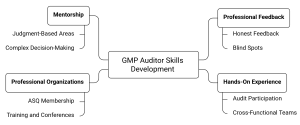
The good news is that none of these skills is fixed. They develop with practice, experience, and deliberate effort. Here are four approaches that consistently help GMP auditors grow:
Professional feedback: Ask colleagues and supervisors for honest, specific feedback after audits. Knowing where you have blind spots is the first step to addressing them.
Hands-on experience: The more audits you participate in across different processes and sites, the more quickly your pattern recognition and judgment develop. Volunteer for cross-functional audit teams where possible.
Professional organisations: Membership in bodies like ASQ, RAPS, or similar organisations gives you access to training, conferences, and peer communities where you can benchmark your skills and stay current with regulatory expectations.
Mentorship: A mentor with significant GMP audit experience can accelerate your development significantly, particularly in areas like professional scepticism and critical thinking, where judgment develops primarily through guided experience rather than coursework.
Great auditors don't just conduct audits—they build inspection-ready organizations. Understanding the complete audit process helps auditors improve their practice and leadership.
Explore comprehensive audit management best practices and how to develop your team's audit readiness culture.
→ Read: Audit Management Systems In Pharma | A Leadership Guide
Conclusion
A skilled GMP internal auditor brings together two distinct competency sets: the technical knowledge of GMP regulations, audit methodology, and quality systems, and the human skills that determine how effectively that knowledge is applied in the real world.
Communication, planning, attention to detail, critical thinking, professional scepticism, empathy, and integrity are not mere add-ons to a technical resume. They are the qualities that define whether an audit genuinely improves GMP compliance or simply satisfies a procedural requirement on a calendar.
These skills are developed over time. They grow through practice, reflection, and a commitment to doing the job well, not just doing it. For anyone working in or moving toward a GMP audit role, investing in these areas will deliver measurable returns for your organisation and for the patients who ultimately depend on the products your quality systems protect.
FAQs
Q1: What qualifications do you need to become a GMP internal auditor?
You typically need a background in life sciences, pharmacy, or engineering, along with direct industry experience in pharmaceutical or medical device manufacturing. Formal certification from organisations such as ASQ, RAPS, or IRCA is also recommended to validate your auditing knowledge and methodology.
Q2: What is the most important skill for a GMP auditor?
Communication is consistently ranked among the most critical skills. A GMP auditor must be able to clearly explain technical findings to audiences ranging from shop floor operators to senior executives, while also being an active, attentive listener during audit interviews.
Q3: How is professional scepticism different from being suspicious of auditees?
Professional scepticism is a disciplined, balanced approach; it means evaluating evidence objectively and asking probing questions without assuming wrongdoing. It is positioned between blind trust and outright doubt, and it helps auditors verify that what they are told is supported by actual documentation and observation.
Q4: Why does empathy matter in a GMP audit?
Empathy helps auditors build trust and rapport with auditees, thereby improving the quality of information gathered during the audit. When people feel respected rather than judged, they are more likely to be open and forthcoming, making the audit process more effective.
Q5: How can a GMP internal auditor improve their critical thinking skills?
Practical ways to build critical thinking include regularly reviewing complex quality data, discussing audit case studies with peers, seeking feedback from experienced auditors on your reasoning, and actively practising root cause analysis in your day-to-day quality work.