by Michael Bani
7 minutes
How Automated Employee Training Works in Regulated Industries And Why It Matters
How automated employee training works in pharma regulatory requirements, practical implementation steps and GxP audit readiness explained.

In regulated industries like pharmaceuticals, medical devices, and healthcare logistics, employee training is not a checkbox activity. It is a regulatory requirement woven into the fabric of how these organisations operate every single day. When your workforce handles life-saving products or processes, even a small training gap can lead to product failures, audit findings, or patient safety risks.
Yet, many companies still rely on manual training systems, spreadsheets, paper records, and email reminders to manage something this critical. That approach is not only inefficient; it leaves organisations exposed during inspections and audits.
Automating employee training is one of the most practical steps a regulated company can take to strengthen compliance, save time, and build a more capable workforce. This guide walks you through everything you need to know, from regulatory requirements to practical implementation tips.
Why Training Is Non-Negotiable in Regulated Environments
In GxP-regulated environments (which include GMP, GLP, GDP, and GCP), maintaining accurate training records is a legal obligation. Regulators expect companies to prove not just that training happened, but that it was effective, and that employees are genuinely competent in their roles.
Think about it this way: researchers, quality specialists, and manufacturing operators are constantly working with updated procedures, new safety protocols, and evolving compliance requirements. If the people doing the work are not properly trained on the latest standards, the integrity of your entire quality system is at risk.
This is why training management has become a central pillar of quality management in life sciences. Well-trained, up-to-date employees can be trusted to fulfil their responsibilities correctly, flag deviations early, and support a culture of quality rather than just ticking compliance boxes.
The Regulatory Framework: What the Rules Actually Require
Understanding the specific regulations governing training in your industry is the starting point for building a compliant training system.
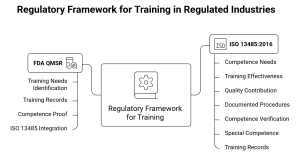
FDA QMSR (21 CFR Part 820)
In the United States, training requirements for medical device companies are governed by the FDA Quality Management System Regulation (QMSR), which took effect on February 2, 2026. Under this regulation, the FDA incorporates ISO 13485:2016 by reference, meaning companies must now satisfy ISO 13485's competence and training documentation requirements as part of their QMSR obligations.
In practical terms, regulators under QMSR expect organisations to:
- Identify the specific training needs for every role that affects product quality
- Keep training records that are controlled, complete, and retrievable
- Demonstrate that training has actually resulted in employee competence, especially for high-risk tasks
ISO 13485:2016
ISO 13485 is the international quality management standard specifically designed for medical device manufacturers. It places significant weight on employee competence and training. Here is what the standard specifically requires:
- Clause 6.2.2 – General Training Requirements: organisations must identify the competence required for each role that affects product quality, implement training to build that competence, and evaluate whether the training was effective.
- Clause 7.2 – Competence, Awareness, and Training: All personnel doing work that affects product quality must be competent based on their education, training, skills, and experience. Records of competence must be maintained.
- Clause 7.3 – Awareness: Employees must understand how their individual activities contribute to quality objectives and regulatory compliance.
- Clause 7.2.2 – Documented Training Procedures: organisations must have documented procedures for identifying training needs, delivering training, and evaluating its effectiveness.
- Clause 6.2.2 / 7.2.2 – Verification of Competence: It is not enough to deliver training; organisations must verify that the training has made employees competent in their tasks.
- Clause 6.2.2 – Special Competence: Certain roles, such as those involved in product design and development, require special competency verification beyond standard training programs.
- Clause 8.2.3 – Monitoring and Measurement: Companies must establish criteria for evaluating training effectiveness and monitor those criteria on an ongoing basis.
- Clause 4.2.4 / 7.2.2 – Training Records: Records of training, qualifications, skills, and experience must be maintained for all personnel involved in quality-affecting activities.
The depth of these requirements makes it clear that a manual or informal training approach will struggle to withstand regulatory scrutiny.
What Is an Automated Training Management System?
An automated training management system is a computerised platform that automatically assigns training to employees based on their specific job roles. Instead of a training manager manually tracking who needs what training and chasing people for completions, the system handles that entire process in the background.
These platforms typically offer:
- Role-based training assignment: The system maps training requirements to job roles, so when an employee is assigned a role, their required training curriculum is automatically generated.
- Real-time dashboards: Quality Assurance managers and training coordinators can see training completion status across the organisation at a glance, without pulling reports or chasing emails.
- Automated retraining reminders: When a standard operating procedure (SOP) is updated, or a periodic retraining interval arrives, the system automatically notifies the relevant employees.
- Assessment management: Quizzes, knowledge checks, and competency evaluations can be built into the training workflow, with results automatically recorded.
- Centralised document and training record storage: All training records are stored in a single location, enabling audit preparation to be significantly faster.
Your training system is only as strong as the QMS behind it.
Here is what ISO 13485 requires from pharma and medical device leaders.
→ Read: ISO 13485 Quality Management System | A Pharma Leaders Guide
The Real Benefits of Automating Employee Training
The value of an automated training system goes well beyond saving time on administrative tasks. Here is what it actually delivers in a regulated environment:
Better use of QA resources. Quality Assurance teams spend a disproportionate amount of time on training follow-ups, reminders, and chasing signatures. Automation removes that burden, freeing QA professionals to focus on building and improving the quality system itself.
Self-directed training visibility. Employees can log into the system, see their assigned training, and understand their own training gaps without needing a manager to tell them. This builds ownership and accountability.
24/7 access to training materials. Whether an employee works night shifts or is based in a different location, they can access the training they need at any time. This is especially important for global organisations or those with remote workers.
Audit readiness at all times. When an inspector asks for training records during an FDA or notified body audit, an automated system means you can pull those records immediately, complete, organised, and traceable. There is no scrambling through paper files or spreadsheets.
Scalability without added complexity. As your organisation grows, a manual training system becomes increasingly difficult to manage. An automated system scales with you; whether you add 10 employees or 1,000, the process stays the same.
Adaptability to organisational changes. Restructured departments, new job roles, updated SOPs, and an automated system can accommodate these changes quickly. Update the role or document, and the system redistributes the training accordingly.
Improved knowledge retention. Interactive content formats, such as quizzes, simulations, and scenario-based modules, keep employees more engaged with training content, which leads to better retention than passive document reading.
6 Practical Steps to Implement Automated Training in Your Organisation
Making the shift to automated training requires more than just choosing a software platform. It takes structured planning and internal alignment. Here is how to approach it.
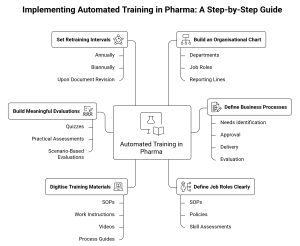
1. Build a Clear Organisational Chart
Before any automated system can assign training correctly, it needs to understand your organisational structure. Create and maintain an up-to-date organisational chart that shows all departments, job roles, and reporting lines. This gives the system, and the training managers behind it, a clear picture of who needs what.
2. Define Your Business Processes Around Training
Map out how training currently works in your organisation: how training needs are identified, how they are approved, how content is delivered, and how effectiveness is measured. Documenting this before implementation helps ensure the automated system is built to match your actual workflows, not just a generic template.
3. Define Job Roles Clearly
Job role clarity is the backbone of role-based training assignments. Each role should have a defined training curriculum tied to it, as well as the SOPs, policies, and skill assessments relevant to that function. The more precisely you define roles, the more targeted and relevant the training will be for each employee.
4. Digitise All Training Materials
Gather existing training content, SOPs, work instructions, training videos, process guides, and digitise them into formats that can be hosted within your training management system. A centralised, digital training library ensures all employees have access to the same, most current version of every document.
5. Build Meaningful Training Evaluations
A training record showing that an employee "completed" a module is not enough on its own. You need assessments that actually test whether the employee understood the material. Design quizzes, practical assessments, or scenario-based evaluations for each training module. The automated system can capture results, flag failures, and trigger retraining when needed.
6. Set Retraining Intervals
Regulated industries require periodic retraining, especially when procedures are updated or when job roles evolve. Define retraining intervals for each training item, whether that is annually, biannually, or upon every document revision. The system then automatically manages scheduling and notifications, so nothing slips through the cracks.
Conclusion
In regulated industries, the stakes of poorly managed training are too high to rely on manual processes. Regulatory bodies like the FDA and standards like ISO 13485 are explicit: organisations must not only train their people, but prove that training has led to real competence. That requires a system built for transparency, traceability, and scale.
Automated training management delivers all of that. It gives your quality team time back, keeps your workforce current, and ensures you are always audit-ready, not just in the week before an inspection, but every single day.
If your organisation is still managing training through spreadsheets and email chains, now is the time to make the shift. The regulatory landscape is only getting more demanding, and the companies that invest in structured, automated training systems will be better positioned to meet those demands with confidence.
Automated training keeps your workforce competent. But compliance alone is not enough.
Here is why pharma organizations must go beyond audit readiness to build real quality.
→ Read: Compliance Vs Quality | Why Pharma Must Go Beyond Audits
FAQs
Q1. What is automated employee training in regulated industries?
Automated employee training in regulated industries refers to using software to automatically assign, deliver, track, and record employee training based on job roles, eliminating the need for manual follow-ups and ensuring ongoing compliance with regulations such as FDA QMSR and ISO 13485.
Q2. Why is training automation important in GxP environments?
In GxP environments, training records are required by regulation. Automated systems ensure training is assigned correctly, completed on time, and documented accurately, which is critical during FDA audits or notified body inspections.
Q3. What regulations require employee training documentation in pharma?
Key regulations include the FDA Quality Management System Regulation (21 CFR Part 820 / QMSR), ISO 13485:2016, and various GxP guidelines (GMP, GLP, GDP). All require organisations to maintain evidence of employee competence and training effectiveness.
Q4. How does role-based training assignment work in a training management system?
In a role-based training system, each job role is linked to a specific training curriculum. When an employee is assigned to that role, the system automatically generates and assigns all required training modules without manual input from a training manager.
Q5. How does automated training help during regulatory audits?
Automated training systems store all records centrally and in real time. During an audit, quality teams can instantly retrieve training completion records, assessment results, and retraining histories, reducing audit preparation time and minimising compliance risk..
.webp&w=256&q=75&dpl=dpl_2PE5h6SQim3wTUG2seKJD6HJ9hx3)