How Schedule M Expects Pharma Companies to Handle Complaints and Adverse Reactions
How Schedule M 2023 Section 6 defines complaint handling, ADR reporting and pharmacovigilance obligations for pharma manufacturers.


Every pharmaceutical company, no matter how well it runs its operations, will receive a complaint at some point. A patient reports an unexpected side effect. A retailer notices something strange inside a syrup bottle. A doctor calls about a tablet that crumbled on the blister. These situations are not just customer service issues; they are quality and safety signals that the law requires you to act on.
Section 6 of Schedule M lays down a clear, structured set of rules for handling complaints and adverse drug reactions (ADRs) in licensed pharmaceutical manufacturing facilities in India. It covers everything from logging the first complaint to notifying the licensing authority when something serious is found. It also makes a pharmacovigilance system mandatory for every licensee.
Understanding these requirements is not just about regulatory compliance. It is about building a system that protects patients and helps your facility continue to improve. This blog breaks down the key requirements, the investigation process, and what your team needs to do to stay fully compliant.
What Section 6 of Schedule M Actually Covers
Section 6 contains 11 specific requirements, numbered 6.1 to 6.11, that together form a complete framework for handling complaints and adverse drug reactions. These requirements cover:
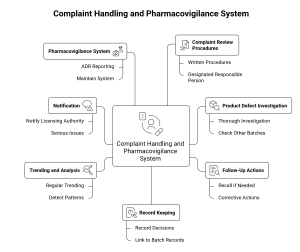
- Written procedures for reviewing complaints
- Having a designated responsible person
- Investigating product defects thoroughly
- Checking other batches when a defect is found
- Taking follow-up action, including product recall when needed
- Recording all decisions and linking them to batch records
- Regular trending of complaints to detect patterns
- Notifying the licensing authority of serious quality problems
- Maintaining a pharmacovigilance system for ADR reporting
The first requirement, Section 6.1, sets the tone for everything else. It states that all complaints and any information about potentially defective products must be carefully reviewed in accordance with written procedures, and that corrective action must be taken. This is not optional. If you do not have a written procedure in place, you are already non-compliant.
Section 6 is just one part of a much larger regulatory overhaul.
Here is everything Indian pharma manufacturers need to know about Schedule M 2023.
→ Read: India's New GMP Rules Are Here: Everything You Need To Know About Schedule M 2023
Types of Complaints That Fall Under Section 6
Not every complaint looks the same. Schedule M covers four main types:
Quality complaints cover visible defects, contamination, packaging failures, and out-of-specification test results. These are the most common types and often trigger laboratory investigations.
Efficacy complaints come in when a patient or healthcare professional reports that the product did not produce the expected therapeutic effect. These can point to potency or formulation issues.
Safety complaints involve unexpected side effects or adverse reactions. These are closely linked to the pharmacovigilance obligation under Section 6.11.
Regulatory and labelling complaints include incorrect labelling, the wrong product in a pack, or even suspicion of counterfeiting. These can escalate quickly into serious regulatory events.
Each type carries a different urgency level and investigation pathway. Knowing which type you are dealing with from the start helps your team move faster and make better decisions.
The Six-Step Complaint Investigation Process
Section 6 does not just say "investigate complaints"; it requires a structured, documented process whenever a complaint about a possible product defect is received. Here is how that process works in practice:
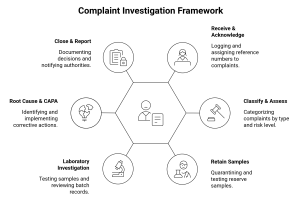
Step 1: Receive and Acknowledge - Log every detail when the complaint comes in: the complainant's name, date received, product name, batch number, nature of the complaint, and whether a sample is available. Assign a complaint reference number and acknowledge receipt to the person who reported it.
Step 2: Initial Assessment and Classification - Classify the complaint by type (quality, safety, efficacy, labelling) and by risk level. Urgent complaints, especially those involving a potential patient safety risk, need to be escalated immediately. At this stage, you also need to decide whether a product recall might be needed.
Step 3: Retain Reference and Reserve Samples - Retrieve the reserve sample of the implicated batch. Request the complaint sample from the complainant. If the defect is confirmed or strongly suspected, quarantine the batch right away.
Step 4: Full Laboratory Investigation - Test both the complaint sample and the reserve sample. Compare the results. Review the batch manufacturing record, in-process data, and any other relevant records. Check whether other batches from the same production run are also affected, as required by Section 6.6.
Step 5: Root Cause Analysis and CAPA - Identify the most likely cause of the defect using tools such as the 5 Whys analysis or a fishbone (Ishikawa) diagram. Implement a corrective and preventive action (CAPA) plan, monitor its effectiveness, and reference all findings to the relevant batch records, as required by Section 6.8.
Step 6: Close and Report - Document all decisions and measures taken. If required, notify the licensing authority in accordance with Section 6.10. Update the complaint register so that the data feeds into your trending process.
Complaint Classification - How Urgency Is Determined
One of the most important things your team needs to decide early in the process is how serious the complaint is. Section 6 expects complaints to be classified by risk, and that classification drives your response timeline.
Class I - Critical: These complaints involve a serious and immediate risk to patient health. Examples include contamination with pathogens or toxic substances, a wrong product found in a pack, sterility failure in an injectable, or suspicion of counterfeiting. The expected response is to initiate a recall within 24 to 48 hours and notify the licensing authority immediately.
Class II - Major: These are complaints where harm is possible but not necessarily immediate. Sub-potent or super-potent product, significant physical contamination such as foreign particles), or significant degradation of the active ingredient fall into this category. The team should evaluate a recall within 48 to 72 hours and notify the authority if one is initiated.
Class III - Minor: These involve issues that are unlikely to cause patient harm, cosmetic tablet defects, minor colour variation, or packaging issues that do not affect product integrity or identity. Standard investigation within 7 to 14 days is expected, and a recall is unlikely but still needs to be assessed.
Having these categories defined in your written procedures before a complaint arrives means your team does not waste time deciding what to do when under pressure.
The Batch Family Check, Section 6.6
One requirement that is sometimes overlooked is Section 6.6. When a defect is identified or even just suspected in one batch, you are required to check whether other batches, including any batches that used reprocessed material from the defective batch, are also affected.
This is not a judgment call. It is mandatory. In practice, your procedure should include a trigger checklist: as soon as a defect is confirmed, automatically initiate a batch family review covering all batches from the same process run or equipment campaign.
The real-world example from the training material illustrates this well. In a recurring broken tablet scenario involving Metformin 500mg across three batches, trend data revealed that the compression force had dropped below specification after a cam track was replaced with a non-original equipment manufacturer (non-OEM) part. This change had bypassed the Change Control process. All three batches were recalled. Without the batch family check, only one batch might have been caught.
Complaint Trending, Section 6.9
Having a complaint register is not enough. Section 6.9 requires regular review of complaint records to detect specific or recurring problems that may justify a recall of marketed products.
In practice, this means:
- Monthly trending for active products as a minimum
- Quarterly review by QA management
- Pre-defined alert thresholds, for example, three or more similar complaints within 30 days, or any single Class I complaint, that automatically trigger an escalation
- Annual complaint data included in the Annual Product Quality Review (APQR)
Your complaint data should be linked to batch records, the deviation register, the CAPA register, stability data, and process monitoring data. Trending should be a cross-functional activity involving QA, QC, Production, and Regulatory teams. And the output, the trend review report, must be formally signed, reviewed, and acted upon.
When this system works as it should, it catches systemic problems before individual complaints escalate into a product recall.
Complaint data feeds directly into your Annual Product Quality Review.
Here is how QRM and product quality reviews are structured under Schedule M 2023.
→ Read: QRM And Product Quality Review Under Schedule M 2023: A Complete Guide
When to Notify the Licensing Authority, Section 6.10
Section 6.10 makes authority notification mandatory, not optional, in specific situations. You must inform the licensing authority when you are considering any action due to:
- Faulty manufacture that has been identified or is suspected
- Product deterioration found in stability or market samples
- Doubt about the purity, potency, or identity of a marketed product
- Any other serious quality problem in the market
Importantly, you should notify the authority before initiating a voluntary recall, not after. This is often misunderstood. The notification is not a post-recall formality; it is a step that must occur as part of the decision-making process.
Section 6.8 also requires that the decision not to recall be documented with a clear justification. Not every complaint will result in a recall, but the reasoning behind every decision must be on record.
Pharmacovigilance - Section 6.11
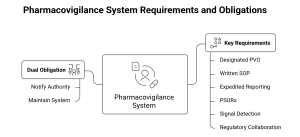
Section 6.11 introduces a requirement that goes beyond complaint handling: every licensee must have a functioning pharmacovigilance system to collect, process, and forward adverse drug reaction reports to the licensing authorities.
This is a distinct and separate obligation from the complaint handling process, even though the two are closely related. Here is what the system needs to cover:
- A designated Pharmacovigilance Officer (PVO) who is responsible for the system
- A written SOP for ADR collection and reporting
- Expedited reporting of serious, unexpected ADRs to CDSCO within 15 calendar days
- Preparation and submission of Periodic Safety Update Reports (PSURs)
- A signal detection process to identify patterns in ADR data over time
- Collaboration with the regulatory authority's pharmacovigilance programme
Sections 6.10 and 6.11 together create what the training material describes as a dual obligation: you must notify the licensing authority of serious quality problems AND maintain an active pharmacovigilance system. One does not replace the other.
A useful example: if three patients report severe skin rash after taking an oral antibiotic, and the product is confirmed genuine and within specification, the complaint may not result in a recall, but the ADR still needs to be assessed, documented, and reported through the pharmacovigilance system. The PSUR has been updated, the signal assessment completed, and the pharmacovigilance obligation fulfilled, even though no product defect was found.
Common Gaps That Lead to Non-Compliance
Inspections and internal audits frequently flag the same issues in complaint handling systems. Being aware of them helps you avoid them.
Closing complaints without confirming product quality. Section 6.4 requires that every investigation reach a definitive conclusion on whether the product was actually defective. Writing "patient error" or "user mishandling" without testing the complaint sample and reserve sample is not acceptable.
Failing to check other batches. Section 6.6 is a mandatory step, not a discretionary one. Your SOP should make the batch family review automatic whenever a defect is confirmed.
Not linking complaint records to batch records. Section 6.8 requires every decision to be cross-referenced to the corresponding batch manufacturing record. If your complaint management system does not do this automatically, it needs to be done manually and verified.
Having no pharmacovigilance system or an untrained PVO. Section 6.11 requires an active, functioning system, not just a document that says one exists. The PVO must be trained, ADR SOPs must be current, and the system should be tested with mock exercises at least annually.
Trending only once a year. Monthly trending is the minimum expected in practice. Annual-only trending means you are likely to miss emerging signals until they become serious enough to trigger a recall.
Conclusion
Section 6 of Schedule M is among the most comprehensive sections of the revised GMP guidelines. It does not just tell you to handle complaints, it tells you exactly how: who should be responsible, what steps to follow, when to notify the authority, and what kind of system you need for adverse drug reactions.
For pharmaceutical manufacturers in India, building a robust complaint and pharmacovigilance system is not a one-time compliance exercise. It is an ongoing process that directly affects product quality, patient safety, and your ability to maintain a manufacturing licence. The companies that treat every complaint as an opportunity to improve are the ones that stay ahead of their regulatory obligations and protect the patients who depend on their products.
FAQs
1. What is the difference between a quality complaint and an adverse drug reaction under Schedule M?
A quality complaint relates to a problem with the physical product, defects, contamination, labelling errors, or out-of-specification results. An adverse drug reaction (ADR) is an unintended, harmful response to a medicine taken at the normal dose. Both require investigation, but ADRs are specifically handled through the pharmacovigilance system under Section 6.11.
2. Is it mandatory to recall a product every time a complaint is received?
No. Not every complaint results in a recall. The decision depends on the nature and severity of the defect, how many batches are affected batches, and the risk to patients. However, every complaint must be investigated, and the decision on whether to recall must be documented with a clear justification.
3. Who is responsible for handling complaints under Schedule M?
Section 6.2 requires the appointment of a designated responsible person with sufficient supporting staff for complaint management. The Authorised Person must also be made aware of all complaints. For adverse drug reactions, a designated Pharmacovigilance Officer (PVO) is required under Section 6.11.
4. When must the licensing authority be notified about a complaint?
Section 6.10 requires notification when a manufacturer is considering action due to faulty manufacture, product deterioration, suspect product, or any other serious quality problem. This notification should happen before initiating a voluntary recall, not after.
5. What is the timeline for reporting a serious unexpected ADR to CDSCO?
Under Section 6.11 and applicable pharmacovigilance guidelines, serious and unexpected adverse drug reactions must be reported to CDSCO within 15 calendar days of the company becoming aware of the event. This is called an expedited report.
Reporting on the science, business and regulation shaping the pharmaceutical industry.
More in Regulatory Intelligence
All articles →
The Pattern Behind FDA Warning Letters: What Startups & CDMOs Often Miss

ISO 14644 Cleanroom Classes for Pharma (with EM Implications)

Discussion