India's New GMP Rules Are Here: Everything You Need to Know About Schedule M 2023
Schedule M 2023 aligns India's pharma GMP with global standards. Learn key changes in data integrity, validation, and compliance.


If you work in pharmaceutical manufacturing in India, Schedule M 2023 is not something you can afford to ignore. It is the most significant overhaul of Good Manufacturing Practice (GMP) regulations in the country in decades, and it changes how manufacturers are expected to design facilities, validate processes, manage data, and handle quality systems.
This blog breaks down what has changed, why it matters, and what pharmaceutical companies need to do to stay compliant.
What Is Schedule M and Why Was It Updated?
Schedule M is part of the Drugs and Cosmetics Act, 1940. It lays down the minimum requirements for premises, plant, equipment, and standards for the manufacture of drugs in India. For many years, the previous version of Schedule M served as the baseline for Indian GMP, but the global regulatory landscape had moved on significantly.
Regulatory bodies like the European Medicines Agency (EMA) and the US Food and Drug Administration (FDA) had updated their GMP expectations to reflect modern science, technology, and risk management principles. Indian manufacturers exporting to global markets were often expected to comply with these international standards, but the domestic regulations hadn't kept pace.
The revised Schedule M (2023) fixes this gap. It brings Indian GMP requirements in line with international benchmarks , most notably the EU GMP Annex 1 (2022) for sterile products , while also addressing the realities of modern manufacturing environments.
General Requirements: What's New at the Foundation Level
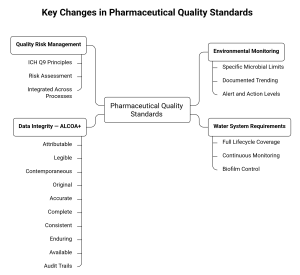
The first section of Schedule M 2023 sets the tone for everything that follows. Several requirements that were either vague or absent in the previous version are now clearly defined.
Environmental Monitoring has gone from a basic requirement to a comprehensive program. Manufacturers must now have specific microbial limits, documented trending, and alert and action levels for their manufacturing environments. A once-in-a-while check is no longer enough.
Water System Requirements have expanded significantly. Where the earlier version simply mentioned purified water specifications, the new Schedule M covers the full lifecycle, water generation, storage, distribution, and continuous monitoring. There is now a specific focus on biofilm control, which was previously not addressed at all.
Data Integrity is perhaps the area with the most dramatic change. The old Schedule M briefly mentioned electronic records. The 2023 version mandates full compliance with ALCOA+ principles:
- Attributable
- Legible
- Contemporaneous
- Original
- Accurate
- Complete
- Consistent
- Enduring
- Available
This means audit trails for all critical data, unique user access controls, electronic signatures compliant with 21 CFR Part 11, data backup and recovery procedures, and periodic system validation reviews.
Quality Risk Management (QRM) is now integrated throughout the entire document, with ICH Q9 principles mandated. Risk assessment is no longer an optional exercise; it is the foundation for decision-making across all processes.
Premises and Infrastructure: Detailed Requirements Replace Basic Guidelines
The previous version of Schedule M gave manufacturers considerable flexibility in facility design. The 2023 version has replaced that flexibility with specificity.
Where the old standard called for basic building requirements and general ventilation, the new Schedule M defines:
- Pressure cascade requirements between manufacturing areas
- Airlock and pass-through specifications
- HEPA filter specifications and placement
- Air change rate requirements for different zones
- Detailed cleanroom classification criteria
This level of detail reflects how modern pharmaceutical facilities are expected to operate and aligns India with how global inspectors evaluate premises.
Sterile Products (Part I-A): The Most Technically Demanding Changes
For manufacturers of sterile products, Schedule M 2023 represents a major shift. The updates in this section draw heavily from EU GMP Annex 1 (2022) and introduce several new mandatory requirements.
Cleanroom Classification and Environmental Monitoring now require continuous monitoring for Grade A environments and real-time monitoring. Particle limits have been updated to match current international standards.
Contamination Control Strategy (CCS) is a new, mandatory requirement. Every sterile manufacturer must prepare a documented CCS that covers all potential sources of contamination , people, environment, equipment, and materials. This was not required under the previous version.
Media Fill Validation has also changed. The old rule was simple: twice a year, with a minimum of 3,000 units. The new requirement is risk-based. Frequency is determined by risk assessment, requirements for interventions are more detailed, and the minimum number of units is based on actual daily production volume.
Isolator and RABS Technology now has its own dedicated requirements. Previously, isolators were mentioned briefly. Now the standard includes:
- Detailed design and qualification specifications for isolators
- A distinction between active and passive RABS, each with its own requirements
- Validated bio-decontamination processes using hydrogen peroxide or other sporicidal agents
- A documented glove integrity testing program, including pressure decay tests and defined replacement criteria
- Validated transfer processes with defined worst-case scenarios
Oral Solid Dosage Forms (Part I-B): Operational Changes on the Floor
For OSD manufacturers, the changes are more operational but no less significant.
Dust Control and containment are now mandatory for all powder handling operations. Enclosed systems are specifically required for potent and highly sensitising drugs such as beta-lactams, hormones, and cytotoxic compounds. Occupational Exposure Limit (OEL) monitoring has also been added as a formal requirement.
Compression and Coating Operations must now include in-process controls at a minimum frequency of every 30 minutes. Statistical Process Control (SPC) is encouraged for monitoring weight variation. For coating solutions, there are enhanced microbial control requirements.
Validation for OSD now follows a lifecycle approach with three stages:
- Stage 1 - Process Design
- Stage 2 - Process Qualification
- Stage 3 - Continued Process Verification
Blend uniformity studies must follow enhanced sampling protocols, and cleaning validation must use health-based limits rather than arbitrary residue limits.
Validation and Qualification: A Lifecycle Approach Replaces Snapshot Thinking
The change in validation philosophy is one of the most important shifts in Schedule M 2023. The old approach was essentially a snapshot: run three consecutive batches and you're done. The new approach treats validation as a continuous activity
Quality Control Laboratories: Modernised Testing Environments
The QC lab requirements have also seen meaningful upgrades. The previous version requested basic segregation between chemical and microbiology labs. Schedule M 2023 requires:
- Dedicated instrument rooms with environmental control
- Separate BSL-2 facilities for microbiology
- HEPA-filtered laminar flow for sterility testing
Stability Studies must now follow ICH Q1A through Q1F protocols, include photostability testing per ICH Q1B, and container-closure integrity testing is now mandatory.
For Reference Standards, manufacturers must define requalification intervals, document qualification and characterization of working standards, and maintain proper Certificate of Analysis documentation.
Understanding validation theory is one thing knowing how to execute it under Schedule M 2023 is another.
Here is your complete implementation guide for qualification and validation.
→ Read: Qualification & Validation Under Schedule M 2023: A Complete Implementation Guide
Water Systems: From Basic Specs to Full Lifecycle Management
Water systems get one of the most comprehensive upgrades in the entire document. A few of the key changes:
- Purified water now requires endotoxin limits (<0.25 EU/ml) and TOC monitoring in addition to the existing 100 cfu/ml microbial limit.
- WFI can now be generated using alternative technologies (RO + Ultrafiltration + EDI) if validated to meet European Pharmacopoeia 10.0 requirements , distillation is no longer the only accepted method.
- Storage and distribution must be either hot (>70°C) or cold (<15°C) with frequent use and sanitization. Circulation is mandatory.
- Biofilm control, which was previously not mentioned, now requires periodic thermal or chemical sanitization, passivation after modifications, and an active biofilm monitoring program.
- Microbiological monitoring at use points must be done daily, with continuous conductivity and TOC monitoring, along with trending and alert/action limits.
Personnel and Training: Competency Is Now Documented and Verified
The personnel requirements in Schedule M 2023 go well beyond the basic GMP training that was required before. Every role in the facility must now have:
- Documented qualification requirements
- Competency assessment before independent operation
- Annual competency requalification
- A job description with detailed responsibilities
Training programs must now cover GMP principles and hygiene, contamination control, data integrity, quality risk management, role-specific SOPs, and equipment operation. Annual medical examinations are required for all personnel, with specific health monitoring for those working with potent compounds.
Training programs don't just check a compliance box they turn regulatory requirements into daily practice.
Here is why GMP training is critical for pharmaceutical manufacturing success.
→ Read: Why GMP Training Is Critical For Pharmaceutical Manufacturing Success
Supplier Qualification, CAPA, and Change Control: Formal Systems Are Now Non-Negotiable
Three areas that were relatively informal under the old Schedule M are now formalised with specific requirements.
Supplier Qualification now requires risk-based categorisation of suppliers into critical, major, and minor categories. Audits are mandatory for critical material suppliers (APIs, excipients, primary packaging), and quality agreements must be documented.
CAPA System requirements now mandate root cause analysis tools such as 5-Why, Fishbone, and Failure Mode Analysis. CAPA effectiveness checks are required, and deviations, complaints, and OOS results must be trended. Cross-functional investigation teams are now the expected standard.
Change Control must include formal risk and impact assessments before any change is implemented. A Change Control Board must provide approval, and post-implementation reviews are required.
Annual Product Quality Review (APQR): A Brand New Mandatory Requirement
One of the most notable additions to Schedule M 2023 is the Annual Product Quality Review, which was completely absent in the previous version. Every product must now go through an annual review that covers:
- Starting materials and new suppliers
- Critical in-process controls and finished product results
- Batches that failed to meet specifications
- Critical deviations and related investigations
- Changes to processes or analytical methods
- Stability results and adverse trends
- Quality-related returns, complaints, and recalls
- Adequacy of corrective actions
- Process performance and product quality monitoring
The APQR must result in documented outcomes, identification of improvement opportunities, revalidation needs, and recommended changes to specifications or processes.
What Should Manufacturers Do Now?
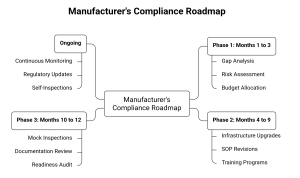
Phase 1 (Months 1–3): Conduct a thorough gap analysis, complete a risk assessment against the new requirements, prepare a master compliance plan, and allocate budget.
Phase 2 (Months 4–9): Execute infrastructure upgrades, carry out system validations, revise all affected SOPs, and run comprehensive training programs.
Phase 3 (Months 10–12): Conduct mock inspections, carry out final verification activities, complete a documentation review, and perform a readiness audit.
Ongoing: Maintain continuous monitoring, conduct annual APQRs, stay updated on regulatory developments, track performance metrics, and carry out regular self-inspections.
Conclusion
Schedule M 2023 is not just a regulatory update; it is a shift in how Indian pharmaceutical manufacturing is expected to think and operate. The new standard demands a risk-based, science-driven, and continuously improving quality culture. Companies that treat it as a checklist exercise will struggle. Companies that genuinely embed these principles into their operations will be better positioned for both domestic compliance and global market access.
The investment in people, systems, and infrastructure required to meet Schedule M 2023 is significant. But it is also an investment in the long-term credibility and competitiveness of Indian pharmaceutical manufacturing.
Frequently Asked Questions
1. What is the main purpose of Schedule M 2023?
Schedule M 2023 is a comprehensive update to India's Good Manufacturing Practice (GMP) regulations for pharmaceutical manufacturers. It aligns with Indian standards and international benchmarks, such as EU GMP Annex 1 (2022) and ICH guidelines, with a focus on contamination control, data integrity, and risk-based quality management.
2. What is a Contamination Control Strategy (CCS) under Schedule M 2023?
A CCS is a new mandatory documented requirement for sterile product manufacturers. It must address all potential contamination sources, including personnel, environment, equipment, and materials, and describe the controls in place to manage each source.
3. What are the new data integrity requirements in Schedule M 2023?
Manufacturers must follow ALCOA+ principles (Attributable, Legible, Contemporaneous, Original, Accurate, Complete, Consistent, Enduring, Available). This includes audit trails for critical data, unique user access controls, compliance with electronic signature requirements, data backup procedures, and periodic system reviews.
4. Is the Annual Product Quality Review (APQR) mandatory under Schedule M 2023?
Yes. The APQR is a completely new mandatory requirement in Schedule M 2023. Every product must undergo an annual quality review covering batch results, deviations, stability data, complaints, change history, and corrective actions.
5. How has process validation changed under Schedule M 2023?
Process validation now follows a lifecycle approach with three stages: Stage 1 (Process Design), Stage 2 (Process Qualification), and Stage 3 (Continued Process Verification). This replaces the previous requirement of simply completing three consecutive validation batches.
Reporting on the science, business and regulation shaping the pharmaceutical industry.
More in Regulatory Intelligence
All articles →
The Pattern Behind FDA Warning Letters: What Startups & CDMOs Often Miss

ISO 14644 Cleanroom Classes for Pharma (with EM Implications)

Discussion