Why GMP Training Is the Backbone of Every Pharmaceutical Manufacturing Facility
Why GMP training is critical in pharma manufacturing Schedule M 2023 principles, records, and compliance explained.


Walk into any pharmaceutical manufacturing plant, and you will find people in gowns, gloves, and hairnets following written procedures to the letter. You will see records being filled in real time, equipment cleaned on schedule, and deviations being investigated before a batch moves forward. None of this happens by accident. It happens because of one thing: Good Manufacturing Practices (GMP) training.
GMP training is not a one-time onboarding formality. It is an ongoing process that equips every person in a manufacturing facility, from a junior operator to a senior quality manager, with the knowledge and habits needed to produce pharmaceutical products that are consistently safe, effective, and of the right quality.
In India, Schedule M 2023 (the updated version of Schedule M under the Drugs and Cosmetics Act) defines the regulatory framework that pharmaceutical manufacturers must follow. Section 3 of Schedule M 2023 lays down the core GMP principles that every facility must implement. Understanding this section and training your teams on it properly is no longer optional. It is a legal requirement and a patient protection obligation.
This blog walks you through what GMP training covers, why it matters, and what the 10 core principles from Section 3 of Schedule M 2023 actually mean in day-to-day practice.
What Is GMP, and Why Does It Need Its Own Training Program?
GMP stands for Good Manufacturing Practices. It is the part of the Quality Management System (QMS) that ensures pharmaceutical products are consistently produced and controlled in accordance with the quality standards appropriate to their intended use.
This definition carries a lot of weight. "Consistently produced" means not just once or twice, but every single batch, every single time. "Controlled" means that quality is not assumed or hoped for; it is verified at each stage with data and records.
What makes GMP unique is that it covers both production and quality control, not just the manufacturing floor, but also the laboratory, documentation system, supply chain, and recall system. When GMP training is done well, it helps people across all departments understand their role in protecting patients.
GMP is primarily aimed at:
- Managing and minimising the risks inherent in pharmaceutical manufacturing
- Ensuring the quality, safety, and efficacy of every product made
- Producing goods that consistently meet their approved specifications
Without trained people, even the best-written procedures and the most expensive equipment will fail to deliver these outcomes.
The 10 Core GMP Principles Under Schedule M 2023
Section 3.1 of Schedule M 2023 defines 10 specific principles that must be implemented in every licensed pharmaceutical manufacturing facility. GMP training must cover all 10, not some of them, but all of them simultaneously.
Here is what each principle means in practice:
1. Defined Manufacturing Processes Every manufacturing process must be clearly written down, reviewed for risks based on current scientific knowledge, and proven capable of producing the required quality every time.
2. Qualification and Validation Critical aspects of operations, equipment, processes, utilities and cleaning methods must be qualified and validated. Training ensures that personnel understand why validation matters and how to maintain a validated state.
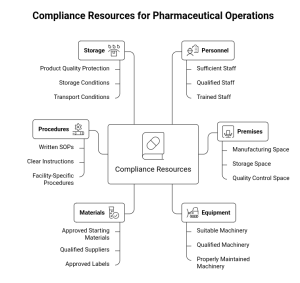
3. Adequate Resources GMP cannot function without the right resources. This includes qualified personnel, suitable premises, proper equipment, approved starting materials, written procedures, and appropriate storage and transport conditions.
4. Clear Written Instructions All procedures must be written in clear, unambiguous language that is specific to the facility and the equipment available. Vague or generic instructions lead to inconsistency and errors.
5. Trained Personnel Procedures are only as good as the people carrying them out. Every person must be trained before performing a task independently, and that training must be documented and verified.
6. Complete Manufacturing Records Records must be made at the time each step is performed , not reconstructed later. Any significant deviation must be fully recorded, investigated for root cause, and addressed with a CAPA (Corrective and Preventive Action).
7. Batch Traceability Records Records of manufacture and distribution must allow the complete history of any batch to be traced. These records must be easily retrievable and understandable , not buried in filing systems.
8. Proper Storage and Distribution Products must be stored and distributed in conditions that protect their quality throughout the supply chain. Temperature-sensitive products, for example, require cold chain controls that must be validated and monitored.
9. Product Recall System A system must exist to recall any batch from the market if needed. This system must be tested periodically to ensure it actually works when a real situation arises.
10. Complaints Investigation Every complaint about a marketed product must be reviewed, the root cause of any quality defect must be investigated, and measures must be taken to prevent it from happening again.
GMP principles don't exist in isolation they need to be verified, certified, and inspection ready.
Here's what that process actually looks like across the EU and US.
→ Read: GMP Certification In The EU And US: Processes, Inspections, And Key Differences
What GMP Training Must Cover: The Six Resources
One of the most practical parts of GMP training relates to Section 3.1(3) , the resource requirements. GMP training should help participants understand that all of the following must be available and properly managed:GMP training helps employees at every level understand that a gap in any one of these six areas is a GMP failure , regardless of how well everything else is managed.
Records and Deviation Management: The Heart of GMP
Among all the topics covered in GMP training, documentation and deviation management receive the most attention , and for good reason. Incomplete records are treated as GMP failures even when no actual product quality impact is found. This is one of the most important cultural lessons that GMP training must deliver.
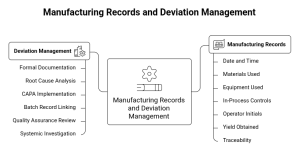
What manufacturing records must include:
- Date and time of each manufacturing step
- Name and quantity of all materials used
- Equipment used and its unique identification number
- In-process control results at each stage
- Initials of the operators performing each step
- Yield obtained at critical processing stages
- Complete traceability from raw material to finished product
What deviation management requires:
- All significant deviations must be formally raised and documented immediately
- Root cause analysis (RCA) must be performed, not a guess, but a structured investigation
- CAPA must be implemented and its effectiveness monitored over time
- Deviation records must be linked to the relevant batch records
- Quality Assurance must review and approve every deviation before batch release
- Recurring deviations must trigger a systemic investigation to identify underlying process or system failures
A practical example from Section 3 training: During a batch record review for Amoxicillin 500mg Capsules, a QA reviewer found that an in-process weight check had not been documented by the operator during compression. The batch was placed on hold. Investigation confirmed the weight was within limits using equipment logs, but a CAPA was still required. Revised SOPs, retraining, and a supervisor countersignature step were implemented before the batch was released. The lesson: in GMP, if it wasn't written, it wasn't done.
GMP Scope: Production AND Quality Control, Both Matter Equally
One of the most common misconceptions about GMP is that it applies only to the production floor. It does not. GMP applies equally and simultaneously to both production and quality control.
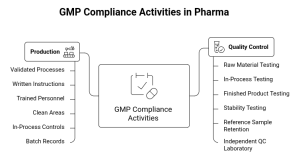
Production activities covered by GMP include:
- Validated and qualified manufacturing processes
- Clear written manufacturing instructions
- Trained personnel for every operation
- Clean and maintained production areas
- Proper in-process controls at each stage
- Complete batch manufacturing records (BMR)
Quality control activities covered by GMP include:
- Testing of raw materials before they are released for use
- In-process testing at defined stages during manufacturing
- Finished product testing and formal release procedures
- Stability testing and shelf-life determination
- Reference sample retention for future investigation
- A QC laboratory that operates independently from production
Failure in either area compromises product quality and patient safety. GMP training must make this dual-domain responsibility very clear to all participants.
GMP Documents Every Pharmaceutical Facility Must Maintain
Documentation is not just a GMP requirement; it is proof that GMP is actually being followed. Under Schedule M 2023, if an activity is not recorded, it is treated as though it never happened. The following six documents form the core of a GMP-compliant documentation system:
1. Master Formula Record (MFR) The MFR is the master blueprint for every product manufactured at a facility. It contains complete details of all raw materials, quantities, processing steps, equipment to be used, in-process controls, expected yield ranges, and storage conditions, for each product and each batch size. No batch can be manufactured without an approved MFR in place.
2. Batch Manufacturing Record (BMR) The BMR is the real-time record of what actually happened during manufacturing. It is filled in at the time of each operation, not later. It captures quantities used, equipment IDs, operator initials, in-process results, and any observations made during production. The BMR is the primary document reviewed before any batch is approved for release.
3. Standard Operating Procedures (SOPs) SOPs are written instructions covering every critical operation in the facility , from equipment operation and cleaning to personnel gowning and material handling. Under GMP, SOPs must be written in clear, unambiguous language, kept current, and followed exactly as written. Any change to an SOP must go through formal change control.
4. Deviation and CAPA Records Whenever a significant departure from an approved procedure or specification occurs, a deviation report must be raised immediately. This record documents what happened, the investigation conducted, the root cause identified, and the CAPA implemented. CAPA effectiveness must also be tracked over time to confirm the problem does not recur.
5. Training Records Every employee must have a training record showing which procedures and tasks they have been trained on, when the training took place, and whether competency was assessed. No person should perform a GMP-critical activity independently until their training is formally documented and confirmed.
6. Distribution Records These records track where each batch went after it left the manufacturing site , which distributors, which regions, and in what quantities. In the event of a recall, distribution records are the tool that allows a batch to be located and quickly and completely withdrawn from the market.
Key Rule: All GMP documents must be completed at the time of the activity, stored securely, and kept retrievable for the duration specified by the regulator. Backdating, overwriting without proper correction, or leaving entries blank are among the most serious documentation failures found during inspections.
Common GMP Pitfalls That Training Must Address
No GMP training program is complete without an honest discussion of where facilities most commonly go wrong. These are the five most frequent failures found during regulatory inspections:
- Incomplete or backdated records - Records must be made in real time. Reconstructing them later is a critical GMP violation, regardless of whether the product was impacted.
- Procedures not followed as written - If an SOP is impractical, it must be updated through the change control process. Informal deviations from written procedures are never acceptable.
- Inadequate deviation investigations - Superficial root cause analyses lead to repeat failures and attract serious regulatory observations. Every investigation must go deep enough to find the true cause.
- Untrained personnel performing critical tasks - No operator should work independently on a critical step until their training is documented, assessed, and formally confirmed.
- Lack of process validation - Relying on retrospective data alone is not a substitute for prospective validation. All critical processes must be validated before routine production begins.
How GMP Fits Into the Bigger Quality Picture
GMP does not stand alone. Under Schedule M 2023, it is one pillar of a three-part framework:
- Section 1, Pharmaceutical Quality System (PQS): The overarching system that ensures products are fit for their intended use.
- Section 2, Quality Risk Management (QRM): A risk-based approach applied proactively to all GMP activities.
- Section 3, GMP: The core operational requirements for consistent production and control.
GMP compliance is also verified through internal self-inspection (Section 10), and GMP failures are managed through complaint handling and recall systems (Sections 6 and 7). All GMP records form the foundation of the documentation system described in Section 17. Training programs should help staff see how their daily work connects to this larger system.
Understanding GMP is one side of the coin knowing how to qualify and validate your processes under Schedule M 2023 is the other.
Here's your complete guide.
→ Read: Qualification & Validation Under Schedule M 2023
Conclusion: GMP Training Is a Patient Safety Tool
Every time a tablet is pressed, a capsule is filled, or an injectable vial is sealed, a patient somewhere is depending on that product being exactly what it claims to be, the right dose, the right purity, the right shelf life, in the right packaging.
GMP training is the tool that turns regulatory text into human behaviour. It turns a list of 10 principles into a daily way of working. And it turns a manufacturing facility from a place that makes medicines into a place that makes medicines patients can trust.
Investing in structured, principle-based GMP training, built on frameworks like Section 3 of Schedule M 2023, is not just a regulatory necessity. It is a commitment to quality that starts with people.
FAQs
Q1. What is GMP training in pharmaceuticals?
GMP training teaches pharmaceutical manufacturing personnel how to produce medicines consistently, safely, and in accordance with approved quality standards. It covers manufacturing processes, documentation, equipment qualification, deviation management, and quality control , as defined by regulations like Schedule M 2023 in India.
Q2. Why is GMP training mandatory for pharmaceutical companies?
GMP training is mandatory because regulators require that all personnel involved in drug manufacturing be trained before performing critical tasks independently. Under Schedule M 2023, untrained personnel performing GMP-regulated activities is treated as a compliance failure.
Q3. What are the 10 GMP principles under Schedule M 2023 Section 3?
The 10 GMP principles include: defined manufacturing processes, qualification and validation, adequate resources, clear written instructions, trained personnel, complete manufacturing records, batch traceability records, proper storage and distribution, a product recall system, and complaints investigation.
Q4. How often should GMP training be conducted in a pharmaceutical plant?
GMP training should be conducted before a new employee performs any critical task independently, and refresher training should be carried out at regular intervals, typically annually or whenever there is a significant change in procedures, equipment, or regulations.
Q5. What is the difference between GMP training and SOP training?
SOP training covers the specific written procedures relevant to an individual's job role. GMP training is broader; it builds understanding of the underlying principles, regulatory requirements, and quality philosophy that all SOPs are built on. Effective compliance requires both.
Reporting on the science, business and regulation shaping the pharmaceutical industry.
More in Regulatory Intelligence
All articles →
The Pattern Behind FDA Warning Letters: What Startups & CDMOs Often Miss

ISO 14644 Cleanroom Classes for Pharma (with EM Implications)

Discussion