GMP Certification In The EU And US: Processes, Inspections, And Key Differences — All You Need To Know In 2026
A complete guide to GMP certification in the EU and US — processes, inspections, and 2026 updates.


Anyone who has been through a major site audit knows the feeling that hits when an inspector walks through the lobby. After weeks of preparation, an auditor can spend hours focused on something you never anticipated — the directional flow of personnel through a changing room, for instance, rather than the meticulously checked machine maintenance logs you stayed late to review.
It is a humbling reminder that obtaining GMP certification is not about ticking off a list of individual requirements. It is about proving that your entire operation runs as a controlled, predictable, and transparent system.
This article explains what GMP certification is, why it matters, how the process works in both the European Union and the United States, the steps involved in preparing for certification, and what the current regulatory landscape looks like as inspections resume at full pace in 2026.
What Is GMP Certification?
GMP certification is a formal verification by a regulatory body such as the European Medicines Agency in Europe, or an authorised third-party auditor in the United States, that a manufacturing facility follows Good Manufacturing Practice standards.
These standards govern how pharmaceutical products, medical devices, and related goods are produced, tested, and controlled, with the overriding goal of ensuring that every product reaching a patient is safe, effective, and of consistent quality.
At its core, GMP compliance is built around what is often called the five Ps: People, Processes, Products, Premises, and Procedures. Regulators want to see that each of these elements is designed, documented, and maintained in a way that prevents errors and contamination systematically and not just occasionally.
Certification, therefore, is not a snapshot of a single good day. It is evidence that the system works reliably, every time, with or without an auditor present.
Your Facility Will Be Judged On Its Systems — Not Just Its Paperwork.
Find out exactly what MHRA inspectors look for — and how to be ready before they walk through the door
→ MHRA Inspection Preparation Guide
The Universal Roadmap For Obtaining GMP Certification
While the technical standards governing GMP are harmonised across many global markets, the administrative procedures through which certification is obtained differ depending on the target regulatory region.
A company seeking to distribute in Europe follows a different formal process than one operating under FDA oversight in the United States.
However, the internal preparation required is fundamentally the same regardless of geography, and understanding that internal roadmap is the starting point for any serious certification effort.
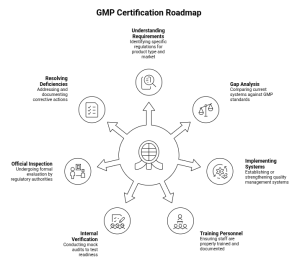
1) Understanding The Applicable Requirements
The first step is to develop a thorough understanding of the specific regulations that govern your product type and your target market. GMP is not a single monolithic standard, it encompasses a range of regulations and annexes, each applicable to different product categories and manufacturing activities.
A manufacturer of sterile medicinal products in the EU must understand Annex 1 of the EU GMP Guide in depth, while a US-based manufacturer of dietary supplements must be familiar with 21 CFR Part 111. Identifying the correct regulatory framework from the outset prevents misdirected preparation and ensures that the compliance effort is focused where it actually needs to be.
2) Conducting A Gap Analysis
Once the applicable requirements are clearly understood, the next step is a thorough and honest gap analysis. This is the process of comparing your current systems, processes, and documentation against the requirements of the relevant GMP standard and identifying every area where your operation falls short.
The emphasis on honesty here is deliberate. A gap analysis that only confirms what is already working well is of limited value. The most useful gap analysis is one that actively looks for weaknesses, inconsistencies, and missing controls because finding them internally, before an inspector does, is the entire point of the exercise.
3) Implementing The Required Systems
With the gaps identified, the next step is to address them systematically. This typically involves establishing or strengthening a Quality Management System, ensuring that all equipment is properly calibrated and that calibration records are maintained, putting validated computer systems in place where required, and verifying that all manufacturing processes are operating within defined and validated parameters.
The objective at this stage is not simply to close individual gaps in isolation but to build a cohesive system in which each element supports the others — a system designed to prevent failures rather than merely detect them after they occur.
4) Training Personnel
A GMP system is only as strong as the people operating within it. The most comprehensive set of SOPs in the industry is worthless if the personnel responsible for following them have not been properly trained and if that training has not been documented.
Training records are among the most frequently reviewed documents during a GMP inspection, and inspectors will look not only for evidence that training took place but also for evidence that it was effective. This means that training programmes should be role-specific, regularly refreshed, and accompanied by documented assessments or competency checks where appropriate.
5) Conducting Internal Verification
Before undergoing any formal inspection, manufacturers should conduct rigorous internal audits, sometimes called mock audits in order to verify that the systems put in place are working as intended. The standard for these internal audits should be demanding.
If an inspector arrived unannounced today and asked to see a specific training record, a batch manufacturing record from six months ago, or the most recent CAPA closure documentation, could your team produce it within minutes? Internal verification is the process of stress-testing your readiness against that standard and addressing anything that falls short before the real inspection takes place.
6) The Official Inspection
The formal inspection is the moment when a regulatory authority or authorised auditor evaluates your facility and systems against the applicable GMP standard. The most productive mindset to bring to this stage is one that treats the inspector as a partner in quality rather than an adversary.
Inspectors are experienced professionals whose role is to verify compliance, and engaging with their questions openly, providing clear and accurate answers, and demonstrating genuine understanding of your own systems will always serve you better than defensiveness or evasion.
Discrepancies identified during an inspection are not necessarily fatal, how a manufacturer responds to findings matters as much as the findings themselves.
7) Resolving Deficiencies & Receiving Certification
Following the inspection, any deficiencies or observations raised by the inspector must be addressed through a formal response. This typically involves a root cause analysis of each finding, the implementation of corrective and preventive actions, and documented evidence that those actions have been completed effectively. Once the regulatory authority or third-party auditor is satisfied that all deficiencies have been resolved, the formal GMP certification or its equivalent is issued.
How To Obtain EU GMP Certification?
For manufacturers seeking to distribute products in Europe, EU GMP certification is a legal requirement, not an optional mark of quality. The process is coordinated by the European Medicines Agency but executed at the national level by National Competent Authorities, or NCAs.
These are the country-level regulatory bodies responsible for conducting inspections and issuing certificates within their respective jurisdictions. Examples include the HPRA in Ireland, the ANSM in France, and the MHRA in the United Kingdom.
Before a GMP certificate can be issued, a manufacturer must first hold a valid manufacturing or import authorisation from their local NCA. This authorisation is a prerequisite, without it, there is no pathway to certification.
Once authorisation is in place, the site becomes subject to GMP inspections, which are typically triggered either by a marketing authorisation application for a new product or by a routine risk-based inspection cycle applied to already-authorised sites.
During the inspection, assessors evaluate the full scope of a manufacturer's GMP compliance. This covers everything from facility design, air filtration, and contamination control through to documentation systems, CAPA logs, deviation management, and personnel training records.
The depth and focus of the inspection will vary depending on the product type and the specific annexes of the EU GMP Guide that apply to the manufacturer's activities.
If the inspection concludes satisfactorily, the NCA issues a formal EU GMP certificate and enters it into the publicly accessible EudraGMDP database, which is the European database for information on manufacturing, import, and distribution authorisations and GMP certificates.
The certificate is typically valid for three years, after which the site must undergo re-inspection to maintain its certified status. A listing in EudraGMDP serves as the primary public record of a site's GMP compliance status and is routinely checked by regulatory authorities, marketing authorisation holders, and business partners across the European Economic Area.
A Form 483 Or A Deficiency Report Is Not The End — It Is A Test Of Your Quality Culture.
Learn how to investigate the root cause, build your response, and close findings that actually stick
→ Human Error Root Cause Analysis In Pharma
How To Obtain FDA GMP Compliance In The United States?
The US approach to GMP verification is a frequent source of confusion for companies more familiar with the EU model, and the key distinction must be understood clearly from the outset.
In the United States, the FDA does not issue a formal, paper-based GMP certificate to domestic manufacturers in the way that EU NCAs do.
Instead, GMP compliance is verified through inspection, and the outcome of that inspection,nrather than a certificate, constitutes the formal record of compliance status.
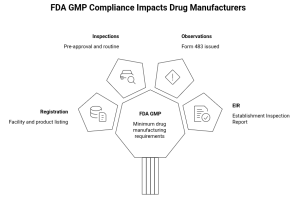
The legal foundation for pharmaceutical GMP in the US is 21 CFR Parts 210 and 211, which set out the minimum current Good Manufacturing Practice requirements for the manufacture, processing, packaging, and storage of drug products.
Manufacturers must register their establishment with the FDA and list their products in the FDA's registration database. New drug manufacturers are subject to a Pre-Approval Inspection, or PAI, which is conducted before a new drug application can be approved.
Established manufacturers operating on commercial products are subject to routine surveillance inspections, conducted on a risk-based schedule.
When an inspection identifies observations, meaning areas where the inspector believes the manufacturer is not fully meeting GMP requirements, these are documented on a Form 483, which is formally issued to the manufacturer at the close of the inspection.
The manufacturer must then submit a written response addressing each observation with a root cause analysis and a corrective action plan. If no significant observations are found, or if the observations raised are satisfactorily resolved, the FDA issues an Establishment Inspection Report, or EIR, which documents the outcome of the inspection.
A clean EIR is the closest equivalent to a formal certificate of GMP compliance under the US system, and it serves as the primary evidence of compliance status for domestic manufacturers.
Because the FDA does not issue a physical certificate, many US manufacturers and particularly those seeking to demonstrate compliance to international business partners, contract manufacturers, or consumer-facing markets, engage authorised third-party organisations to conduct formal GMP facility certification audits.
These third-party certificates are widely recognised across the industry as a credible and independently verified mark of quality, even though they carry no direct regulatory standing with the FDA itself.
The 2026 Inspection Landscape And What It Means For Manufacturers
The period from 2020 through 2023 saw significant disruption to routine GMP inspection schedules globally, as regulatory authorities adapted their oversight activities in response to the operational constraints of the pandemic.
Many EU National Competent Authorities granted temporary extensions to GMP certificate validity during this period, allowing manufacturers whose certificates would otherwise have lapsed to continue operating while on-site inspections were delayed or conducted remotely.
Those extensions were phased out at the end of 2024, and as we move through 2026, NCAs across Europe have cleared the resulting backlog and returned to a full schedule of on-site inspections.
Manufacturers who have been operating under extended certificates, or who have not been subject to a routine inspection in several years, should treat the current environment as a period of heightened inspection risk and prepare accordingly.
In the United States, the regulatory landscape is also evolving in ways that are directly relevant to manufacturers seeking to understand GMP compliance obligations.
The FDA's Quality Management System Regulation, which came into effect on February 2, 2026, represents a significant step toward global regulatory harmonisation in the medical device sector.
By aligning 21 CFR Part 820 more closely with the international standard ISO 13485:2016, the FDA has made it meaningfully easier for manufacturers operating in both US and international markets to manage their compliance obligations within a single, coherent quality framework rather than maintaining parallel systems to satisfy divergent requirements.
This convergence has practical implications for GMP certification efforts. Manufacturers who are already compliant with ISO 13485:2016 for international markets will find that much of their existing quality infrastructure maps directly onto the updated US requirements.
The alignment also reduces the documentation burden for premarket submissions, particularly around design controls and manufacturing process documentation, and it signals a broader trend toward international regulatory harmonisation that manufacturers in both regions should factor into their long-term compliance strategy.
In Conclusion
Obtaining GMP certification, whether through the formal EU certificate issued by a National Competent Authority or through the inspection-based compliance verification used by the FDA in the United States — is one of the most operationally demanding and consequential undertakings a life sciences manufacturer will face.
It requires not just technical competence in each individual area of GMP but the ability to demonstrate that those competencies are embedded in a coherent, documented, and reliably functioning system.
The path to certification is the same regardless of geography: understand the requirements that apply to your product and market, conduct an honest and thorough gap analysis, implement the systems and training needed to close those gaps, verify your readiness internally before an inspector does it for you, engage constructively with the inspection process, and resolve any findings promptly and completely.
Manufacturers who approach GMP certification not as a periodic compliance exercise but as a continuous operating standard will find that the inspection, when it comes, is simply a confirmation of what they already know — that their facility is doing exactly what it should be doing, every day, for every batch, for every patient.
FAQs
FAQ 1: What Is GMP Certification And Why Is It Important In 2026?
GMP certification is the formal confirmation that a facility consistently follows Good Manufacturing Practice standards to ensure product safety and quality. In 2026, it is especially important because regulators in the EU and US have fully resumed on-site inspections after pandemic-related delays, leading to stricter oversight. Certification shows that a manufacturer’s systems operate reliably every day—not just during audits—and it remains essential for legal market access and industry credibility.
FAQ 2. How Does The Process Of Obtaining GMP Certification Differ Between The EU And The US?
The EU issues an official GMP certificate after a successful inspection by a National Competent Authority, and this certificate is listed in the EudraGMDP database. In the US, the FDA does not issue GMP certificates; instead, compliance is confirmed through inspection outcomes documented in an Establishment Inspection Report. If observations appear on a Form 483, companies must address them before receiving a favourable outcome. Many US companies also use third-party audits to demonstrate compliance internationally, even though these are not regulatory certificates.
FAQ 3: How Should Manufacturers Prepare For EU And US GMP Inspections In 2026?
Manufacturers should start by understanding the exact regulations that apply to their product and market. They must conduct an honest gap analysis, strengthen their Quality Management System, validate equipment and processes, and ensure that procedures are clear and well-documented. Training is crucial because inspectors focus heavily on whether staff follow SOPs in practice. Internal mock audits help confirm readiness, which is especially important in 2026 as inspection schedules have returned to full strength and expectations around documentation and quality systems have increased.
Reporting on the science, business and regulation shaping the pharmaceutical industry.
More in Regulatory Intelligence
All articles →
The Pattern Behind FDA Warning Letters: What Startups & CDMOs Often Miss

ISO 14644 Cleanroom Classes for Pharma (with EM Implications)

Discussion