DHF, DMR, DHR, and QMSR — A Complete Guide To Medical Device Documentation
A complete guide to medical device documentation files and the QSR to QMSR regulatory shift.


If you work in the medical device industry in the United States, you have almost certainly come across the abbreviations DHF, DMR, and DHR — and possibly found them confusing given how similar they sound. More recently, you may have also heard about QMSR and its associated terms, DDF and MDF.
This article explains each of these terms clearly and in full, describes how they connect to one another, and covers the important regulatory update that changed how they are referenced going forward.
Understanding The purpose Of medical device Documentation
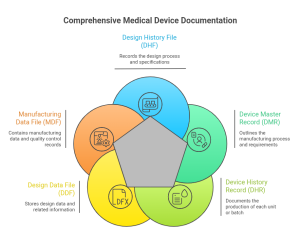
Every medical device that reaches a patient has a story behind it. There is the story of how it was designed, the story of how it is supposed to be manufactured, and the story of how each individual unit or batch was actually made.
The FDA requires medical device manufacturers in the United States to document all three of these stories in structured, traceable, and auditable files. DHF, DMR, and DHR, along with the newer terms DDF and MDF, are the names given to each of these documentation categories.
Although these abbreviations sound alike and are closely related, they serve fundamentally different purposes and are generated at different stages of the medical device lifecycle. Together, they form a complete record that regulators, auditors, and manufacturers rely on to verify that a device is safe, effective, and consistently produced to a defined standard.
Understanding what each file contains and why it exists is essential for anyone working in medical device quality, regulatory affairs, or manufacturing.
The Design History File (DHF) — Now Known As The Design & Development File (DDF)
The Design History File, commonly abbreviated as DHF, was the term used under the FDA's original Quality System Regulation (QSR) framework. It referred to the complete collection of records that documented how a medical device was designed and developed, from the earliest concepts all the way through to the final approved design.
The DHF was required under 21 CFR 820.30 and served as the primary evidence that a manufacturer had followed a structured, controlled design process. Under the updated regulatory framework known as the Quality Management System Regulation (QMSR), which became effective on February 2, 2026, the DHF concept has been aligned with the terminology used in the international standard ISO 13485:2016.
The term now used is the Design and Development File, or DDF. The detailed DHF language from the old CFR text is no longer explicitly defined, but the documentation requirements are substantially the same, they simply reflect updated international terminology.
The DDF answers a fundamental question: was this device designed and developed according to a pre-approved plan, and can the manufacturer prove it? It contains the entire design and development history, making it possible for auditors and regulators to trace the origins of every design decision.
This includes the design and development plans that were established at the outset of the project, the user needs and intended use that the device was built to address, and the design inputs, the specific requirements the device must meet.
Alongside those, the DDF contains design outputs such as specifications, drawings, and software documentation, as well as records of design reviews conducted at key stages.
It also captures verification and validation plans and results, which confirm that the device performs as intended, along with risk management documentation, records of design changes and how they were controlled, and design transfer documentation that shows how the approved design was handed over to manufacturing.
In practical terms, the DDF is the memory of the design process. It shows regulators that a device was not built arbitrarily but was the result of a deliberate, documented, and reviewed development effort grounded in safety and performance requirements.
The Device Master Record (DMR) — The Blueprint For Manufacturing
Once a medical device has been designed and approved for production, the Device Master Record or DMR, comes into play. The DMR is the comprehensive manufacturing specification for a device. It contains or references everything a manufacturer needs to build the device correctly, consistently, and in compliance with its approved design.
In simple terms, if the DDF is the story of how the device was designed, the DMR is the instruction manual for how it must be made. The DMR must be established and maintained for each type of device, and it serves as the authoritative reference for all manufacturing activities.
Anyone involved in producing the device such as operators, quality teams, engineers, should be able to look to the DMR for the definitive answer on how a task should be performed or what specifications a component must meet. A complete DMR contains design specifications such as drawings, material compositions, formulations, component specifications, and software specifications.
It also includes the Bill of Materials, which lists every component and material that goes into the device. Production processes and procedural instructions are documented in the DMR, describing step by step how the device is to be assembled or manufactured. Equipment specifications outline which tools and machines are to be used and how they must be calibrated or maintained.
The DMR further contains packaging and labeling specifications, which define how the finished device must be presented and identified, along with quality assurance procedures and acceptance criteria that determine what standards the device must meet before it can be released. Finally, the DMR covers installation, maintenance, and servicing procedures for devices that require them in the field.
The DMR is not a record of what happened — It is a prescription for what must happen. It is a living document that must be kept current and controlled, with any changes going through a formal change management process to ensure that the manufacturing instructions always reflect the latest approved design.
Your Medical Device Design and Development Plan Starts Here
Most manufacturers skip this step — and pay for it later
→ Medical Device Design and Development Plan
The Device History Record (DHR) — Proof That The Instructions Were Followed
The Device History Record, or DHR, is the evidence file. While the DMR describes how a device must be manufactured, the DHR documents what actually happened during the manufacture of each specific device unit or production batch. It is, in essence, the manufacturing logbook and it exists to prove that the device was produced in accordance with the DMR.
The DHR is critically important for traceability and post-market surveillance. If a device is later found to be defective, or if a field safety issue arises, the DHR allows manufacturers and regulators to trace the problem back to a specific batch, identify the materials and processes involved, and understand exactly what happened during production. This kind of traceability can be essential for recalls, investigations, and corrective actions.
The DHR contains acceptance records that demonstrate compliance with the DMR at each stage of production. It includes product and component identifiers, material lots and serial numbers that link back to specific raw material batches, and full production records capturing what was done and when. Non-conformance reports are also included when production activities deviate from specifications, along with the actions taken to address those deviations.
The DHR records the dates of manufacture, the quantity of devices manufactured, and the quantity released for distribution. It also contains primary identification labeling for each unit and the Unique Device Identifier, or UDI, along with any other device identification or control numbers assigned to that production run.
Although the specific DHR section of the old QSR framework, formerly found at 21 CFR 820.184, has been restructured under QMSR, the requirement to maintain equivalent production and traceability records remains fully in place through the ISO 13485:2016 provisions now incorporated by reference into U.S. regulation.
The Medical Device File (MDF) — The Conformity Umbrella
The Medical Device File, or MDF, is a concept introduced to align U.S. regulation with ISO 13485:2016. It is broader in scope than the DMR or DDF individually, and it serves as the overarching file that demonstrates a device's overall conformity to applicable regulatory requirements.
The MDF contains documentation showing that the device, as a complete product, meets the regulatory standards it is subject to. The MDF includes product specifications, labeling documentation, a description of the device's intended use, and risk management documentation.
While it may include or reference manufacturing information, its primary purpose is not to define production instructions but to show that the device, as designed and specified, is compliant with the regulatory framework. Under QMSR, manufacturers are required to maintain an MDF for each type of device, and it serves as a key reference point during regulatory reviews and audits.
One way to distinguish the MDF from the DMR is to think of the MDF as the "what is this device and why is it safe?" file, while the DMR is the "how do we build this device?" file. Both are necessary, and together they form a comprehensive picture of the device from a regulatory and manufacturing standpoint.
How DHF, DMR, DHR, DDF, And MDF Connect To Each Other?
These documents are not independent files that exist in isolation. They follow the natural sequence of a medical device's lifecycle and are deeply interconnected. The DDF, or formerly the DHF, is created first during the design and development phase. It captures every decision made while the device was being designed and confirms that the process followed approved plans.
Once the design is complete and approved, the information from the DDF feeds into the DMR, which translates the approved design into the specific manufacturing instructions that production teams must follow. Every time a batch of devices is manufactured according to those instructions, a DHR is created that records what happened in that particular production run.
The MDF sits across all of this as the regulatory conformity record, drawing on design, manufacturing, and labeling documentation to demonstrate that the device meets applicable requirements. The connection between the DMR and the DHR is particularly important. The DMR defines the standard; the DHR confirms the standard was met.
If there is ever a question about whether a batch of devices was manufactured correctly, the answer is found by comparing the DHR — what actually happened, against the DMR, what should have happened. This relationship is central to how the FDA and international regulators evaluate manufacturing compliance.
The Regulatory Shift From QSR To QMSR
For decades, medical device quality management in the United States was governed by the Quality System Regulation, or QSR, under 21 CFR Part 820. This framework defined requirements for the DHF, DMR, and DHR and had been in use since 1996.
On December 31, 2024, the FDA announced a final rule amending 21 CFR Part 820 and renaming it the Quality Management System Regulation, or QMSR. These changes came into effect on February 2, 2026.
The primary motivation behind this change was alignment with ISO 13485:2016, the internationally recognised standard for quality management systems in the medical device industry. Many U.S. manufacturers that sell their products globally had long been required to comply with both QSR and ISO 13485:2016, which involved significant duplication of effort since the two frameworks addressed the same core areas with slightly different terminology and structure.
By incorporating ISO 13485:2016 by reference into 21 CFR Part 820, the FDA aimed to reduce that redundancy and create a more consistent regulatory environment for manufacturers operating in both the U.S. and international markets. Under QMSR, the term Design History File is no longer explicitly defined in the CFR text. Instead, the concept is aligned with the Design and Development File terminology from ISO 13485:2016.
The legacy CFR sections that formerly defined the DMR and DHR in detail have also been restructured, though the underlying requirements for production specifications and production history records remain fully in force through the ISO 13485 provisions incorporated by reference.
Additionally, the QMSR introduces the requirement to maintain a Medical Device File, consistent with ISO 13485 terminology. It is important to understand that while the terminology has changed, the substantive documentation requirements have not changed dramatically.
The FDA has consistently emphasised that manufacturers already complying with ISO 13485:2016 internationally will find the QMSR requirements very familiar. The shift is primarily one of alignment and harmonisation, not a wholesale reimagining of what must be documented.
GMP Certification Is Not Optional — Here Is What You Need To Know
The gap between QSR and global compliance is smaller than you think
→ GMP Certification — EU and US Guide
Best Practices For Managing Medical Device Documentation
Whether a company is transitioning to QMSR terminology or building its quality management system from scratch, sound documentation practices remain the foundation of regulatory compliance.
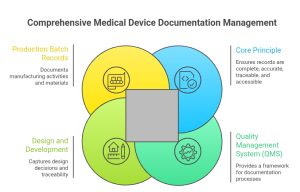
The core principle is that records must be complete, accurate, traceable, and accessible, both during day-to-day operations and during regulatory audits or inspections.
1) Establishing A Strong Quality Management System
The starting point for all medical device documentation is a well-structured Quality Management System, or QMS. A robust QMS provides the framework within which design files, manufacturing records, and batch histories are created, reviewed, approved, and stored.
It defines who is responsible for each type of document, how documents are created and approved, what version control procedures apply, and who has access to what records. A centralised document repository is essential.
All documents — including draft versions, reviewed versions, and approved versions, should be held in a single, organised system with clear access controls. This prevents the confusion that arises when multiple versions of a document are in circulation and ensures that production teams are always working from the current, approved instructions.
Secure access controls mean that editing and approval rights are assigned based on individual roles and responsibilities, so that critical documents cannot be changed without appropriate authorisation.
Formal change management is equally important. Any change to a design, a manufacturing process, a specification, or a record-keeping procedure must go through a structured review and approval process before it is implemented.
This ensures that changes are properly evaluated for their impact on safety, performance, and compliance before they take effect. Personnel at all levels should also receive ongoing, documented training on their specific documentation responsibilities.
It is to ensure that everyone who contributes to a design file, a manufacturing record, or a batch history understands what is required of them. Regular internal audits help identify gaps in compliance before they are discovered by external regulators, allowing companies to address issues proactively.
2) During The design And Development Phase
Good documentation practice during the design phase begins early. Records should be created and maintained from the very beginning of a project, not assembled retrospectively at the end.
Starting documentation early ensures that nothing is missed and that the records accurately reflect the decisions made throughout the process. Every design decision, design review, and approval should be captured in detail and in context, so that the reasoning behind each choice is clear to anyone reading the file later.
Traceability is one of the most important qualities of a design file. Records should make it easy to follow the thread from user needs to design inputs, from design inputs to design outputs, and from outputs through verification and validation.
This chain of traceability is what allows regulators to confirm that the device was designed to meet real-world requirements and that those requirements were properly verified. Design files should also be structured in a way that supports future improvement efforts, making it straightforward for engineering teams to revisit the design history when considering changes or enhancements to the device
3) Managing Production Batch Records
For the Device History Record, the guiding principle is real-time recording. Manufacturing and quality control activities should be documented as they occur, not from memory hours or days later.
Real-time records are more accurate, more credible to auditors, and more useful in the event of a quality investigation. Traceability at the batch level means that every DHR should contain enough information to identify the specific materials, components, and processes that went into that particular production run, allowing any issue to be traced back to its source.
When deviations from the DMR occur during manufacturing, as they sometimes do, those deviations must be documented promptly, investigated, and resolved. The DHR should contain a record of what happened, why it happened, and how it was addressed, including any corrective actions taken.
A well-maintained DHR that honestly records both successful production and resolved deviations demonstrates a mature and trustworthy quality management culture, which regulators look upon favourably.
In Conclusion
DHF, DMR, DHR, DDF, MDF, and QMSR — while the abbreviations can seem overwhelming at first, each one represents a distinct and necessary piece of the medical device documentation puzzle. The Design and Development File (formerly the Design History File) captures the design journey.
The Device Master Record defines how the device must be built. The Device History Record proves how each batch was actually produced. The Medical Device File provides the overarching evidence of regulatory conformity. And the QMSR is the updated regulatory framework that brings U.S. requirements into alignment with international standards.
The 2026 transition from QSR to QMSR reflects the FDA's commitment to harmonising U.S. medical device regulation with global standards, reducing redundancy for manufacturers, and maintaining a high bar for patient safety.
For most manufacturers already following ISO 13485:2016, the practical impact of the change is relatively modest, primarily a matter of updating terminology and ensuring the QMS structure reflects the new framework.
For companies building their quality management systems for the first time, understanding these documents and how they connect is the essential foundation for bringing safe, compliant, and traceable medical devices to market.
FAQs
FAQ 1: What Is The Difference Between DHF, DMR, And DHR?
The DHF—now known as the Design & Development File (DDF) under QMSR—contains the complete history of how a medical device was designed, including user needs, design inputs, outputs, reviews, and validation records. The DMR, in contrast, defines how the device must be manufactured and includes all specifications, drawings, procedures, and quality requirements used during production. The DHR is the record of what actually happened during manufacturing, documenting production steps, materials, test results, and any deviations. Together, these files ensure full traceability from the initial design phase to real-world manufacturing.
FAQ 2: What Changed When The FDA Moved From QSR To QMSR?
The shift from the Quality System Regulation (QSR) to the Quality Management System Regulation (QMSR) was primarily made to align U.S. regulations with ISO 13485:2016. This update modernized terminology but kept most core requirements intact. For example, the traditional DHF terminology has transitioned to the Design & Development File (DDF), and the Medical Device File (MDF) has become a formal requirement. Although the structure and wording have evolved, manufacturers already familiar with ISO 13485 will find that the expectations for documentation and compliance remain largely the same.
FAQ 3: Why Are These Documentation Files Important For Manufacturers?
These documentation files are crucial because they ensure that medical devices are designed properly, manufactured consistently, and fully traceable throughout their entire lifecycle. They provide regulators with proof that devices meet required safety and performance standards. For manufacturers, they support smooth design control, accurate production, effective change management, and efficient investigations or recalls if needed. Maintaining complete and accurate documentation ultimately strengthens regulatory compliance and protects patient safety.
Reporting on the science, business and regulation shaping the pharmaceutical industry.
More in Regulatory Intelligence
All articles →
The Pattern Behind FDA Warning Letters: What Startups & CDMOs Often Miss

ISO 14644 Cleanroom Classes for Pharma (with EM Implications)

Discussion