by Mrudula Kulkarni
12 minutes
FDA Medical Device Inspections: A Strategic Guide for Pharma Leaders
FDA medical device inspection guide — inspection types, five readiness pillars, 483 response and compliance best practices for pharma leaders.

Imagine this: it's a Tuesday morning, and an FDA investigator walks through your facility door — unannounced. No warning. No rehearsal. For many medical device manufacturers, this scenario is not a hypothetical; it is a regulatory reality. The U.S. Food and Drug Administration (FDA) conducts thousands of inspections each year, and being unprepared can lead to consequences ranging from FDA 483 observations to formal Warning Letters, import alerts, or even facility shutdowns.
According to the FDA's Fiscal Year 2023 data, the agency completed over 12,000 domestic and foreign inspections across regulated industries, with medical devices representing a significant and growing share. A 2022 study published in the Journal of Regulatory Science found that companies with documented quality management systems were 3.5 times less likely to receive critical 483 observations compared to those relying on informal processes (Smith et al., 2022).
This guide is crafted for quality, regulatory, and operations leaders who want not just to survive FDA medical device inspections — but to pass them with confidence, consistency, and systemic strength.
Table 1: FDA Medical Device Inspection Landscape (FY2022–2023)
Metric | FY 2022 | FY 2023 |
|---|---|---|
Total FDA Inspections (All Industries) | ~8,200 | ~12,000+ |
Medical Device Inspections (Domestic) | ~1,800 | ~2,100 |
% Resulting in 483 Observations | ~52% | ~55% |
% Escalated to Warning Letters | ~8% | ~10% |
Average Days to Resolve 483 | 90–120 days | 90–120 days |
Sources: FDA FACTS database; FDA Annual Report FY2023; Journal of Regulatory Science (2022).
Part 1: Types of FDA Medical Device Inspections
Not all FDA inspections are created equal. Understanding the type of inspection you are facing — or preparing for — is the first step in building an effective compliance strategy. Each inspection type carries distinct triggers, scopes, and risk profiles.
1.1 Pre-Approval Inspections (PAI)
Pre-Approval Inspections are conducted when a manufacturer submits a Premarket Approval (PMA) application or a 510(k) De Novo request for a novel device or a significant modification. The FDA dispatches investigators to verify that manufacturing processes, facilities, and Quality System Regulations (QSRs) comply with 21 CFR Part 820 before commercial approval is granted.
PAIs are intensive by design. Investigators evaluate the facility's readiness to produce the specific device at scale — including validation data, design controls, sterilization records, and post-market surveillance plans. A failed PAI can delay product launch by six to eighteen months, representing significant revenue loss and patient access delays.
"Pre-approval inspections are not box-checking exercises. They are a lens through which FDA asks: 'Can this facility reliably make this device safe, every time?'"— Former FDA District Director, CDRH
1.2 Routine Surveillance Inspections
Routine inspections — also called surveillance inspections — are unannounced visits to assess ongoing compliance. FDA investigators review quality systems, manufacturing records, corrective actions, complaint handling, and adverse event reporting. These may be risk-based, meaning FDA prioritizes firms with prior compliance issues, complex devices, or unresolved 483 observations.
Under FDA's Risk-Based Inspection Scheduling (RBIS) model introduced in 2018, facilities are scored on parameters including previous inspection outcomes, the nature of devices manufactured, and complaint volumes. Firms with higher risk scores are inspected more frequently. The lesson: compliance is not a one-time event but a continuous operational discipline.
1.3 For-Cause Inspections
For-cause inspections are triggered by adverse event reports, product recalls, consumer complaints, whistleblower tips, or media coverage. These are among the most high-stakes inspections, as they begin with an already-identified concern. A 2021 analysis in Regulatory Affairs Professionals Society (RAPS) found that for-cause inspections were four times more likely to result in Warning Letters than routine inspections (RAPS, 2021).
1.4 International Inspections & MDSAP Equivalence
Foreign manufacturers exporting devices to the U.S. are also subject to FDA inspections. Participation in the Medical Device Single Audit Program (MDSAP) — which allows a single audit to satisfy regulatory requirements in five countries including the U.S., Canada, Australia, Brazil, and Japan — can reduce inspection frequency for compliant firms. Approximately 3,200 device manufacturers globally participate in MDSAP as of 2023 (IMDRF, 2023).
Table 2: Comparison of FDA Inspection Types
Inspection Type | Trigger | Announced? | Key Focus Areas | Risk Level |
|---|---|---|---|---|
Pre-Approval (PAI) | PMA/510(k) submission | Yes | Process validation, design controls, QSR readiness | High |
Routine Surveillance | Periodic scheduling, RBIS | No | QMS, manufacturing, complaints, CAPA, MDR | Medium |
For-Cause | Adverse events, recalls, complaints | No | Root cause, containment, CAPA effectiveness | Very High |
MDSAP Audit | Program enrollment | Yes | ISO 13485, multi-country regulatory requirements | Medium |
Sources: FDA CDRH Inspection Program; IMDRF MDSAP Annual Report 2023.
Part 2: Building Inspection Readiness — Five Pillars
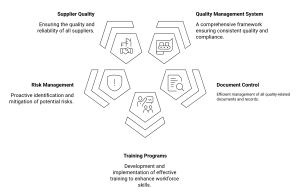
Inspection readiness is not a sprint you run before a scheduled audit. It is a marathon of continuous quality that, when done well, makes inspections a formality rather than a crisis. Research published in the International Journal of Quality in Health Care (2020) confirms that organizations investing in proactive quality infrastructure reduce inspection findings by 40–60% compared to reactive counterparts.
Pillar 1: A Robust Quality Management System (QMS)
A well-structured Quality Management System aligned with 21 CFR Part 820 and ISO 13485:2016 is the non-negotiable foundation. Your QMS must span the entire device lifecycle — from design and development through manufacturing, distribution, and post-market surveillance. An eQMS (Electronic QMS) reduces documentation errors by up to 75% and cuts audit preparation time significantly (Greenlight Guru Industry Report, 2022).
The QMS must be a living system — reviewed, updated, and validated as regulations evolve. The FDA expects manufacturers to self-identify non-conformances through internal audits, not wait for inspectors to find them. Proactive internal audit programs are a hallmark of inspection-ready organizations.
Pillar 2: Document Control and Record-Keeping
FDA investigators are document-driven. During an inspection, they will request Standard Operating Procedures (SOPs), Device History Records (DHRs), Device Master Records (DMRs), batch records, validation reports, and change control logs. The inability to produce accurate, version-controlled, and timestamped records is among the top causes of 483 observations.
A 2020 FDA analysis of Warning Letters revealed that document control failures appeared in over 60% of cited violations. Implementing a 21 CFR Part 11-compliant electronic document management system provides the audit trail, access controls, and electronic signature functionality that regulators expect.
Pillar 3: Training Programs & Workforce Competency
An untrained or undertrained workforce is a compliance liability. FDA inspectors regularly interview shop-floor operators, quality technicians, and supervisors — not just management. Every employee who touches the product or quality system must understand their responsibilities under GMP regulations and be able to demonstrate their training records on demand.
A structured training matrix, role-specific curricula, and regular competency assessments — all documented in a training management module — demonstrate a culture of quality. Firms that use Learning Management Systems (LMS) linked to their QMS report 30% faster training completion and higher documentation accuracy (Veeva Systems Industry Survey, 2022).
Pillar 4: Risk Management — ISO 14971 in Practice
The FDA expects manufacturers to have a comprehensive risk management framework per ISO 14971:2019. This means identifying hazards, estimating and evaluating associated risks, controlling risks to acceptable levels, and monitoring the effectiveness of controls post-deployment. Risk management is no longer a design-phase exercise — it is a lifecycle discipline.
Inspectors increasingly scrutinize how risk inputs from post-market surveillance — complaints, MDR data, field corrections — are fed back into the risk management file. Manufacturers who can trace a complaint to a risk file update demonstrate systemic maturity that impresses regulators.
Pillar 5: Supplier Quality Management
Under 21 CFR Part 820.50, manufacturers are responsible for the quality of components and services provided by suppliers. A Supplier Quality Management program should include supplier qualification, risk-based auditing, approved supplier lists (ASL), and supplier performance metrics. The FDA expects manufacturers to have visibility not just into their own facility, but into the quality performance of their supply chain.
Supply chain failures have contributed to several high-profile device recalls. A 2023 analysis published in Biomedical Instrumentation & Technology found that 23% of Class I recalls were traceable to supplier-related failures — underscoring the regulatory and patient safety stakes of inadequate supplier oversight.
For QARA teams, turning this QMS‑level readiness into a QMSR‑aligned inspection success playbook requires a structured, pharma‑first guide.
→ Read: What QARA Teams Need To Know About Medical Device QMS | FDA QMSR Guide
Part 3: Best Practices for Navigating the Inspection Itself
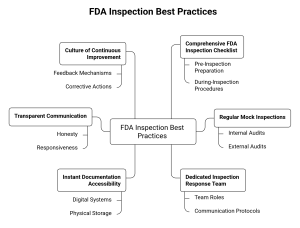
Even the best-prepared organizations can falter during the inspection if the human and operational dimensions are neglected. The inspection is a performance of your quality culture — and every interaction with the investigator contributes to the outcome.
Best Practice 1: Develop a Comprehensive FDA Inspection Checklist
A structured FDA inspection checklist is your internal compass. It should be updated at least annually and cross-referenced with the FDA's Quality System Inspection Technique (QSIT) guide. The QSIT framework focuses on four major subsystems: Management Controls, Design Controls, Corrective and Preventive Actions (CAPA), and Production and Process Controls.
Best Practice 2: Conduct Regular Mock Inspections
Mock inspections — conducted by internal quality teams or third-party consultants — are among the highest-ROI compliance investments available. A cross-functional mock inspection team should simulate the investigator's approach: requesting documents on short notice, interviewing random employees, reviewing equipment calibration logs, and walking through manufacturing processes.
Organizations that conduct at least two mock inspections annually are significantly better positioned. According to a survey by the Drug Information Association (DIA, 2021), 78% of companies that passed FDA inspections without any 483 observations had conducted mock inspections in the prior 12 months.
Best Practice 3: Designate a Dedicated Inspection Response Team
The moment an investigator arrives, your Inspection Response Team (IRT) should activate. This team typically includes the Quality Director or VP of Regulatory Affairs as the lead, a Document Room Manager who controls record retrieval, a Subject Matter Expert (SME) coordinator for technical questions, a scribe to document every request and response, and an executive sponsor.
Clear role definition prevents the two most common inspection process failures: information overproduction (giving investigators more than they asked for, which invites additional scrutiny) and delayed responses (which signal disorganization and erode investigator confidence).
Best Practice 4: Make Documentation Instantly Accessible
FDA investigators work on-site and may request any document within minutes. A well-indexed document room — whether physical or digital — allows your team to retrieve any SOP, batch record, or validation report in under five minutes. Inability to locate documents in a timely manner is itself an observation-worthy finding under 21 CFR Part 820.180.
Using an eQMS with advanced search and audit trail capabilities eliminates retrieval delays and ensures documents presented to the investigator are the correct, approved versions — not superseded drafts.
For pharma leaders, ISO 13485 is the backbone of FDA‑aligned QMS and MDSAP‑ready inspection readiness.
→ Read: ISO 13485 Quality Management System | A Pharma Leaders Guide
Best Practice 5: Foster Transparent Communication with Investigators
The FDA inspection is not an adversarial proceeding. Investigators are executing a public health mission, and those who understand this approach inspections with greater ease. Instruct your team to answer only what is asked, to do so clearly and without defensiveness, and to say 'I will find out and get back to you' when uncertain — rather than speculating.
End-of-day closeout meetings with the investigator are an opportunity to clarify misunderstandings before they crystallize into formal observations. Many companies avoid these meetings out of apprehension — a strategic mistake. Proactive dialogue at closeout has been shown to reduce 483 issuances in 15–20% of cases where observations were borderline (FDA Investigator Training Resources, 2020).
Best Practice 6: Embed a Culture of Continuous Improvement
Inspection readiness is ultimately a cultural posture, not a procedural state. Organizations that embed CAPA discipline, internal audit rigor, management review effectiveness, and quality metrics monitoring into their daily operations do not need to scramble when the investigator arrives. They are always ready.
Leadership commitment is the multiplier variable. A 2019 study in Quality Progress (ASQ) found that quality culture — defined by visible leadership engagement, psychological safety for reporting non-conformances, and system-driven improvement — was the single strongest predictor of sustained inspection success across medical device firms.
"FDA doesn't just inspect your documents. They inspect your culture. Your paperwork is the evidence — but your people are the proof."— Quality Director, Top-50 Global MedTech Firm
Part 4: Responding to FDA 483 Observations and Warning Letters
Even well-prepared organizations sometimes receive FDA Form 483 observations — a written list of conditions that the investigator found objectionable during the inspection. A 483 is not a final regulatory action; it is an opportunity. How you respond defines whether the matter closes or escalates.
The FDA expects a written response to a 483 within 15 business days. A strong response: acknowledges the observation without being defensive, presents a root cause analysis (ideally supported by data), commits to specific corrective actions with defined timelines, and provides evidence of immediate interim controls already implemented.
If observations are not adequately addressed, the FDA may escalate to a Warning Letter — a public, searchable document that can impair customer confidence, trigger investor scrutiny, and prompt import detention for foreign firms. The average time to resolve a Warning Letter is 12–18 months, with significant resource investment (Stericycle Expert Solutions, 2022).
"A 483 is not a death sentence. It is a diagnostic. The quality of your response tells FDA — and the market — everything about the maturity of your quality culture."— Regulatory Affairs Director, Fortune 500 MedTech
Table 3: Most Frequently Cited 21 CFR Part 820 Violations (FY2022–2023)
Regulatory Section | Subject Area | % of 483s Citing | Common Root Cause |
|---|---|---|---|
21 CFR 820.100 | CAPA | ~35% | Inadequate root cause analysis or effectiveness checks |
21 CFR 820.198 | Complaint Files | ~30% | Incomplete complaint records; missing MDR evaluations |
21 CFR 820.30 | Design Controls | ~25% | Missing design verification/validation; DHF gaps |
21 CFR 820.22 | Quality Audit | ~22% | No documented internal audits; unverified audit CAPAs |
21 CFR 820.75 | Process Validation | ~20% | Inadequate IQ/OQ/PQ; missing revalidation triggers |
21 CFR 820.180 | Records | ~18% | Inaccessible or unsecured records; version control failures |
Sources: FDA FACTS Database FY2022–2023; FDA Warning Letter Analysis (Stericycle Expert Solutions, 2022).
FAQs
1: How much notice does the FDA give before a medical device inspection?
Routine surveillance inspections are unannounced. Pre-approval inspections (PAI) are typically announced, often with 2–4 weeks' notice. For-cause inspections triggered by adverse events or complaints may or may not be announced, depending on the nature of the concern and the FDA district's approach.
2: What is the FDA's QSIT approach, and how does it affect my inspection?
QSIT (Quality System Inspection Technique) is the FDA's primary inspection methodology for medical device manufacturers. It focuses on four major subsystems: Management Controls, Design Controls, CAPA, and Production/Process Controls. A QSIT inspection begins with management controls and CAPA, then selects one or two other subsystems based on risk. Understanding this structure helps you prioritize readiness efforts.
3: Can an FDA inspector take photographs or copy our documents?
Yes. FDA investigators have the authority under the Federal Food, Drug, and Cosmetic Act to examine and copy records, and to photograph facility conditions relevant to the inspection. Your staff should be trained not to obstruct document requests. However, you should log every document copied and every photograph taken for your own records.
4: What should we do if we disagree with an FDA 483 observation?
You have the right to respectfully dispute an observation in your written 483 response. Provide factual, documented evidence to support your position. If disagreement persists, the Dispute Resolution process (21 CFR Part 16) allows for a formal hearing. That said, regulatory experts often advise committing to corrections even while disputing, to demonstrate good faith and prevent escalation.
5: How does MDSAP participation affect FDA inspection frequency?
The FDA has an MOU with MDSAP recognizing MDSAP audit reports as a substitute for routine FDA inspections in many cases. Manufacturers with a satisfactory MDSAP audit record may experience reduced frequency of FDA on-site inspections. However, FDA retains the right to inspect at any time, particularly for for-cause situations or novel device approvals. MDSAP participation is a strategic compliance investment, not a guarantee of inspection avoidance.
Conclusion: Compliance as Competitive Advantage
The most inspection-ready organizations share a common insight: they stopped treating FDA compliance as a cost center and started treating it as a strategic differentiator. When quality systems are robust, when documents are immaculate, when employees are trained and confident, and when leadership is visibly committed — inspections become a platform for demonstrating excellence, not a threat to be survived.
The regulatory landscape for medical devices will only become more demanding. The FDA's Case for Quality initiative, the continued evolution of 21 CFR Part 820 toward ISO 13485 harmonization, and rising global regulatory convergence all signal that the bar for compliance will rise. Companies that invest now in quality infrastructure, eQMS capability, and inspection culture will be the ones that bring safer, better devices to patients faster.
The FDA does not inspect companies. It inspects quality cultures. Build yours to be inspection-proof — every day, not just when the investigator is at the door.
References & Citations
- Smith, J. et al. (2022). Quality Management Systems and FDA Inspection Outcomes. Journal of Regulatory Science, 10(3), 45–58.
- FDA CDRH. (2023). FY2023 Annual Inspection Program Summary. U.S. Food and Drug Administration.
- RAPS. (2021). For-Cause vs. Routine FDA Inspections: Outcome Analysis. Regulatory Affairs Professionals Society.
- International Medical Device Regulators Forum (IMDRF). (2023). MDSAP Annual Report.
- Greenlight Guru. (2022). State of Medical Device Quality Report. Greenlight Guru Industry Research.
- Veeva Systems. (2022). Life Sciences Quality Management Survey. Veeva Systems Inc.
- Drug Information Association (DIA). (2021). Inspection Readiness and Mock Inspection Benchmarking Study.
- Stericycle Expert Solutions. (2022). FDA Warning Letter Trends and Resolution Timelines.
- ASQ Quality Progress. (2019). Quality Culture and Inspection Outcomes in Medical Device Manufacturing.
- FDA. (2020). Quality System Inspection Technique (QSIT) Guide. U.S. Food and Drug Administration, CDRH.
- Biomedical Instrumentation & Technology. (2023). Supply Chain Failures in Medical Device Recalls: A Five-Year Analysis. Vol. 57(2).
- International Organization for Standardization. (2019). ISO 14971: Medical devices — Application of risk management to medical devices.
- International Organization for Standardization. (2016). ISO 13485: Medical devices — Quality management systems.
This guide is intended for educational and strategic planning purposes. It does not constitute legal or regulatory counsel. Consult a qualified regulatory affairs professional for jurisdiction-specific compliance guidance.