Everything QARA Teams Need To Know About Medical Device Quality Management Systems
Complete medical device QMS guide | FDA QMSR 2026, ISO 13485, 8 core processes, implementation strategies & compliance best practices.


If you work in Quality Assurance or Regulatory Affairs for a medical device company, you already know how much rides on a solid Quality Management System. A weak QMS is not just a compliance risk; it can delay product launches, trigger regulatory action, and, most critically, put patients at risk.
But here is the thing: a well-built medical device QMS is not just about ticking boxes for auditors. It is the foundation that holds your entire product lifecycle together, from the first design input to post-market surveillance. This guide covers what your QARA team needs to know, what a QMS is, what the regulations require, and how to implement one that actually works.
What Is a Medical Device Quality Management System?
A Quality Management System for medical devices is a structured set of policies, processes, procedures, and records designed to ensure your products are consistently safe, effective, and compliant. It covers every stage of the product lifecycle, design and development, manufacturing, distribution, and post-market monitoring.
What sets a medical device QMS apart from a general quality system is the direct link to patient safety and the regulatory oversight associated with it. Every process you document, every change you control, and every nonconformity you investigate contributes to a bigger picture of public health protection.
Beyond compliance, a mature QMS reduces errors and rework, makes audits less stressful, supports faster decision-making, and helps new employees get up to speed quickly. When quality is genuinely embedded in how your company operates, not just managed by a dedicated team, the entire organisation runs better.
The Documentation Hierarchy Every QMS Is Built On
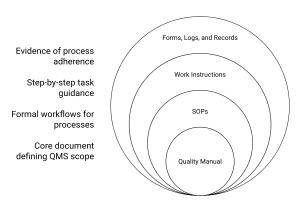
A medical device QMS is structured around four levels of documentation:
- Quality Manual: The top-level document defining your QMS scope, quality policy, and objectives.
- Standard Operating Procedures (SOPs): Formal, repeatable workflows covering processes such as document control, CAPA, and complaint handling.
- Work Instructions: Step-by-step task-level guidance for employees performing specific activities.
- Forms, Logs, and Records: The evidence that processes were followed and compliance was maintained.
Getting this hierarchy right from the beginning makes everything downstream, audits, training and change control, significantly easier to manage.
Key Regulations and Standards Your QMS Must Align With
No matter where you plan to sell your device, your QMS must meet the regulatory requirements of those markets. Here are the frameworks your QARA team needs to understand.
ISO 13485:2016 is the internationally recognised standard for medical device QMS requirements. It takes a process-based approach and covers risk management integration, supplier controls, control of nonconforming products, and post-market surveillance. ISO 13485 certification is widely recognised globally as evidence of a credible, well-structured QMS.
ISO 14971:2019 addresses medical device risk management. It defines a systematic process for identifying hazards, evaluating risks, implementing controls, and monitoring their effectiveness throughout the product lifecycle. Risk management under ISO 14971 is not a one-time activity; it runs continuously alongside all other QMS processes.
FDA QMSR (Quality Management System Regulation) replaced the old 21 CFR Part 820 and became effective on February 2, 2026. The QMSR formally incorporates ISO 13485:2016 by reference, meaning companies already aligned with ISO 13485 will find QMSR compliance considerably more straightforward. QARA teams should map existing compliance against ISO 13485 clauses and ensure staff are trained on the updated requirements.
EU MDR (2017/745) replaced the older Medical Device Directive and introduced significantly stricter requirements, stronger clinical evidence expectations, expanded post-market surveillance, unique device identifier (UDI) requirements, and greater Notified Body scrutiny.
EU IVDR (2017/746) focuses on in vitro diagnostic devices and introduced a new four-class risk-based classification system. It requires extensive clinical performance evaluations and a QMS built to support scientific validity and ongoing lifecycle monitoring.
MDSAP (Medical Device Single Audit Program) allows a single audit to satisfy the requirements of multiple regulators simultaneously, including the FDA, Health Canada, Japan's PMDA, Brazil's ANVISA, and Australia's TGA, reducing the audit burden for companies operating across several markets.
FDA QMSR harmonizes with ISO 13485 — but mastering the standard itself requires deeper operational understanding.
Explore complete ISO 13485 requirements and certification roadmap pharma leaders must know.
→ Read: ISO 13485 Quality Management System | A Pharma Leaders Guide
The 8 Core Processes Inside a Medical Device QMS
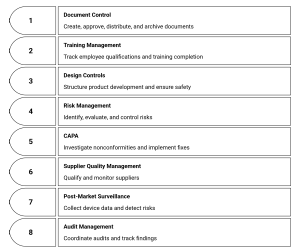
A medical device QMS is a system of interconnected processes, not a single document. Here are the eight core processes every effective QMS must include:
- Document Control manages the creation, approval, distribution, and archiving of all quality documents to ensure everyone works from the current, approved version.
- Training Management Tracks employee qualifications and training completion, ensuring every team member is competent and up to date on the latest procedures.
- Design Controls, Structures product development from user needs through verification, validation, and design transfer, ensuring safety and effectiveness before manufacturing begins.
- Risk Management follows ISO 14971 to identify hazards, evaluate and control risks, and monitor outcomes continuously across the product lifecycle.
- CAPA (Corrective and Preventive Action) investigates root causes of nonconformities or complaints, implements fixes, and prevents recurrence.
- Supplier Quality Management: Qualifies and monitors suppliers to ensure incoming materials and services consistently meet quality requirements.
- Post-Market Surveillance collects and analyses real-world device performance data to detect emerging risks and drive product improvements after launch.
- Audit Management Coordinates internal and external audits, tracks findings, and ensures corrective actions are closed out effectively.
How to Implement a Medical Device QMS
Building or strengthening a QMS does not have to be overwhelming. A clear, stepwise approach makes the process manageable.
Start with a gap analysis, map your current processes against applicable regulatory requirements to identify exactly where the gaps are. Then assign ownership by appointing a QMS lead and involving people from design, manufacturing, regulatory, and quality for well-rounded input.
Next, define your quality policy and measurable objectives, then develop your core documentation: the Quality Manual, SOPs, work instructions, and forms, keeping everything clear and proportionate to the complexity of your processes.
After that, choose the right technology. Paper-based systems work at a small scale but become unmanageable as your company grows. An electronic QMS (eQMS) centralises documents, automates workflows, and provides real-time compliance visibility that paper systems simply cannot.
Finally, train your team consistently and validate your QMS through internal audits and mock inspections before facing a real regulatory review.
Understanding FDA's regulatory evolution helps QARA teams anticipate future compliance shifts and changes.
Learn how foundational FDA requirements shaped today's QMSR framework and what shifted.
→ Read: FDA 21 CFR Part 210: Drug Manufacturing Compliance Guide
Common Challenges and How to Handle Them
Even experienced QARA teams run into the same recurring problems. Keeping up with regulatory changes requires proactive monitoring and a change management process that can respond quickly.
Managing documentation at scale is nearly impossible without the right tools; an eQMS solves most version control and traceability issues outright. Getting cross-functional buy-in means making quality everyone's responsibility, not just the quality department's concern.
And balancing speed to market with rigorous quality controls is a constant tension, but shortcuts almost always cost more in the long run through rework and regulatory delays.
Quality Is a Strategic Asset, Not a Burden
A mature, well-maintained medical device QMS accelerates time-to-market, protects your brand, reduces recall risk, and builds trust with regulators and patients alike.
For QARA professionals, it is the most powerful tool available, not just for staying compliant, but for helping your company deliver products that genuinely improve patient outcomes. When quality is built into how your organisation thinks and operates every day, your QMS stops feeling like overhead and becomes a real competitive advantage.
FAQs
Q1: What is a medical device QMS?
A medical device QMS is a structured framework of policies, processes, and records that ensures devices are designed, manufactured, and monitored to meet safety and regulatory standards consistently throughout the product lifecycle.
Q2: What is the difference between ISO 13485 and FDA QMSR?
ISO 13485 is the international standard for medical device QMS requirements. The FDA QMSR, effective February 2026, incorporates ISO 13485 by reference, aligning US requirements with international standards and reducing compliance duplication for global manufacturers.
Q3: What are the core components of a medical device QMS?
The core components include document control, training management, design controls, risk management, CAPA, supplier quality management, post-market surveillance, and audit management.
Q4: How long does QMS implementation take?
A startup building from scratch can typically expect six to twelve months to implement a QMS and achieve ISO 13485 certification. Companies with existing systems may take less time, depending on the gaps identified.
Q5: What is the advantage of an eQMS over a paper-based system?
An eQMS centralises documentation, automates workflows, reduces manual errors, and provides real-time compliance visibility, making audit preparation faster and quality management more scalable as the company grows.
Reporting on the science, business and regulation shaping the pharmaceutical industry.
More in Regulatory Intelligence
All articles →
The Pattern Behind FDA Warning Letters: What Startups & CDMOs Often Miss

ISO 14644 Cleanroom Classes for Pharma (with EM Implications)

Discussion