by Simantini Singh Deo
9 minutes
The Future Of Computerized Systems Validation (CSV)
CSV is being dismantled, not evolved. FDA's CSA shift, GAMP 5 Ed.2, and AI validation are rewriting pharma's rules in 2026.
For more than two decades, Computerized Systems Validation (CSV) has been one of the most resource-intensive activities in regulated life sciences manufacturing. Its traditional model relied on exhaustive scripted testing, binders of signed documentation, and full re-validation triggered by even minor software changes. That model was built for a different era — one where enterprise software changed once every few years. That era is over.
Cloud platforms now push updates weekly. AI and machine learning models evolve continuously, often without a clear version event to mark the change. The future of CSV is not simply an evolution of the old model. It is, in large part, the dismantling of it.
A handful of recent regulatory milestones show exactly how fast this shift is moving:
- On September 24, 2025, the FDA's Center for Devices and Radiological Health (CDRH) and Center for Biologics Evaluation and Research (CBER) jointly published final guidance titled “Computer Software Assurance for Production and Quality System Software” (Docket No. FDA-2022-D-0795). This followed a draft first issued in September 2022.
- The guidance “supersedes Section 6” of the FDA's older “General Principles of Software Validation” guidance, formally retiring that section's CSV-centric approach
- The “ISPE GAMP® Guide: Artificial Intelligence” — a 290-page industry framework for validating AI/ML systems in GxP environments, written by more than 20 industry and academic experts — was published in “July 2025”
- The “GAMP 5 Second Edition”, the industry's primary risk-based validation framework, was updated in 2022 with new appendices on AI/ML, cloud computing, and Agile development — laying the groundwork that the industry has spent the past three years building on
From CSV To CSA: What Actually Changed?
The central development shaping the future of validation is the FDA's formal shift from Computer System Validation (CSV) to Computer Software Assurance (CSA). This is not a rebranding exercise. It is a genuine philosophical change in how regulators define what "validated" actually means and it carries real consequences for how validation teams spend their time and budget.
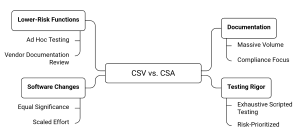
The distinction between the two models comes down to four key differences:
- CSV proves compliance through documentation volume. The traditional model required exhaustive scripted testing of every software function. This applied regardless of whether that function carried any meaningful risk to patient safety or product quality. Full revalidation was effectively required after nearly any change.
- CSA proves assurance through risk-prioritized critical thinking. The new model asks manufacturers to start with one simple question: what is this software actually used for? From there, teams assess the real risk to patient safety and product quality, then target their testing rigor accordingly. The FDA describes this as a "risk-based" approach designed to be no more burdensome than necessary.
- CSV treats every software change as equally significant. A minor interface update and a change to a critical algorithm both historically triggered a comparable revalidation burden under classic CSV practice.
- CSA scales validation effort to consequence. Lower-risk functions — particularly those built on already-validated, off-the-shelf platforms can be assured through lighter-touch methods, such as ad hoc testing or vendor documentation review. Higher-risk functions still receive rigorous, scripted testing.
One Important Clarification: The FDA's CSA guidance does not change the underlying regulatory text. The Quality System Regulation (21 CFR Part 820) and, for drugs, 21 CFR Parts 210/211 remain in force exactly as written. What CSA modernizes is the “philosophy and method” companies use to demonstrate GMP-quality outcomes, not the legal requirement to demonstrate them.
The philosophy changed.
The mechanics of actually applying it are a deeper question entirely.
→ Read: FDA Computer Software Assurance (CSA): A Definitive Guide For Pharma Leaders
What The Guidance Actually Covers And Doesn't?
Understanding the future of CSV means understanding the precise scope of the FDA's September 2025 guidance. Its boundaries matter just as much as its content.
The Guidance Applies Specifically To:
- Computer systems and automated data processing used in production or quality operations including manufacturing execution systems, electronic document management systems, and laboratory information systems
- Medical device manufacturers, as the guidance's primary stated scope, issued under the Quality System Regulation (21 CFR Part 820)
The Guidance Explicitly Does Not Apply To:
1) Software-in-a-Medical-Device or Software-as-a-Medical-Device products where the software itself is the regulated device. These continue to follow separate device software validation and premarket submission pathways.
2) Drug-specific CGMP requirements as a standalone matter. The FDA and industry observers widely expect a parallel or extended application of CSA principles to pharmaceutical quality systems. Some industry sources point to early 2026 as a likely timeframe for further FDA action, though this is worth confirming against FDA's own published guidance index as it becomes available, rather than treating it as settled fact today.
This scope distinction is becoming more important as manufacturers deploy systems that blend production tooling with embedded AI functionality. Increasingly, the line between "quality system software" and "medical device software" is no longer obvious.
GAMP 5: The Industry Framework Operationalizing The Shift
Running parallel to the FDA's regulatory shift is the continued evolution of GAMP 5, Good Automated Manufacturing Practice, the ISPE-developed framework most life sciences companies use to put validation strategy into practice. The GAMP 5 Second Edition, published in 2022, modernized the original framework to address the exact technologies now reshaping CSV's future.
The most consequential updates introduced in GAMP 5 Second Edition include:
- New appendices addressing AI/ML, cloud computing, and blockchain. These technologies were largely absent from the original GAMP 5 framework. They now have dedicated, risk-based validation guidance.
- Explicit support for Agile and iterative development. The rigid, linear "V-model" validation lifecycle is no longer the only accepted approach. Iterative methodologies are now formally supported throughout the system lifecycle.
- Clarified treatment of electronic signatures under Agile workflows. Formal electronic-signature requirements apply specifically to records governed by predicate rules, not to every internal approval step in an Agile development process.
- A distinct cloud and SaaS framework. This provides practical guidance on evaluating cloud vendor risk, data integrity in multi-tenant environments, and validation responsibilities once infrastructure sits outside a company's direct control.
In July 2025, ISPE built on this foundation with a dedicated “GAMP Guide: Artificial Intelligence” — a 290-page, expert-authored framework addressing exactly what GAMP 5 Second Edition could only gesture toward: how do you validate a system whose behavior is shaped continuously by data, rather than fixed at the moment of release?
Validating AI: The Frontier The Future Of CSV Must Solve
The hardest unresolved challenge in the future of computerized systems validation is simple to state and hard to solve: how do you validate a system that never stops changing? Traditional validation logic assumes a system, once tested and approved, behaves identically until a human developer introduces a deliberate, documented change.
Artificial intelligence and machine learning models break that assumption at a structural level. No legacy validation framework was ever designed to handle this reality.
20260624123850.svg "AI Validation Framework")
The emerging best practices for AI/ML validation, drawn from the 2025 ISPE GAMP AI Guide and reinforced by the FDA's broader AI guidance activity include:
- Treating data as a validated deliverable in its own right. An AI model's behavior is inseparable from its training data, so the data lifecycle itself must be tracked and validated alongside the software. In machine learning, data quality and model quality cannot be separated.
- Applying data integrity principles (ALCOA+) to AI training data. Training datasets, annotations, and preprocessing steps must be attributable, legible, contemporaneous, original, and accurate — with added emphasis on completeness, consistency, durability, and availability.
- Monitoring for model drift as an ongoing validation activity. Rather than a one-time approval event, AI validation increasingly requires continuous performance monitoring, watching for the moment a model's real-world behavior diverges from its validated baseline.
- Aligning quality risk management with established frameworks. The ISPE Guide explicitly references standards such as ISO/IEC 42001:2023 for AI management systems, placing AI validation within recognized international quality infrastructure rather than treating it as something entirely new.
Conclusion: Validation As Continuous Assurance, Not A One-Time Event
The future of Computerized Systems Validation is not a future without validation. It is a future where validation becomes proportional, continuous, and genuinely risk-informed, rather than reflexively comprehensive regardless of actual stakes.
The shift from CSV to CSA, formalized in the FDA's September 2025 final guidance and reinforced by GAMP 5 Second Edition and the 2025 ISPE GAMP AI Guide, shows the regulatory and industry quality apparatus finally catching up to a software landscape that has outpaced the validation models built to govern it.
One thing remains constant even as the methodology transforms: the underlying purpose. Patient safety, product quality, and data integrity are non-negotiable. The companies that genuinely thrive in this new landscape will stop treating validation as a checkbox completed once at launch and forgotten.
Instead, they will treat it as a continuous discipline, built on critical thinking, proportional risk assessment, and ongoing assurance. That discipline must apply just as rigorously to a self-updating AI model as it once applied to a static piece of enterprise software running quietly in a server room.
CSV and CSA are not interchangeable terms.
Knowing exactly where one ends and the other begins is the real test for validation teams.
→ Read: CSV vs CSA: Computer System Validation vs Software Assurance Explained
FAQs
1) What Is Driving The Shift From CSV To CSA In Regulated Industries?
The move from Computerized Systems Validation (CSV) to Computer Software Assurance (CSA) is being driven by the rapid evolution of modern software technologies, including cloud platforms, Agile development, and artificial intelligence. Traditional CSV approaches often required extensive documentation and testing regardless of the actual risk associated with a software function. CSA introduces a more flexible, risk-based methodology that focuses validation efforts where they matter most. This allows organizations to maintain compliance while improving efficiency and reducing unnecessary validation burdens.
2) How Does Computer Software Assurance (CSA) Differ From Traditional CSV?
CSA emphasizes critical thinking and risk assessment rather than relying heavily on documentation volume as proof of compliance. Instead of testing every software function with the same level of rigor, organizations evaluate how a system impacts product quality and patient safety before determining the appropriate testing approach. Lower-risk functions may require less formal testing, while high-risk functions continue to receive comprehensive validation. This approach helps companies focus resources on areas that have the greatest potential impact.
3) Why Is Artificial Intelligence Creating New Validation Challenges?
Artificial intelligence and machine learning systems can continuously evolve based on new data, making them fundamentally different from traditional software applications. Conventional validation methods assume that software behavior remains unchanged until a documented update occurs. AI models may experience performance changes over time through model drift, requiring ongoing monitoring rather than one-time validation. As a result, organizations must develop new strategies to ensure AI systems remain reliable, accurate, and compliant throughout their lifecycle.