by Vaibhavi M.
8 minutes
GMP and QMS: Answers to the 11 Most Frequently Asked Questions
11 straight answers to the GMP and QMS questions pharma QA teams ask most. No guesswork, no product pitch, just clarity. 121 characters

GMP compliance is not optional in the life sciences industry. Whether you manufacture pharmaceuticals, APIs, or medical devices, building a robust Quality Management System (QMS) that meets GMP requirements is a core regulatory obligation. Yet, many quality professionals still run into the same recurring questions about audit trails, validation, change control, risk management, and more.
This article addresses the top 11 FAQs about GMP guidelines for a QMS, providing straightforward answers grounded in regulatory expectations from the FDA, EMA, WHO, and ICH.
What Is a GMP-Compliant QMS?
A Quality Management System (QMS) under GMP is a structured framework that defines, validates, and controls every aspect of pharmaceutical manufacturing. It goes beyond documentation; it covers people, processes, systems, and continuous improvement. Regulatory frameworks such as FDA 21 CFR Parts 210/211, EU GMP (EudraLex Volume 4), WHO GMP, and ICH Q10 all describe how a QMS must be built and maintained to ensure that every batch produced is safe, effective, and of consistent quality.
Top 11 FAQs About GMP Guidelines for QMS
FAQ 1: What are the core elements a GMP-compliant QMS must include?
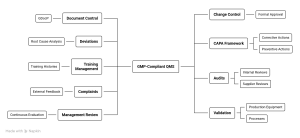
A GMP-compliant QMS must cover the following key processes:
- Document control and Good Documentation Practices (GDocP)
- Change management and change control
- Deviation management and investigation
- Corrective and Preventive Actions (CAPA)
- Training management
- Audit management (internal and supplier)
- Complaint handling
- Equipment qualification and process validation
- Management review
These are not optional add-ons. ICH Q10 describes them as the backbone of a Pharmaceutical Quality System, and both FDA and EMA inspectors will evaluate each area during regulatory inspections.
FAQ 2: Is audit trail functionality mandatory in computerised systems?
Yes. As per EU GMP Annex 11 and FDA 21 CFR Part 11, audit trails must be in place for all GMP-relevant data and any modifications made within a computerised system. This means the system must automatically capture who made a change, what was changed, when it happened, and, where possible, why it was changed.
If audit trail functionality was not available when a system was originally acquired, the first step is to check whether that functionality can now be enabled or added. If it genuinely cannot be implemented, neither Annex 11 nor 21 CFR Part 11 prescribes a specific alternative, but procedural controls through Good Documentation Practice must be applied to ensure all changes to GMP-relevant data are fully documented.
Regulators expect audit trails to be routinely reviewed as part of ongoing data integrity monitoring, not just during audits.
Annex 11 and 21 CFR Part 11 are not the same beast.
Know exactly where they split before your system fails you.
→ Read: 21 CFR Part 11 vs EU GMP Annex 11: What Every Life Sciences Professional Must Know
FAQ 3: What does ALCOA+ mean, and why does it matter for GMP documentation?
ALCOA+ is the internationally accepted standard for data integrity in regulated environments. Each letter stands for:
Principle | Meaning |
|---|---|
A – Attributable | Every record must identify who performed the action |
L – Legible | Records must be readable throughout their retention period |
C – Contemporaneous | Data must be recorded at the time the activity occurs |
O – Original | The first-captured record is the authoritative one |
A – Accurate | Records must reflect what actually happened |
+ | Also: Complete, Consistent, Enduring, and Available |
Failing to meet ALCOA+ expectations is one of the most common triggers of FDA warning letters and EU GMP deficiency findings. Every QMS document, from batch records to deviation reports, must meet these criteria.
FAQ 4: What is the difference between a deviation and a CAPA?
This is one of the most frequently confused areas in GMP.
A deviation is any departure from an approved procedure, specification, or established standard. It can be planned (prior to the occurrence) or unplanned (discovered after the occurrence). Deviations must be documented, investigated for root cause, and assessed for product impact.
A CAPA (Corrective and Preventive Action) is the systematic response to a deviation or quality issue. It has two parts:
- Corrective Action - fixes the problem that has already occurred
- Preventive Action - eliminates the root cause to stop recurrence
Not every deviation requires a CAPA. Significance, recurrence, and product/patient risk should drive that decision. However, when a CAPA is opened, it must include measurable acceptance criteria and an effectiveness check to confirm the problem does not return.
FAQ 5: How does change control work under GMP?
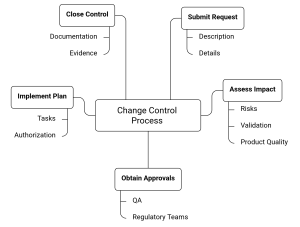
Change control is the formal process for evaluating, approving, implementing, and documenting changes that could affect product quality, process performance, or regulatory compliance. Under GMP, no change to a validated process, system, or facility can be implemented without going through a documented change control process.
Key steps in a GMP change control process:
- Submit a change request with a clear description
- Conduct an impact assessment on product quality, validation status, and regulatory filings
- Obtain appropriate approvals (QA, technical leads, Regulatory Affairs if needed)
- Implement the change according to the approved plan
- Close the change with documented evidence that it was completed correctly
A poorly managed change control system is a direct route to losing a validated state and to regulatory findings.
Change control done wrong is a validated state lost.
See how a documented change process keeps your GMP standing intact.
→ Read: Mastering Change Control In Pharmaceutical Manufacturing: A Detailed And Clear Guide
FAQ 6: What tools can be used for Quality Risk Management (QRM)?
GMP guidelines do not restrict which tools a company uses for quality risk management. What matters is that the chosen method is fit for purpose and well-documented. Commonly used QRM tools include:
- FMEA (Failure Mode and Effects Analysis)
- HACCP (Hazard Analysis and Critical Control Points)
- Fault Tree Analysis (FTA)
- Risk ranking and filtering
- Ishikawa (fishbone) diagrams
Companies can also combine tools for a more comprehensive assessment. EU GMP Part III provides several practical examples of QRM in use. The goal is to systematically identify, evaluate, control, and communicate quality risks, with patient safety as the primary consideration, in line with ICH Q9.
FAQ 7: Does the Qualified Person (QP) have a formal role in process validation?
The Qualified Person (QP) does not have a formally defined role in the validation process itself. However, including the QP in validation activities is strongly recommended, and, practically speaking, it makes good sense. The QP is ultimately responsible for certifying each batch before it is released to the market. That release decision can only be made with confidence when the QP understands and trusts the quality systems and validated processes used during manufacturing.
In the EU, the QP must also confirm that active substances are manufactured in accordance with GMP guidelines and that the entire supply chain has been appropriately controlled.
FAQ 8: How should a company handle out-of-specification (OOS) results in a GMP environment?
An out-of-specification (OOS) result is any test result that falls outside the established acceptance criteria. Under GMP, an OOS result cannot simply be repeated or dismissed. The required approach is:
- Phase I Laboratory Investigation: Determine if there was a laboratory error (instrument issue, analyst mistake, sample preparation error)
- Phase II Full-Scale Investigation: If no assignable lab error is found, a full manufacturing investigation must be conducted
- CAPA must be raised if a root cause is identified
- Batch disposition decisions must be documented and justified
Regulatory agencies, particularly the FDA, have issued detailed guidance on OOS investigations. Failing to conduct a thorough and timely OOS investigation is a frequently cited GMP deficiency.
FAQ 9: What is a Product Quality Review (PQR) and how often should it be done?
A Product Quality Review (PQR), called an Annual Product Review (APR) under FDA terminology, is a periodic review of all batches of a product manufactured during a defined period, typically one year. Its purpose is to identify trends, verify the consistency of the process, and determine if any improvements are needed.
A comprehensive PQR should cover:
- Batch release data and any batch failures
- Deviations and their outcomes
- CAPAs opened and closed
- Out-of-specification and out-of-trend results
- Change control actions
- Complaints and recalls
- Stability data
- Raw material and supplier performance
EU GMP Chapter 1 and FDA 21 CFR 211.180(e) both require PQRs. They are a key tool for demonstrating continuous process improvement and sustained GMP compliance.
FAQ 10: What are the GMP expectations for supplier qualification?
GMP requires that all suppliers of critical raw materials, APIs, excipients, and services be qualified before use. Supplier qualification is not a one-time exercise; it is an ongoing quality management process.
GMP Supplier Qualification Checklist:
- Supplier audit conducted (on-site or remote) before approval
- Supplier questionnaire completed and reviewed
- Quality Agreement (Technical Agreement) in place
- Certificate of Analysis reviewed against specifications
- Risk assessment performed and documented
- The Approved Supplier List (ASL) is maintained and current
- Periodic re-qualification schedule established
- Change notification process agreed with the supplier
- Performance monitoring (complaints, deviations, OOS) is in place
For API suppliers specifically, ICH Q7 sets out detailed GMP expectations that must be met as part of qualification.
FAQ 11: Can a digital or electronic QMS (eQMS) be used under GMP?
Yes, and increasingly it is the preferred approach. An electronic QMS (eQMS) can fully support GMP compliance, provided it is properly validated in line with Annex 11 (EU) or 21 CFR Part 11 (US). The system must be able to demonstrate controlled access, audit trail functionality, electronic signature compliance, and data integrity throughout the record lifecycle.
Modern eQMS platforms offer significant advantages over paper-based systems: automated workflows, real-time CAPA tracking, linked training management, and faster inspection readiness. The FDA's updated guidance on Computer Software Assurance (CSA), released in 2022, further supports a risk-based approach to validating these systems, shifting the focus from exhaustive testing to demonstrating intended use and business impact.
Summary
GMP compliance within a QMS touches every function, from document control and training to validation, risk management, and supplier oversight. The questions covered above represent the issues quality teams navigate most frequently, and understanding them clearly is the foundation of a strong quality culture.
FAQs
Q1. What does GMP stand for in pharma?
GMP stands for Good Manufacturing Practice. It refers to the set of regulations and guidelines that ensure pharmaceutical products are consistently produced and controlled to meet defined quality standards.
Q2. What is the difference between GMP and QMS?
GMP is the regulatory framework; a QMS is the system a company builds to comply with it. GMP defines the "what," while the QMS defines the "how" through documented processes, procedures, and controls.
Q3. Is a QMS mandatory under GMP?
Yes. Regulatory bodies, including the FDA, EMA, and WHO, all require companies to operate a documented Quality Management System as a core condition of GMP compliance and product approval.
Q4. What is CAPA in GMP?
CAPA stands for Corrective and Preventive Action. It is a systematic process used to investigate quality problems, eliminate root causes, and prevent recurrence, a mandatory element of any GMP-compliant QMS.
Q5. What happens if a company fails a GMP inspection?
Consequences can include FDA warning letters, import alerts, manufacturing suspensions, product recalls, or the withdrawal of the EU GMP certificate, depending on the severity and nature of the deficiencies identified.