by Simantini Singh Deo
14 minutes
ISO Audit Readiness: Building Strong Documentation, CAPA, and Training Systems
Discover how to build an always-ready pharma QMS. Stop the last-minute panic and fix the 10 most common ISO audit pitfalls.

Let's be honest — the words "ISO audit" can make even experienced quality professionals feel a little uneasy. There's always that quiet worry in the back of your mind: Are we really ready? Is everything in order? What if the auditor finds something we missed?
If you work in life sciences such as pharmaceuticals, medical devices, biotech, or diagnostics, ISO audits are simply part of the job. They're how the outside world confirms that your processes are real, your quality system is working, and your products are safe to trust. Standards like ISO 13485 and ISO 9001 aren't just paperwork requirements.
They represent a promise, to your customers, to regulators, and to the patients at the end of your supply chain. This guide is written for anyone who wants to understand ISO audits more clearly, what they are, why they matter, what goes wrong, and how to make sure your team is prepared without the last-minute panic.
Whether you're walking into your first audit or your tenth, there's always something worth knowing before the auditor walks through the door!
Breaking Down The Basics: So, What Exactly Is An ISO Audit?
At its core, an ISO audit is a structured, independent review of your quality system. A qualified auditor, usually from an external certification body, comes in to assess whether your processes, documentation, and practices genuinely meet the requirements of a specific ISO standard.
For life sciences companies, the stakes are higher than in most other sectors. Your products aren't consumer goods. They affect real patients, real health outcomes, and real lives. That's exactly why these audits carry so much weight. The standard that's relevant to your work will depend on what your company does:
- ISO 13485 — designed specifically for medical device manufacturers and their suppliers, with a strong focus on regulatory compliance and risk management
- ISO 9001 — the foundational quality management standard applicable across industries, including healthcare and biotech
- ISO 15189 — built for medical laboratories, covering the quality and competence of testing services
It also helps to understand that not every audit is the same type. Knowing which kind you're dealing with changes how you prepare:
- First-party audits are internal audits your own team carries out. Think of these as your dress rehearsal, a chance to find problems before anyone else does.
- Second-party audits are conducted by external parties with a direct interest in your operations, like a major customer assessing a supplier.
- Third-party audits are performed by accredited, independent certification bodies. These are the ones that count for certification or recertification and where your QMS is truly tested under pressure.
The Real Price Of Getting It Wrong: What A Failed Audit Actually Costs You
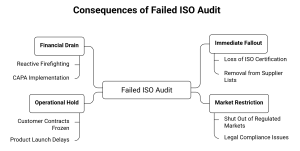
Here's something most people don't fully appreciate until they're in the middle of it: failing an ISO audit isn't just an embarrassing report on a shelf. It can genuinely shake the foundations of your business.
The consequences are practical, financial, and reputational and they tend to compound. When a life sciences company loses its ISO certification or receives a major finding, the immediate fallout can include:
- Being shut out of regulated markets where ISO certification is a legal or contractual requirement to operate
- Losing customer contracts, especially with large healthcare systems, distributors, or OEMs who require certified vendors
- Disqualification from supplier lists of partners who simply won't work with uncertified companies
That's just the beginning. Once an audit failure is on record, you're also dealing with:
- A formal Corrective Action Plan (CAP), which means documenting every issue, conducting root cause analysis, implementing changes, and providing evidence that each problem has been resolved — often under a tight deadline
- Increased audit frequency, where regulators return more often to verify that findings are being addressed
- Product launch delays or holds, because certification gaps can freeze your path to market
- Warning letters or recall notices in serious cases, particularly when patient safety is implicated
And beyond all of that, there's the human cost. Failed audits drain people. They shift your quality team from meaningful improvement work into reactive firefighting. They create tension between departments.
They slow momentum at exactly the moment when you want to be moving forward.
The hardest part? Most of it is preventable. The effort required to clean things up after a failed audit almost always exceeds what it would have taken to prepare thoughtfully in the first place.
Where Things Fall Apart: 10 Audit Pitfalls That Catch Teams Off Guard?
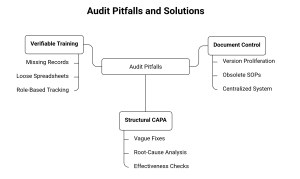
After seeing audits go well and watching some go poorly, certain patterns emerge. The same issues appear again and again, across companies of different sizes, in different parts of the industry. The good news is that once you know what to look for, these mistakes are very much fixable.
1) Your Documents Are All Over the Place
Document control issues are the most common audit finding for a reason. It's not that companies don't have documents, it's that those documents aren't managed carefully enough.
Procedures go out of date. Different departments use different versions. Updates happen without proper approvals. And when an auditor asks to see the current SOP for a process, someone ends up scrambling through folders to find it.
To avoid this, your document management needs to be:
- Centralised, so there's one clear location for every approved document
- Version-controlled, with a complete history of changes and who authorised them
- Accessible, so the right people can find the right document without having to ask around
- Disciplined, meaning old versions are retired and not floating around in inboxes or shared drives
2) Your CAPA Records Don't Tell the Full Story
Corrective and Preventive Action (CAPA) is one of the areas auditors look at most carefully — because it tells them whether your quality system actually learns and improves, or just generates paperwork.
A weak CAPA process often looks like this:
- Issues are closed quickly without identifying the real root cause
- Actions are vague ("procedure updated," "staff reminded") with no specifics
- There's no follow-up to check whether the fix actually worked
- The same issue reappears in the next audit because nothing truly changed
What a strong CAPA looks like instead:
- A clear description of the problem and how it was discovered
- A documented root cause analysis (5 Whys, fishbone, or equivalent)
- Specific actions with named owners and deadlines
- Evidence of effectiveness verification — proof the fix worked
Weak CAPA records are one of the most common audit findings.
Learn how to write CAPA reports that satisfy auditors and prevent recurrence.
→ Read: How To Write a CAPA Report That Stands Up To Any Audit
3) Nobody Can Prove Who Was Trained On What
Training records are one of the simplest things to get right, yet they're consistently flagged during audits. The requirement isn't complicated: you need to show that the right person was trained on the right procedure at the right time, before they performed the task.
In practice, this means your training records should include:
- The name of the employee who completed the training
- The exact title and version of the document or procedure they were trained on
- The date the training was completed
- Some form of acknowledgement or assessment confirming they understood it
If your records are stored in a spreadsheet or emailed around, there's a real chance something is missing or inconsistent. That's a gap an auditor will find.
4) Leadership Shows Up Only When There's A Problem
Quality management is not just a job for the quality department. It never has been. But in many companies, leadership treats ISO compliance as something that gets delegated and forgotten, until an audit arrives. Auditors can tell the difference immediately.
What auditors want to see from leadership includes:
- Regular management review meetings where quality data is actually discussed and acted on
- Documented evidence that leadership sets quality objectives and monitors progress against them
- Active support for CAPA processes and resource allocation for improvement
- A visible commitment to quality that flows down through the organisation
If your management team can't speak to recent quality trends or findings during an audit, it sends a clear message and not a good one.
5) Risk Is Documented But Not Really Managed
Risk management is woven into most ISO standards, and for good reason. In life sciences, unmanaged risk translates directly into potential harm. Yet it's an area where many companies produce documentation that looks thorough on paper but doesn't hold up under questioning.
Your risk management approach should be able to demonstrate:
- Identified risks at each relevant stage of the product or process lifecycle
- A clear link between risks and the controls or mitigations put in place
- Evidence that risk decisions were reviewed and approved appropriately
- Updates to the risk register when new information emerged or processes changed
Risk management isn't a document you produce once and file away. It's an ongoing activity, and auditors know when it hasn't been treated that way.
6) You've Lost Track Of What Your Suppliers Are Actually Doing
Your quality system doesn't stop at your front door. Suppliers who contribute to your product or service quality are part of your compliance picture too. If a component fails, a material is out of specification, or a service provider causes a problem, the audit trail comes back to you.
Effective supplier oversight means keeping up-to-date records of:
- Supplier qualification and approval status
- Current certifications and when they expire
- Audit results — your own or third-party assessments
- Complaint history and how issues were resolved
- Ongoing performance monitoring data
If you can't quickly produce evidence that your critical suppliers are qualified and being monitored, expect questions.
7) Critical Processes Are Still Living In Spreadsheets
Most quality teams have some version of "the spreadsheet that runs everything." It starts as a temporary solution and somehow becomes the system. Spreadsheets, shared drives, and email chains can work for a while — but they introduce real risks that are hard to defend during an audit.
The problems with manual systems include:
- No reliable version control — files get overwritten or go missing
- No clear audit trail — you can't see who changed what and when
- No automatic reminders for renewals, reviews, or expiring documents
- Difficulty linking related records (a CAPA to a training record to a document change, for example)
Moving critical workflows into a proper QMS doesn't have to happen overnight. But every manual workaround that still exists is a potential gap waiting to be found.
8) Changes Are Being Made With No Clear Trail Behind Them
Traceability is a non-negotiable expectation in ISO audits. Auditors need to be able to follow the thread from a decision to its evidence — who made a change, when, why, and who signed off on it. When that trail has gaps, it raises questions about the integrity of your entire system.
A complete audit trail should capture:
- Who initiated a change or action
- The date and time it was made
- What specifically was changed
- Who reviewed and approved it
- Any comments or justifications attached to the record
Missing pieces don't just fail the checklist, they suggest to the auditor that your system may not be as controlled as it appears.
Complete audit trails and traceability are foundational to ISO 13485 compliance.
Understand the full QMS framework that auditors expect to see.
→ Read: ISO 13485 Quality Management System | A Pharma Leaders Guide
9) Audit Prep Only Starts When The Auditor's Date Is Confirmed
One of the most telling signs of an underprepared quality team is the flurry of activity that starts three weeks before an audit. Documents suddenly get updated. Training gets pushed through. Records get tidied up in a hurry. Auditors have seen this pattern many times, and it doesn't inspire confidence.
Companies that consistently pass audits tend to:
- Conduct internal audits on a regular, planned schedule — not just when an external audit is approaching
- Maintain documents and records as a continuous responsibility, not a seasonal one
- Hold regular management reviews so quality data is always current and reviewed
- Treat audit readiness as a state of being, not a project with a start and end date
When your team operates this way, an external audit isn't a test you study for. It's a confirmation of how you already work.
10) The Same Issues Keep Coming Back Audit After Audit
If the same issue appears in multiple consecutive audits, it tells the auditor something important: your corrective action process isn't working. Either the root cause wasn't properly identified, the fix wasn't fully implemented, or no one verified that it actually held over time.
To break this cycle, you need to:
- Keep a clear log of all previous audit findings and their current status
- Verify that corrective actions were truly completed — not just documented as complete
- Schedule follow-up internal reviews of areas that have been flagged before
- Escalate persistent issues to leadership rather than leaving them to the quality team alone
Recurring findings are one of the fastest ways to damage your relationship with an auditor and signal that your quality culture needs attention
Key Takeaways
There's a lot to take in from everything above, so here's the version you can come back to quickly when you need it!
- ISO audits are not bureaucratic exercises, they're a meaningful test of whether your quality system actually works, and in life sciences, the safety of patients depends on getting it right.
- Failing an audit has real consequences: loss of certification, market access issues, product delays, increased regulatory scrutiny, and significant internal disruption.
- The most common failures are avoidable, poor document control, weak CAPAs, missing training records, and insufficient management involvement are all fixable before an auditor arrives.
- Audit readiness isn't a project, it's a practice, the companies that consistently do well treat quality as an everyday discipline, not a seasonal effort.
- Your suppliers are part of your compliance picture, overlooking supplier oversight is a mistake that auditors will catch.
- Technology helps, but culture matters more, a good QMS makes compliance easier to manage, but only if the people using it are committed to doing things properly.
- Internal audits are your best preparation tool, use them honestly, act on the findings, and treat them as a gift that gives you the chance to fix things on your own terms.
Conclusion: Building a Quality System That's Always Ready
Preparing for an ISO audit shouldn't feel like cramming before an exam. The companies that handle audits with confidence aren't the ones that prepared hardest in the final weeks — they're the ones that built good habits into how they work every single day.
That means keeping documentation current and controlled. It means taking CAPA seriously as a learning process, not just a compliance checkbox. It means training people properly and keeping the records to prove it. It means involving leadership in quality conversations, not just sending them the report. And it means using internal audits honestly, finding the gaps yourself, before someone else does.
When you operate this way, an ISO audit stops being something that happens to you and starts being something that confirms what you already know: that your team is doing the work, your system is solid, and your organisation is worthy of the trust that certification represents.
That confidence is built one good habit at a time. Start now, before the next audit date appears on the calendar.
FAQs
1. What Is An ISO Audit And Why Does It Matter?
An ISO audit is a formal, independent review of your Quality Management System (QMS) to confirm that your processes meet the requirements of standards like ISO 13485, ISO 9001, or ISO 15189. It matters because passing an audit proves your organisation is reliable, compliant, and committed to patient safety and product quality. This helps build trust with regulators, customers, and partners.
2. What Happens If A Company Fails An ISO Audit?
Failing an ISO audit can lead to losing certification, being removed from supplier lists, delaying product launches, and facing increased regulatory oversight. It also results in corrective actions, additional audits, and significant internal workload to fix the issues. These consequences can disrupt operations and impact long-term business growth.
3. What Are The Most Common Reasons Companies Struggle During ISO Audits?
Common issues include poor document control, incomplete CAPA records, missing or inconsistent training documentation, unclear risk management, lack of supplier oversight, and last-minute audit preparation. These problems are preventable with consistent maintenance and a well-structured QMS. Strengthening these areas ahead of time makes audits far smoother and less stressful.