by Manish Bhatkar
9 minutes
A Practical Guide To Loan Licensing And Contract Manufacturing In Schedule M 2023
Learn how Schedule M 2023 Section 9 governs loan licensing and contract manufacturing with strict GMP controls.
Loan licence and contract manufacturing have become essential components of modern pharmaceutical operations. As companies expand their market presence, optimize costs, and respond to fluctuating demand, the need to outsource certain manufacturing and testing activities has grown significantly.
However, outsourcing does not reduce a company’s responsibility for quality or regulatory compliance. Schedule M 2023, specifically Section 9, ensures that when pharmaceutical work is carried out by another licensed manufacturer or laboratory, it is done under strict GMP control.
This framework protects patient safety, maintains product integrity, and ensures that activities conducted outside the primary organization meet the same standards as those conducted internally. This article offers a structured, narrative explanation of Section 9.
It provides a clear understanding of what loan licence and contract manufacturing entail, how these arrangements must be managed, and what responsibilities both parties hold under the updated requirements.
Understanding The Concept Of Loan Licence And Contract Manufacturing
Loan licence and contract manufacturing refer to formal arrangements in which one company outsources production or analytical activities to another licensed facility. These arrangements allow companies to manufacture products without owning the entire infrastructure themselves.
However, Schedule M 2023 makes it clear that these partnerships must be carefully defined and rigorously controlled. According to Clause 9.1, any activity connected to Good Manufacturing Practices must be correctly defined, agreed upon, and executed in a manner that prevents misunderstanding or quality failures.
In practice, this means that the organization outsourcing the work, called the contract giver or loan licensee, remains fully responsible for the quality, safety, and compliance of the product, regardless of where the operations take place. The contract acceptor performs the work, but the accountability for the final product never shifts away from the contract giver.
The Regulatory Foundation And Purpose Of Section 9
Section 9 establishes the rules governing every outsourced GMP activity. Its central purpose is to ensure that quality standards remain consistent, even when production or testing happens outside the primary manufacturing site.
The regulation emphasizes that all arrangements must be in line with the approved product licence. Any activity related to manufacturing, technology transfer, or analytical testing must comply with the regulatory requirements specified in the product approval.
Additionally, the contract must give the contract giver explicit rights to audit the contract acceptor and verify compliance at any time. This includes the ability to inspect:
- Facilities
- Documentation
- Quality systems
- Subcontractors (If Applicable)
Another core requirement is that the authority for final batch release cannot be transferred. Even if analysis or manufacturing is outsourced, Clause 9.2.3 states that the final decision to release a batch must come from the authorised person at the contract giver’s site. This provision ensures that the final quality decision remains under the control of the organization that holds the licence for the product.
Section 9 sits within a much larger regulatory overhaul. Before diving deeper,
understand the full scope of what Schedule M 2023 demands from Indian pharma manufacturers.
→ Read: India's New GMP Rules Are Here: Everything You Need to Know About Schedule M 2023
Responsibilities Of The Contract Giver
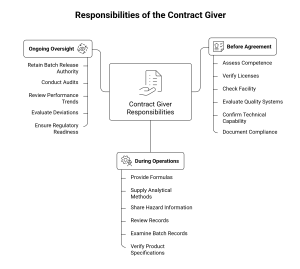
The contract giver carries the highest level of responsibility in this arrangement. Section 9 places detailed expectations on this party to evaluate, control, and continuously oversee all outsourced activities.
Before entering into any agreement, the contract giver must assess the contract acceptor for legal, technical, and GMP competence. This includes verifying:
- Valid manufacturing licences
- Suitability of facilities and equipment
- Adequacy of quality systems
- Technical capability and expertise
- Compliance with Quality Risk Management principles
These checks must be documented thoroughly and retained as evidence of compliance.
Once an arrangement begins, the contract giver must provide all the information necessary for the contract acceptor to carry out the work correctly.
This Includes:
- Detailed manufacturing formulas
- Batch records
- Analytical methods
- Specifications
- Hazard information
- SOPs and supporting documents
Without this information, the contract acceptor cannot correctly meet the quality requirements laid out in the product licence. The contract giver must also review every record generated by the contract acceptor.
Batch manufacturing records, in-process data, analytical results, and certificates of analysis must be carefully examined to ensure the product meets specifications. Only after this review may the authorised person perform the batch release.
Section 9 additionally requires the contract giver to continuously monitor and evaluate the performance of the contract acceptor. This ongoing oversight may involve periodic audits, performance trend reviews, evaluation of deviations and CAPAs, and verification that the contract acceptor is prepared for regulatory inspection at all times.
Responsibilities Of The Contract Acceptor
While the contract giver bears full accountability, the contract acceptor plays an equally important role in maintaining GMP compliance. Section 9 requires the contract acceptor to demonstrate that they possess the necessary facilities, equipment, competencies, and staffing to perform the contracted activities.
They must also hold a valid manufacturing licence for any activity they accept, ensuring that all contracted operations fall within the scope of their regulatory authorizations. The contract acceptor is expected to conduct all work exactly as described in the written contract and accompanying technical documents.
They must refrain from making any unauthorised changes that could impact product quality. Equally important is the prohibition against subcontracting without written approval. To remain compliant, the contract acceptor must avoid:
- Passing work to a third party without approval
- Deviating from agreed procedures
- Making process changes without authorization
The contract acceptor must also maintain complete, traceable, and timely records of all activities and must make these records fully accessible to the contract giver whenever needed.
The Written Contract: The Heart Of The Arrangement
Section 9 places strong emphasis on the written contract, which must be in place before any GMP-related work begins. This document forms the backbone of the relationship and clearly defines how responsibilities are divided. It must describe who is responsible for production, sampling, quality control testing, technology transfer, handling rejected materials, and record retention.
The Contract Must Also Explicitly State That:
- The batch release authority lies with the contract giver’s authorised person
- All technical content must be prepared by qualified experts
- Rejected materials and failed analysis results must be handled in a defined way
Records and reference samples from contracted activities must always remain accessible to the contract giver or be stored in a manner that allows immediate retrieval.
Documentation And Record Requirements
Section 9 highlights the importance of proper documentation as a fundamental component of GMP. Before contracted activities begin, a complete set of documents must be established.
This Encompasses:
- The signed written contract
- Qualification and audit records
- Evidence of licence validity
- Technology transfer documents such as MFR, BMR, SOPs, and validation data
During Operations, The Contract Acceptor Must Generate & Maintain:
- Batch manufacturing records
- In-process control results
- Analytical data
- Certificates of analysis
- Distribution records
- Reference samples
These documents support decision-making, investigations, and regulatory inspections.
Integration Of Section 9 With The Pharmaceutical Quality System
The requirements of Section 9 cannot operate in isolation. They must be integrated into the organization’s Pharmaceutical Quality System (PQS). This integration ensures that outsourced activities are governed by the same principles as in-house processes.
The PQS Must Extend Its Oversight To:
- Selection and qualification of contract acceptors
- Risk-based evaluation and monitoring
- Self-inspection programs that include contract acceptor sites
- Annual Product Quality Reviews that incorporate contracted batches
Proper integration ensures that the relationship is transparent, robust, and fully compliant.
A strong Pharmaceutical Quality System goes hand in hand with effective risk management.
Learn how QRM and Product Quality Reviews are structured under Schedule M 2023.
→ Read: QRM And Product Quality Review Under Schedule M 2023: A Complete Guide
Practical Examples Of Section 9 In Action
The principles of Section 9 apply across many real-world scenarios. For instance, a loan licensee might engage a contract manufacturer to produce a tablet product due to capacity limitations.
Before approving the arrangement, the contract giver would audit the facility, confirm licence validity, review GMP systems, and transfer all required technical documentation. After the first batch is manufactured, the contract giver would review the complete batch record and release the product through its authorised person.
In another scenario, a pharmaceutical company might outsource sterility testing to an external laboratory. Even though the analysis is conducted elsewhere, the final release decision remains with the contract giver. The contract must clearly define responsibilities for sampling, testing, timelines, and reference sample retention.
In a third example involving capsule manufacturing, the contract giver performs a full technology transfer, supervises initial operations, and conducts periodic performance reviews to ensure that the contract acceptor remains compliant over time.
These examples illustrate the consistent message of Section 9: outsourced work may be performed by external partners, but the responsibility for quality and compliance remains firmly with the contract giver.
Avoiding Common Compliance Gaps
Many regulatory findings stem from weakly controlled outsourcing arrangements, where essential GMP safeguards are overlooked or not implemented consistently. Even well-established organizations can fall into the trap of assuming that outsourced partners will manage quality on their behalf. However, Section 9 reinforces that the contract giver must maintain full control over every aspect of the contracted activity. Understanding common pitfalls helps organizations proactively strengthen their compliance posture.
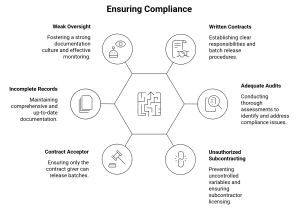
Several Issues Frequently Appear During Regulatory Inspections:
1) Starting Work Without A Written Contract:
This remains one of the most serious and surprisingly common violations. Without a signed contract in place, there is no formal assignment of responsibilities, no clarity on batch release procedures, and no guarantee that GMP standards will be followed. Any manufacturing or analytical activity conducted without a contract is considered non-compliant, regardless of the quality of work performed.
2) Failing To Conduct Adequate Audits:
Many companies approve contract acceptors based solely on reputation or previous experience. However, GMP requires documented evidence of suitability, which can only be obtained through a detailed audit. Skipping audits or performing superficial assessments creates blind spots that may later lead to quality failures or regulatory observations.
3) Allowing Contract Acceptors To Subcontract Without Approval:
Unauthorized subcontracting introduces uncontrolled variables into the supply chain. The subcontractor may not be licensed, qualified, or compliant. Because the contract giver is ultimately responsible for the finished product, any subcontracting must be evaluated, approved, and formally documented.
4) Relying On The Contract Acceptor’s Personnel For Batch Release:
Batch release must always be conducted by the authorised person at the contract giver’s site. Allowing the contract acceptor to release batches, even informally, undermines one of the foundational controls of GMP, as the final quality decision must remain with the organization that holds the product licence.
6) Maintaining Incomplete Or Inaccessible Batch Records:
Incomplete documentation, missing analytical data, delayed updates, or inaccessible records create major risks. During investigations, complaints, or inspections, the inability to produce complete and accurate records can lead to significant regulatory action. Section 9 requires that all records be readily available to the contract giver at all times.
These compliance gaps often arise from weak communication, insufficient oversight, or misconceptions about how responsibilities are shared. To prevent them, organizations must adopt a disciplined and proactive approach.
This includes implementing clear procedures for selecting and qualifying contract acceptors, maintaining rigorous audit schedules, defining escalation pathways, and ensuring that all outsourced activities are continuously monitored.
Equally important is maintaining a robust documentation culture. Contracts, audit reports, technology transfer records, batch manufacturing records, analytical data, and correspondence must be complete, current, and traceable. When documentation is well-organized and readily available, it becomes far easier to demonstrate compliance and maintain control.
By strengthening oversight mechanisms, reinforcing internal expectations, and ensuring that contractual and GMP requirements are consistently applied, organizations can avoid common pitfalls and maintain a high level of regulatory readiness throughout the lifecycle of every outsourcing arrangement.
In Conclusion
Section 9 of Schedule M 2023 provides a comprehensive framework for managing loan licence and contract manufacturing. It ensures that outsourced pharmaceutical activities are governed by the same level of control, oversight, and regulatory compliance as in-house operations.
While the contract acceptor handles the actual work, the responsibility for product quality, safety, and compliance always remains with the contract giver. Through well-structured contracts, detailed technical transfers, thorough documentation, and ongoing performance monitoring, organizations can build effective and compliant outsourcing partnerships.
When these principles are followed, contract manufacturing becomes a powerful tool that supports operational efficiency without compromising patient safety or product integrity.
FAQs
1) What Is Loan Licensing And Contract Manufacturing Under Schedule M 2023?
Loan licensing and contract manufacturing are formal arrangements where one licensed manufacturer performs production or testing on behalf of another company. Under Schedule M 2023, these activities must follow strict GMP requirements to ensure that quality, safety, and compliance are maintained at all times. The contract giver remains fully responsible for the product, while the contract acceptor must perform the work exactly as agreed. This ensures that outsourcing never compromises patient safety or product integrity.
2) Why Does Section 9 Of Schedule M 2023 Place Strong Emphasis On Written Contracts?
Section 9 requires that all outsourced GMP activities be governed by a detailed written contract before any work begins. This contract defines responsibilities for manufacturing, testing, documentation, batch release, and handling of rejected materials. It also gives the contract giver full rights to audit the contract acceptor at any time. A well-structured contract prevents miscommunication and ensures both parties operate with complete regulatory clarity.
3) What Responsibilities Do Contract Givers And Contract Acceptors Have In Outsourced Manufacturing?
The contract giver (loan licensee) carries full accountability for product quality and must assess, approve, supervise, and continuously monitor the contract acceptor. The contract acceptor must hold a valid licence, follow all provided technical documents, avoid unauthorized changes, and maintain complete and accessible records. Both parties must operate strictly within GMP and product licence requirements. This shared structure ensures that outsourced work meets the same standards as in-house manufacturing.