by Mrudula Kulkarni
10 minutes
The 5 Must-Have Templates for Managing Your QMS
Stop failing FDA audits over bad documentation. Get the 5 essential pharma QMS templates to eliminate compliance gaps and simplify your SOPs.

Picture this: Your facility is three days from an FDA inspection. Your quality team scrambles through shared drives, email threads, and binders trying to locate the right version of a critical SOP. Sound familiar?
According to a 2023 survey by the Pharmaceutical Quality Group (PQG), over 63% of quality deviations in regulated industries are traceable to inadequate documentation practices — not process failures. The documentation is the process. And yet, standardized templates remain the most overlooked lever in pharmaceutical quality management.
"In quality management, if it wasn't documented, it didn't happen." — FDA Investigator maxim, echoed in 21 CFR Part 211 Subpart J
This guide is built for pharma and medical device leaders who understand that quality systems are only as strong as their foundational documents. We'll walk you through the five must-have templates, the regulatory framework demanding them, and the leadership checklist to get your documentation house in order.
Why QMS Documentation Is a Strategic, Not Just Regulatory, Asset
Most organizations treat QMS documentation as a compliance checkbox. High-performing organizations treat it as institutional memory.
The documentation hierarchy forms the backbone of any electronic Quality Management System (eQMS). It creates a structured, traceable environment where quality processes can be communicated, taught, audited, and continuously improved. The pyramid below illustrates how documentation levels build upon each other:
Documentation Level | Examples | Primary Purpose |
|---|---|---|
Level 1: Policy | Quality Manual, Quality Policy | Define organizational intent and direction |
Level 2: Procedures | SOPs | Describe how processes are executed |
Level 3: Instructions & Forms | Work Instructions, Templates | Provide task-level operational detail |
Level 4: Records | Completed forms, logs, audit trails | Evidence of execution |
Source: ISO 9001:2015 and ISO 13485:2016 documentation requirements, adapted for life sciences
ISO 9001:2015 does not mandate a specific hierarchy — but it does require organizations to "maintain and retain documented information to support the operation of its processes." The hierarchy framework above is globally recognized as best practice in pharmaceutical cGMP environments.
The Regulatory Landscape: What's Demanding Your Documentation
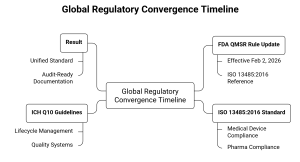
Pharma and medical device leaders operate at the intersection of multiple regulatory frameworks. Understanding the documentation requirements of each is foundational to building an audit-ready QMS.
ISO 9001:2015 Requirements
The world's most widely implemented QMS standard. Published research in Quality Management Journal (ASQ, 2022) found that ISO 9001-certified organizations reported a 37% reduction in quality escape rates compared to non-certified peers. Required documented information includes:
- Quality Policy and Objectives
- Documented Procedures and Process Maps
- Internal and External Audit Trails
- Records of Non-Conformities and Corrective Actions (CAPA)
- Staff Training and Competency Records
ISO 13485:2016 Requirements
Specific to medical devices, ISO 13485 applies a stricter, risk-based documentation regime. Key requirements include:
- Quality Manuals (unlike ISO 9001:2015, this is mandatory for medical devices)
- Medical Device Files and Technical Documentation
- Training Records and Complaint Handling Records
FDA 21 CFR Part 211 (cGMP for Pharmaceuticals)
The FDA's Current Good Manufacturing Practice (cGMP) regulations demand written procedures, records, and reports be maintained and readily available for inspection. Required documentation includes batch production records, equipment use logs, complaint files, and sanitation procedures.
FDA Quality Management System Regulation (QMSR, 21 CFR Part 820, effective February 2, 2026)
This landmark regulatory update formally incorporates ISO 13485:2016 by reference while retaining jurisdiction-specific requirements. For medical device manufacturers operating in the US, the QMSR is now the primary compliance framework. Key documented information requirements include:
- Medical Device Files (aligned with ISO 13485:2016)
- Design and Development Records
- Production and Process Control Records
- CAPA Records and Complaint Handling Files
- Traceability Records
"The QMSR doesn't add new documentation burdens — it harmonizes them globally. For manufacturers already aligned with ISO 13485, this is an opportunity, not a disruption." — FDA CDRH, QMSR Final Rule Preamble, 2024
ICH Q10
The ICH Q10 Pharmaceutical Quality System guideline extends the documentation mandate to include quality manuals, CAPA documentation, product discontinuation reports, and deviation records — critical for any organization engaged in clinical or commercial drug manufacturing.
The 5 Must-Have QMS Templates: A Deep Dive
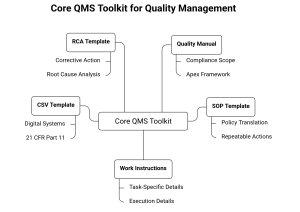
1. Quality Manual Template
The Quality Manual is the apex document of your QMS. It defines what your quality system is, why it exists, and how it functions. Think of it as the organizational constitution for quality.
Under ISO 13485:2016 (and by extension, the FDA QMSR), a Quality Manual is mandatory for medical device manufacturers. For pharmaceutical companies under ISO 9001:2015, it remains strongly recommended as a strategic communication tool with regulators, customers, and partners.
Essential Elements of a Quality Manual:
- Cover Page with Document Control (version history, approval signatures)
- Title and Table of Contents
- Scope (products, sites, exclusions)
- Normative References (applicable regulations and standards)
- Terms and Definitions
- Quality Management System description
- Management Responsibility
- Resource Management
- Product Realization
- Measurement, Analysis, and Improvement
- References
2. Standard Operating Procedure (SOP) Template
If the Quality Manual is the constitution, SOPs are the legislation. They translate policy intent into operational reality. According to a 2022 benchmarking study published in PDA Journal of Pharmaceutical Science and Technology, organizations with structured SOP templates experienced 42% fewer repeat deviations compared to those using ad-hoc formats.
SOPs must be robust, repeatable, and written for the user, not the auditor. They form the operational backbone of GMP compliance.
Essential Elements of an SOP Template:
- Cover Page with Document Control
- Title and Table of Contents
- Overview
- Purpose
- Scope
- Terms and Definitions
- Responsibilities (with RACI where applicable)
- Procedure (step-by-step)
- References
Writing Principles for Pharma-Grade SOPs:
"Write every SOP as if a competent employee reading it for the first time must be able to perform the task correctly without additional guidance." — WHO Technical Report Series, GMP Guidelines
Common SOP Pitfall | Best Practice |
|---|---|
Vague responsibility assignments | Use RACI matrix per step |
Overly complex language | Target 8th-grade reading level |
No version control | Enforce through eQMS workflows |
Outdated references | Link SOPs to live regulatory references |
Missing effective date | Always include effective and review dates |
3. Work Instructions (WI) Template
Where SOPs describe how a process works, Work Instructions describe exactly how a specific task within that process is executed. They are the ground-level operational documents that bridge policy and practice.
Consider a complex manufacturing process with 15 sub-steps. An SOP may describe the overall process flow. But for a specific critical step — say, aseptic fill-line changeover — a WI provides granular, role-specific guidance with tolerances, tool specifications, and acceptance criteria.
Research from Journal of GXP Compliance (2021) highlighted that WI deficiencies are among the top five root causes cited in FDA 483 observations related to procedure control failures.
Essential Elements of a Work Instruction Template:
- Cover Page with Document Control
- Title and Table of Contents
- Purpose / Goal
- Scope
- Terms and Definitions
- Responsibilities
- Procedure / Checklist / Step-by-step Instructions
- References
- Related Documents
- Attachments
4. Computer System Validation (CSV) Template
As pharmaceutical and medical device operations become increasingly digitalized, Computer System Validation (CSV) has moved from a niche IT concern to a front-line regulatory requirement. Under 21 CFR Part 11, FDA's regulation on electronic records and electronic signatures, validated systems are not optional — they are mandatory.
The GAMP 5 framework (Good Automated Manufacturing Practice, 5th Edition) provides the globally recognized guidance for risk-based CSV. A structured CSV template ensures that every software system used in regulated operations — from your eQMS to your LIMS to your MES — is validated, documented, and inspection-ready.
Essential Elements of a CSV Template:
- Cover Page with Document Control
- User Requirement Specification (URS)
- Risk Assessment (RA)
- Functional Requirement Specifications (FRS)
- Configuration Requirement Specifications (CRS)
- Performance Qualification Testing (PQT)
- Traceability Matrix (TM)
- Risk Assessment (RA) Matrix
Why This Matters for Pharma Leaders:
CSV Document | Regulatory Relevance |
|---|---|
URS | Defines intended use — foundational for 21 CFR Part 11 |
Risk Assessment | Supports GAMP 5 risk-based approach |
Traceability Matrix | Demonstrates requirements are tested end-to-end |
PQT | Provides documented evidence of system performance |
"Computer systems used in GMP environments must be validated. The extent of validation and data integrity controls depends on the risk to product quality and patient safety." — EMA Guideline on Computerised Systems, Annex 11
5. Root Cause Analysis (RCA) Template
Every non-conformance, deviation, or complaint is a signal. The Root Cause Analysis (RCA) template is the instrument that transforms that signal into learning and systemic improvement.
Under ICH Q10, CAPA systems must include robust root cause investigation processes. The FDA's warning letter database consistently cites "failure to investigate the root cause" as a leading observation in both pharmaceutical and medical device inspections.
A structured RCA template enables quality teams to apply proven methodologies — Fishbone (Ishikawa), 5 Whys, Fault Tree Analysis — in a consistent, documented, and auditable format.
Essential Elements of a Root Cause Analysis Template:
- Cover Page with Document Control (including Opening and Closure Approvals)
- Issue Details (ID, Title, Date Reported)
- Issue Description (Source, Criticality Level: Low / Medium / High)
- Possible Root Causes (Cause Description, Probability Level, Details)
- Suggested Solutions (Description, Risks, Measurement of Success)
- Attachments
RCA Methodology Comparison:
Method | Best For | Pharma Application |
|---|---|---|
5 Whys | Simple, linear problems | Production deviations, minor non-conformances |
Fishbone (Ishikawa) | Multi-factorial analysis | OOS investigations, complaint patterns |
Fault Tree Analysis | Complex, systemic failures | Equipment failures, process validation gaps |
Failure Mode & Effects Analysis (FMEA) | Proactive risk identification | New process introduction, design changes |
Best Practices for QMS Documentation Excellence
Regulatory compliance sets the floor for documentation. Operational excellence sets the ceiling. Here are the principles that distinguish world-class QMS documentation from merely compliant documentation:
1. Use a Distinct, Logical Structure
Documentation must be navigable. A reader — whether a new employee or an FDA auditor — should be able to move through your QMS documentation hierarchy intuitively. Consistent numbering, clear cross-references, and a master document index are non-negotiable.
2. Write for the User, Not the Auditor
The best SOP is the one your most junior team member can follow on day one. Use plain language, active voice, and short sentences. If a term requires a glossary, define it in the Terms and Definitions section — every time.
3. Avoid Duplication Through Cross-Referencing
If a process is thoroughly documented in one SOP, reference it rather than repeating it. Duplication creates version control risk. When the source document is updated, all duplicates become hazardous.
4. Maintain Currency as a Non-Negotiable
A published study in Regulatory Affairs Professionals Society (RAPS) Regulatory Focus (2023) found that outdated SOPs were cited in 28% of Warning Letters related to documentation failures. Processes change. Personnel change. Regulations change. Your documents must reflect current reality.
5. Embed Visuals for Complex Processes
Flowcharts, decision trees, and annotated photographs dramatically improve comprehension and reduce error rates in execution. This is especially critical for Work Instructions governing complex manufacturing or testing procedures.
6. Enforce Version Control Rigorously
Every document in your QMS should have a controlled version history, approval audit trail, and clear effective date. This is not just regulatory best practice — it is the foundation of data integrity.
World-class QMS documentation requires more than templates, it demands sustainable systems thinking and secure infrastructure.
Learn how environmental and cybersecurity considerations reshape QMS strategy.
→ Read: QMS Environmental Sustainability in Life Sciences
QMS Documentation: Key Statistics at a Glance
Metric | Data | Source |
|---|---|---|
% of quality deviations linked to documentation gaps | 63% | Pharmaceutical Quality Group (PQG), 2023 |
Reduction in repeat deviations with structured SOP templates | 42% | PDA Journal, 2022 |
Warning letters citing outdated SOPs | 28% | RAPS Regulatory Focus, 2023 |
ISO 9001-certified orgs reducing quality escapes | 37% | Quality Management Journal, ASQ, 2022 |
Top 5 FDA 483 observations including WI deficiencies | Consistent finding | FDA inspection data, 2020-2024 |
FAQs
Q1. Are QMS templates legally required by the FDA or ISO standards?
Templates themselves are not explicitly mandated. However, the underlying requirement for consistent, controlled, traceable documentation effectively makes structured templates a practical necessity. Regulators expect documented processes to be standardized and reproducible — templates are the most efficient way to achieve this at scale.
Q2. How often should QMS templates be reviewed and updated?
Best practice is to review all QMS templates at minimum annually, or whenever a regulatory update, process change, or internal audit finding necessitates revision. Templates linked to validated systems (e.g., CSV templates) must also be reviewed following system changes or upgrades.
Q3. Can one universal template serve both ISO 13485 and FDA QMSR requirements?
Yes, with careful design. Since the FDA QMSR incorporates ISO 13485:2016 by reference, a well-structured template that meets ISO 13485 requirements will largely satisfy QMSR documentation expectations. However, jurisdiction-specific elements — such as the Device Master Record (DMR) and Device History Record (DHR) requirements — must be explicitly addressed.
Q4. What is the biggest documentation mistake pharma companies make during inspections?
The most common failure is the gap between written SOPs and actual practice. Inspectors are trained to observe processes and compare them against documentation. When the two diverge, it signals systemic QMS weakness. Ensure your documents reflect current, verified practice — not idealized workflows.
Q5. How does an eQMS improve QMS template management?
An electronic Quality Management System (eQMS) centralizes template storage, enforces version control, automates approval workflows, and maintains a complete audit trail for every document. It eliminates the risk of employees working from superseded documents and dramatically reduces the time required to prepare for inspections or audits.
eQMS systems centralize templates and enforce compliance. But the infrastructure decision — cloud vs on-premise, directly impacts security, accessibility, and regulatory readiness.
Understand the cybersecurity and operational trade-offs.
→ Read: Cloud vs On-Premise QMS: Pharma Cybersecurity Guide
Final Thoughts
The five templates described in this guide — Quality Manual, SOP, Work Instruction, CSV, and Root Cause Analysis — are not administrative burdens. They are precision instruments for organizational learning, regulatory resilience, and product quality assurance.
For pharma and medical device leaders, the question is not whether to implement structured QMS templates. The question is whether your current templates are good enough to withstand an unannounced inspection, onboard a new manufacturing site, or scale operations without quality degradation.
Investing in world-class QMS documentation today is the most defensible strategic investment your quality organization can make. Your patients, your regulators, and your business results will reflect it.
References and Citations
- Pharmaceutical Quality Group (PQG). Annual Quality Benchmarking Report. 2023.
- PDA Journal of Pharmaceutical Science and Technology. SOP Standardization and Deviation Reduction in GMP Environments. 2022.
- ASQ Quality Management Journal. Impact of ISO 9001 Certification on Quality Escape Rates. 2022.
- RAPS Regulatory Focus. Documentation Failures in FDA Warning Letters: A 5-Year Analysis. 2023.
- Journal of GXP Compliance. Work Instruction Deficiencies and FDA 483 Observations. 2021.
- FDA CDRH. Quality Management System Regulation (QMSR) Final Rule Preamble. 21 CFR Part 820, effective February 2, 2026.
- International Organization for Standardization. ISO 13485:2016 — Medical Devices: Quality Management Systems. Geneva: ISO, 2016.
- International Organization for Standardization. ISO 9001:2015 — Quality Management Systems: Requirements. Geneva: ISO, 2015.
- International Council for Harmonisation (ICH). Q10: Pharmaceutical Quality System. ICH, 2008.
- ISPE GAMP 5. A Risk-Based Approach to Compliant GxP Computerized Systems, 2nd Edition. ISPE, 2022.
- EMA. Annex 11: Computerised Systems — GMP Guidelines. European Medicines Agency, 2011.
- World Health Organization. WHO Technical Report Series No. 986, Annex 2: WHO Good Manufacturing Practices for Pharmaceutical Products. WHO, 2014.
- FDA. 21 CFR Part 11: Electronic Records; Electronic Signatures. U.S. Food and Drug Administration.
- FDA. 21 CFR Part 211: Current Good Manufacturing Practice for Finished Pharmaceuticals. U.S. Food and Drug Administration.