by Manish Bhatkar
8 minutes
A Practical Breakdown Of Product Recalls In The Pharmaceutical Industry
How product recalls work in pharma Schedule M 2023 requirements, recall types, 10-step process and documentation explained
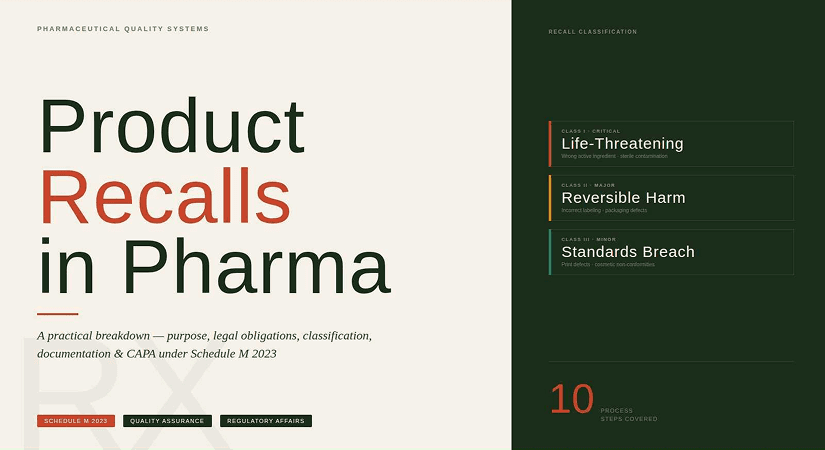
Product recalls are one of the strongest consumer protection mechanisms in the pharmaceutical industry, created to safeguard patients from products that fail to meet quality standards, pose safety risks, or create uncertainty about their intended use.
Although the public often assumes that medicines are always reliable, ensuring product quality is a continuous responsibility that extends far beyond manufacturing. Even after extensive testing, defects may still appear once the product reaches the market, which is why Schedule M 2023 legally mandates robust recall systems.
A well-implemented recall system ensures defective or potentially harmful products are quickly identified, traced, and removed, maintaining patient safety and regulatory compliance.
Understanding how recalls work is essential because product defects can arise from many sources, including manufacturing deviations, packaging errors, contamination risks, or stability failures.
Manufacturers must be able to respond promptly, transparently, and systematically whenever such issues surface. A functional recall system reflects a company’s maturity, ethical responsibility, and commitment to quality.
This article provides a practical, structured explanation of product recalls under Schedule M 2023, covering their purpose, legal requirements, the recall process, essential documentation, and common challenges for professionals involved in manufacturing, quality assurance, regulatory affairs, and supply chain operations.
What Is a Product Recall?
A product recall is a formal, controlled, and documented process used to remove defective or potentially defective products from the market. According to Schedule M 2023, manufacturers must have a system capable of recalling any product known or suspected to be defective.
This definition acknowledges that recalls do not occur only in proven cases of defects but must also be initiated when there is sufficient suspicion that a product may pose a risk. The primary objective of a recall is to prevent harm to patients. Medicines that do not meet specifications may lead to treatment failure, adverse effects, toxicity, or other health risks.
Recalls also serve to maintain trust in pharmaceutical products and regulatory systems. They protect companies from legal liabilities and demonstrate adherence to quality and safety standards. To ensure the recall process is effective, manufacturers must establish written Standard Operating Procedures (SOPs).
These SOPs Must Include:
- Clear roles and responsibilities
- Steps for initiating and executing a recall
- Methods for communication with regulators and customers
- Timelines and escalation triggers
- Documentation requirements
- Procedures for reconciliation of quantities
- Procedures for product segregation and disposal
These elements ensure that the recall process is predictable, organized, and aligned with regulatory expectations.
Legal Obligation Under Schedule M 2023
Schedule M 2023 mandates that pharmaceutical manufacturers implement a robust recall system. Compliance with this requirement is not optional. It applies to all products, irrespective of their distribution scale, therapeutic category, or form. The law recognizes that defective medicines pose significant public health risks and therefore requires manufacturers to act quickly and decisively.
Under Schedule M 2023, Manufacturers Must:
- Maintain a written recall SOP
- Ensure rapid and effective withdrawal of defective products
- Notify regulatory authorities as required
- Maintain updated and complete distribution records
- Document every stage of the recall process
- Investigate the root cause of the defect
- Implement corrective and preventive actions
- Ensure that defective products are destroyed or appropriately handled
Regulatory non-compliance may result in penalties, product seizures, withdrawal of manufacturing licenses, legal actions, or mandatory inspections. Therefore, the recall system is a core component of the Pharmaceutical Quality System and must be maintained with utmost seriousness.
When A Recall Is Necessary?
A recall becomes necessary when a product is defective or even suspected to be defective. Recalls may be triggered by various events, such as deviations, testing failures, audit observations, or customer complaints. The decision to recall a product is often based on a structured risk assessment conducted by Quality Assurance.
Common Triggers For Recalls Include:
- Labeling Errors: Wrong strength, incorrect batch number, missing expiry date.
- Stability Failures: Loss of potency, degradation, or appearance changes.
- Contamination Risks: Microbial contamination, cross-contamination, or foreign matter.
- Packaging Defects: Leaking containers, damaged blister packs, poor sealing.
- Manufacturing Deviations: Process inconsistencies, equipment malfunctions.
- Regulatory Alerts: Instructions from authorities following inspections or market complaints.
Even suspicion of a defect is sufficient to initiate recall activity. This precautionary approach prioritizes patient safety above commercial considerations.
Most recalls begin with a complaint that was not acted on fast enough.
Schedule M 2023 Section 6 defines exactly what that action must look like.
→ Read: Complaint Handling Under Schedule M 2023 | Pharma Guide
Types Of Recalls

Recalls are generally classified into three categories based on risk levels:
1) Critical (Class I) Recall: This involves defects that may cause life-threatening or serious health hazards. Immediate action is required. Examples include wrong active ingredient, microbial contamination in sterile products, or incorrect dosage strength.
2) Major (Class II) Recall: This involves defects that may cause temporary or medically reversible harm. Examples include incorrect labeling, under-potent products, or packaging issues.
3) Minor (Class III) Recall: This involves defects that are unlikely to cause harm but still violate quality standards or labeling requirements. Examples include minor printing defects or cosmetic issues.
Regardless of classification, the recall process must follow the same structured approach, with urgency determined by severity!
Steps In The Recall Process
The recall process must follow a clearly defined and systematic sequence to ensure that the defective product is quickly traced, recovered, and prevented from causing further harm. Each step plays a crucial role in ensuring the recall is efficient, compliant, and fully documented.
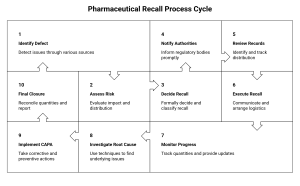
A well-designed recall procedure not only protects patients but also demonstrates the company’s ability to respond responsibly and transparently in critical situations. Below is an expanded explanation of each step in the recall process.
1) Identification Of A Defect
The recall process begins the moment a potential quality issue is detected. Defects may come to light through various channels such as customer complaints, spontaneous reports from healthcare professionals, deviation investigations, out-of-specification results, internal or external audits, regulatory inspections, or periodic stability studies.
In some instances, defects may also be discovered during routine trending of quality data or during batch reviews. Regardless of the source, every signal must be taken seriously. The issue is first recorded, documented, and investigated to determine whether it represents a potential risk to patient safety or product quality.
2) Initial Risk Assessment
Once the defect is identified, Quality Assurance (QA) conducts an initial risk assessment to determine the seriousness of the issue. The assessment considers factors such as the nature of the defect, the patient population using the product, the therapeutic category, potential clinical impact, and the extent of distribution.
At this stage, QA may gather additional information from production, QC, regulatory affairs, and other involved teams. The objective is to determine whether the defect poses an immediate or potential health risk and whether recalling the product is the most appropriate action. This assessment must be fast, unbiased, and scientifically justified.
3) Decision To Recall
Based on the initial risk assessment, the organization formally decides whether to initiate a recall. If the decision is made to proceed, the recall SOP is activated without delay. This step typically involves senior QA leadership and sometimes top management, depending on the severity of the risk.
The decision is recorded, along with the justification and classification of the recall (such as critical, major, or minor). At this point, roles, responsibilities, timelines, and communication pathways defined in the SOP become fully operational. Internal teams are notified so that the recall can begin immediately.
4) Notification To Regulatory Authorities
Regulatory authorities must be notified promptly, as required by applicable laws and guidelines. Timeliness is critical because regulators may issue additional instructions, safety alerts, or public notifications. The notification typically includes details such as: the product name, batch numbers, nature of the defect, risk assessment summary, distribution extent, and the proposed recall strategy.
In many regions, regulatory bodies also require periodic progress reports until the recall is closed. Transparent and timely communication prevents misinformation and ensures regulatory oversight throughout the recall.
5) Review Of Distribution Records
Accurate and up-to-date distribution records form the backbone of an effective recall. Once the recall is initiated, these records are reviewed to identify all customers, distributors, wholesalers, hospitals, pharmacies, or agencies that received the affected product. The records must include quantities shipped, dates of dispatch, batch numbers, and customer contact details.
This step allows the recall team to estimate the total amount of product in the market and strategically plan the communication and retrieval process. Any gaps or delays in traceability can significantly slow down the recall, making this step absolutely critical.
6) Execution Of The Recall
During recall execution, communication is sent immediately to all affected stakeholders, instructing them to stop using or selling the product and return it to the manufacturer. This may involve phone calls, emails, letters, or even public announcements depending on the severity of the recall. The communication must be clear, consistent, and aligned with regulatory expectations.
During this phase, the company arranges logistics for receiving, storing, and segregating the returned product to prevent accidental re-entry into the market. Depending on the distribution scale, this step may involve extensive coordination with supply chain teams, third-party distributors, and healthcare institutions. Clear documentation of all communications and actions is essential.
7) Monitoring Recall Progress
Monitoring progress ensures that the recall remains controlled, timely, and fully accountable. The recall coordinator oversees reconciliation activities by tracking the quantities of product distributed versus quantities returned. Regular status updates help identify outstanding stock that has not yet been recovered.
If responses from customers are slow, follow-up reminders may be issued. The company may also be required to submit periodic updates to regulatory authorities to demonstrate ongoing progress. Effective monitoring ensures that recalled products are recovered efficiently and that no unaccounted stock remains in the market.
8) Root Cause Investigation
After or during the recall, a detailed root cause investigation is conducted to determine exactly why the defect occurred. This investigation may involve reviewing batch records, interviewing staff, inspecting equipment, analyzing test data, reviewing environmental monitoring trends, and assessing supplier performance.
The aim is to go beyond superficial causes and identify the true underlying factor responsible for the defect. Techniques such as the 5-Why method, Fishbone (Ishikawa) analysis, or Failure Mode and Effects Analysis (FMEA) may be used. A strong investigation helps prevent recurrence and reinforces confidence in the quality system.
9) Corrective & Preventive Actions (CAPA)
Once the root cause is identified, appropriate Corrective and Preventive Actions (CAPA) must be developed and implemented. Corrective actions address the immediate issue—such as repairing equipment, updating procedures, retraining employees, or tightening process controls.
Preventive actions ensure the problem does not happen again and may include changes to process design, qualification activities, material supplier assessments, or enhancements to monitoring systems. CAPA effectiveness must be verified to ensure the actions genuinely resolve the underlying issue. A recall is not considered truly successful unless strong CAPA measures are put in place.
10) Final Closure Of The Recall
The recall can only be officially closed once all activities have been fully completed. This includes reconciling all distributed versus returned quantities, ensuring all defective stock is segregated, destroyed, or disposed of as per regulatory guidance, and verifying that CAPA measures have been implemented.
The recall coordinator compiles a comprehensive recall closure report summarizing the reason for recall, actions taken, quantities recovered, investigation results, and final conclusions. Regulators may review and approve the closure, especially in high-risk recall cases. Once approved, the recall is considered formally closed, but the lessons learned should be shared internally to strengthen the organization’s quality culture.
Importance Of Distribution Records And Traceability
Distribution records are one of the most important components of an effective recall system. Without accurate and complete traceability information, a company cannot identify where defective products have been shipped. This can delay the recall and increase patient risk. Distribution records must be maintained in real time and should be easily searchable.
These Records Must Include:
- Batch numbers and dates of manufacture
- Quantities dispatched
- Names and addresses of customers (distributors, hospitals, pharmacies, retailers)
- Transportation details and invoice references
- Export distribution details (where applicable)
Accurate traceability ensures that no product is missed during a recall and that the recall process is executed quickly and completely.
Integration With The Quality Management System
Product recall management works closely with several elements of the Pharmaceutical Quality System (PQS). Recalls are not independent activities; they rely on information and processes from various quality subsystems.
Key Integrations Include:
- Complaints System: Customer complaints often serve as early warnings of possible product defects.
- Deviations & Self-Inspection: Internal audits or deviations may uncover weaknesses that prompt a recall.
- Corrective & Preventive Actions (CAPA): CAPA ensures that issues identified during recalls are addressed permanently.
- Change Control: Implemented changes must be documented and evaluated to prevent recurrence of the same defects.
This integration ensures that recalls lead to continual improvements within the overall quality system.
A recall system is only as strong as the quality system behind it.
The full Schedule M 2023 framework is where that foundation is built.
→ Read: India's New GMP Rules Are Here | Schedule M 2023 Guide
Documentation Requirements
Documentation is a mandatory component of recall compliance under Schedule M 2023. Every action taken during a recall must be recorded in real time and maintained for regulatory inspection.
Essential Recall Documentation Includes:
- Recall initiation letter or decision record
- Batch distribution lists
- Recall communication letters and notifications
- Records of returned quantities
- Investigation and root cause analysis reports
- CAPA implementation records
- Final recall closure and product disposal reports
Complete, clear, and audit-ready documentation demonstrates compliance and ensures traceability and accountability.
In Conclusion
Product recalls are essential for protecting public health. They ensure that defective or potentially harmful medicines are removed from the market before causing harm. Schedule M 2023 places responsibility on manufacturers to maintain an effective recall system that is fast, traceable, and fully documented.
A successful recall demonstrates a company’s commitment to safety, quality, and continuous improvement. With well-established procedures, trained teams, and accurate records, pharmaceutical manufacturers can manage recalls confidently and uphold the highest standards of patient