by Vaibhavi M.
9 minutes
How To Get GMP Certified: A Step-by-Step Guide For EU And US Companies
UKCA marking rules for medical devices in Great Britain what applies in 2026, how it differs from CE marking, and what to do next.

If you manufacture medical devices and sell them in the United Kingdom, the UKCA mark is something you cannot afford to ignore. Since the UK left the European Union, the rules governing the approval and marketing of medical devices in Great Britain have changed significantly. And they are still changing.
For regulatory affairs professionals, quality managers, and manufacturers, this creates a real challenge. You need to keep up with new rules while managing day-to-day compliance, and the MHRA keeps updating its position on what comes next.
This guide will walk you through everything you need to know: what the UKCA marking is, how it compares to CE marking, the current rules and how to plan your regulatory strategy for 2026 and beyond.
What Is UKCA Marking?
UKCA stands for UK Conformity Assessed. It is the United Kingdom's own product conformity mark, introduced after Brexit to replace the CE mark for goods sold in Great Britain, that is, England, Wales, and Scotland.
In theory, it was a straightforward switch: the UK would have its own version of the CE mark, with its own conformity assessment process and regulatory framework. In practice, the rollout has been far more complex, especially for the medical device sector, where conformity assessments are detailed, time-consuming, and expensive.
The UKCA mark signals that a product has been assessed against UK regulations and meets the required safety and performance standards. For medical devices, this means compliance with the UK Medical Devices Regulations 2002 (UK MDR 2002), registration with the MHRA (Medicines and Healthcare products Regulatory Agency), and, depending on the device class, assessment by a UK Approved Body.
One important clarification: the UKCA marking applies only to Great Britain. Northern Ireland operates under different rules due to the Northern Ireland Protocol. Devices sold in Northern Ireland still need CE marking (and in some cases, the UKNI mark). If you want to cover the whole UK, you need to manage both pathways.
UKCA vs CE Marking: What Is the Difference?
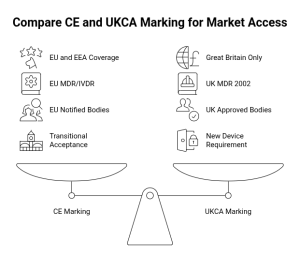
This is the question most manufacturers ask first. If you already have CE marking, do you also need UKCA?
The short answer: yes, if you want to sell in Great Britain long-term.
Here is a straightforward comparison of the two:
CE Marking
- Covers the EU and EEA
- Issued under EU MDR or EU IVDR
- Assessed by EU Notified Bodies
- Currently still accepted in Great Britain under transitional arrangements
UKCA Marking
- Covers Great Britain only
- Issued under UK MDR 2002
- Assessed by UK Approved Bodies
- Required for new devices entering the GB market
The two systems overlap significantly in the technical documentation required. Clinical evaluations, risk management files, and post-market surveillance reports: much of this content is the same under both frameworks. That overlap makes dual compliance possible and, for many companies, the smartest long-term strategy.
That said, the two systems are slowly diverging. As the MHRA develops its "future medical devices regime," the UK regulatory pathway will increasingly differ from the EU's, meaning companies relying solely on CE marking for GB market access will face growing risks over time.
The Current Regulatory Picture: What Actually Applies in 2026
Understanding what is in force right now versus what is being planned is critical. There is a lot of noise in the industry about future changes, and it is easy to confuse proposals with current legal requirements..
What applies right now:
- CE-marked devices can still be placed on the Great Britain market under transitional arrangements, subject to certificate expiry dates and device classification.
- General medical devices with CE marking can continue to be sold under these transitional rules until certificate expiry or 30 June 2028, whichever comes first.
- In vitro diagnostics (IVDs) have a transitional period extending to 30 June 2030.
- All manufacturers placing devices on the GB market, whether via UKCA or CE under transitional rules, must register with the MHRA.
- Non-UK manufacturers must have a UK Responsible Person (UKRP) in place.
- UKCA remains a fully valid and active conformity route and can be used at any time.
What is in discussion or development:
- The MHRA has proposed consulting on allowing CE-marked devices to remain on the GB market indefinitely, but this has not yet been made law.
- International reliance routes are being developed, which would allow faster access for devices already cleared by trusted regulators such as the FDA in the US, Health Canada, or Australia's TGA.
- The physical UKCA logo requirement may be removed once a national Unique Device Identifier (UDI) system is operational in the UK, reducing labelling burdens.
- Greater digital traceability through UDI registries is a stated policy goal, moving away from paper-heavy compliance.
The MHRA's inspection priorities are evolving alongside these regulatory changes.
If you are placing devices on the GB market, understanding what MHRA inspectors actually look for is not optional.
→ Read: MHRA Inspection Preparation Guide: Everything You Need To Know For A Successful Audit
The key message here is this: do not wait for the situation to fully settle before making decisions. The direction of travel is clear: less duplication, more digital traceability, and greater reliance on international approvals, but these changes will roll out over time, and the current rules still apply today.
Is UKCA Still Required If CE Marking Gets Extended?
This is a question many manufacturers are actively debating in 2026, given the MHRA's statements about potentially accepting CE marks indefinitely.
Even if that proposal becomes law, UKCA still matters. Here is why:
- Regulatory divergence will continue. Even if CE marks are accepted in GB for now, the UK will continue to develop its own rules. Devices that undergo major changes or new devices coming to market may need to meet UK-specific requirements.
- GB-specific obligations remain. Regardless of which conformity route you use, you still need MHRA registration, UK post-market surveillance reporting, and a UK Responsible Person if you are based outside the UK.
- Operational resilience. Companies with active UKCA certification are not exposed to the risk of sudden policy reversals or transitional deadline changes, a risk that has materialised multiple times since Brexit.
Who should actively pursue UKCA right now:
- UK-based manufacturers who want a simpler, single-jurisdiction compliance path
- Companies planning major device changes or new product launches in GB
- Manufacturers who want to use UK Approved Bodies and keep their regulatory footprint local
- Any organisation seeking the stability of dual-marketing across both the GB and EU markets
For companies with minimal GB market exposure that are heavily CE-focused, a monitoring approach may be acceptable for now, but MHRA registration, UKRP appointment, and post-market obligations must still be in place.
How to Build a Future-Proof UK Regulatory Strategy
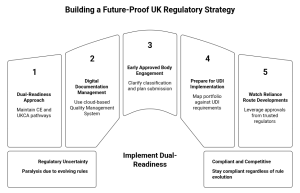
The uncertainty in the UK regulatory environment need not mean paralysis. Here is a practical framework for staying compliant and competitive, regardless of how the rules continue to evolve.
1. Adopt a dual-readiness approach
The most resilient strategy is to maintain both CE and UKCA pathways in parallel. This does not mean doing everything twice from scratch. Because the two systems share much of the technical content, you can build a shared documentation core and add UK- or EU-specific annexes as needed.
For UKCA, the UK-specific elements you need to layer on top of your CE documentation include:
- A declaration of conformity referencing UK MDR 2002
- UK Approved Body certificates (where required by device class)
- UK Responsible Person information
- MHRA registration records
- UK-specific labelling, including the UKCA mark (for now)
- Local post-market surveillance and vigilance reporting to the MHRA
2. Manage your documentation digitally
With two regulatory regimes to manage, document version control becomes critical. Using a cloud-based Quality Management System lets you efficiently manage shared and separate documentation, track certificate expiry dates, manage labelling changes, and prepare for audits without doubling your workload.
This is also important as the MHRA moves toward a more digital, UDI-based traceability model. Getting your QMS infrastructure in order now will make that transition easier.
3. Engage your UK Approved Body early
If you need a UKCA conformity assessment for your device class, do not leave it until the last minute. UK Approved Bodies have limited capacity, and early engagement allows you to clarify classification questions, get feedback on your technical file, and plan a submission timeline that does not put your market access at risk.
4. Prepare for UDI implementation
The MHRA's future regime places significant emphasis on Unique Device Identification as a tool for traceability and post-market monitoring. Even if the physical UKCA logo requirement is eventually dropped, UDI readiness will remain essential. Start by mapping your device portfolio against UDI requirements and building UDI data management into your quality processes now.
5. Watch the reliance route developments
If your device already has regulatory approval from the FDA, Health Canada, or Australia's TGA, you may be able to take advantage of the international reliance routes the MHRA is developing. These are designed to speed up GB market access by leveraging approvals from trusted overseas regulators. Keep a close eye on MHRA guidance as eligibility criteria are confirmed.
Great Britain vs Northern Ireland: Do Not Overlook This
If you sell across the whole of the United Kingdom, you need to manage two different regulatory frameworks:
- Great Britain (England, Wales, Scotland): UKCA marking applies, or CE marking under transitional rules. MHRA registration and UKRP required.
- Northern Ireland: EU rules apply under the Northern Ireland Protocol. CE marking (and where required, UKNI marking) is needed. UKCA alone is not sufficient for Northern Ireland market access.
This is a detail that catches some manufacturers off guard. If your distribution covers the whole UK, your labelling, technical files, and conformity documentation need to reflect both requirements.
Managing dual regulatory frameworks means your documentation, DHF, DMR, and conformity files must hold up across both jurisdictions.
Here is how leading medical device teams structure that paperwork from day one.
→ Read: DHF, DMR, DHR & QMSR: The Medical Device Documentation Guide
What the MHRA's Future Medical Devices Regime Means for You
In July 2025, the MHRA published its response to consultations on routes to market for medical devices and IVDs. The key policy direction set out includes:
- Faster access pathways for devices already approved by internationally recognised regulators
- A forthcoming consultation on indefinite CE mark recognition in Great Britain
- A move away from physical UKCA logo requirements once UDI is operational
- Greater use of digital tools and registries to reduce administrative burden and improve post-market traceability
These are significant policy signals. They suggest the MHRA wants to reduce duplication for manufacturers, speed up access for safe devices, and shift the compliance emphasis from physical labelling toward digital traceability. But most of these changes still need to be implemented through secondary legislation or further MHRA rulemaking; they are not yet in force.
The practical takeaway: plan for a future in which UKCA documentation may look different, CE marks may be accepted in the long term, and UDI plays a central role in how devices are tracked and monitored. But comply fully with what is required today while that future takes shape.
Key Actions to Take Right Now
To summarise, here are the practical steps every medical device manufacturer should be taking in 2026:
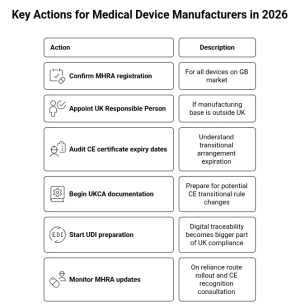
- Confirm MHRA registration for all devices placed on the GB market, whether via UKCA or CE under transitional rules
- Appoint a UK Responsible Person if your manufacturing base is outside the UK
- Audit your CE certificate expiry dates and understand when transitional arrangements will expire for your specific devices
- Begin or progress UKCA documentation so you are not scrambling if CE transitional rules change
- Start UDI preparation as digital traceability becomes a bigger part of UK compliance
Monitor MHRA updates on the reliance route rollout and the CE recognition consultation
Final Thoughts
The UKCA mark is not going away, but the rules around it are still being shaped. The MHRA's direction is encouraging, with less duplication, faster access, and more digital focus, but the current framework still requires careful management of registration, responsible persons, labelling, and post-market obligations.
Companies that get ahead of this now, rather than waiting for every rule to be finalised, will be in a much stronger position. Dual readiness, keeping CE and UKCA pathways live and documentation up to date, is the safest, most flexible strategy for any manufacturer with meaningful exposure to the Great Britain market.
Regulatory certainty in the UK may still be some way off. But compliance readiness does not have to wait for it.
FAQs
1. What is UKCA marking for medical devices?
UKCA (UK Conformity Assessed) marking is the UK's post-Brexit product conformity mark required for placing medical devices on the market in Great Britain. It replaced CE marking following the UK's departure from the EU and is governed by the UK MDR 2002, with oversight from the MHRA.
2. Is CE marking still valid in the UK in 2026?
Yes, under transitional arrangements. CE-marked general medical devices can remain on the GB market until certificate expiry or 30 June 2028, and CE-marked IVDs until 30 June 2030. Registration with the MHRA is still required even for CE-route devices.
3. Do I need both CE and UKCA marking?
If you sell in both Great Britain and the EU, dual marking is the recommended approach. If you sell only in Great Britain via UKCA, CE marking is not required. If you are already CE-marked and selling in GB, you may rely on transitional arrangements for now, but planning for UKCA is advisable.
4. What is a UK Responsible Person, and do I need one?
A UK Responsible Person (UKRP) is a UK-based individual or organisation that takes legal responsibility for a medical device placed on the GB market by a non-UK manufacturer. If your company is based outside the UK and you sell devices in Great Britain, you must appoint a UKRP.
5. What is changing about UKCA marking after 2026?
The MHRA is consulting on allowing CE marks to be recognised in GB indefinitely, developing international reliance routes for devices already approved overseas, and planning to remove the physical UKCA logo requirement once a national UDI system is in place. These changes are not yet law, but they signal a shift toward less duplication and more digital-based compliance.