by Mrudula Kulkarni
13 minutes
Deviation Management in Pharma: The Complete Guide to Detection, Investigation, and CAPA
Deviation management 6-phase framework - detection, investigation, RCA, FMEA classification, CAPA implementation, verification and trending.

In 2021, the U.S. Food and Drug Administration issued a warning letter to a mid-sized contract manufacturer after investigators found that the facility had repeatedly failed to investigate deviations in its sterile injectable production line. Batches had shipped. Patients had received product. The root cause, a miscalibrated pH meter, had been in service for six months without corrective action.
This is not a rare story. It is a predictable one, rooted in a system that treats pharmaceutical deviations as paperwork problems rather than patient safety signals.
This guide is written for Quality leaders, Heads of Manufacturing, and QA Directors who understand that deviation management in pharma is not a compliance checkbox. It is the first line of defense between your processes and patient harm. Read on to build a system that works not just for auditors, but for the patients who depend on your products.
What Is a Deviation in Pharma? Defining the Boundaries of Acceptable Performance
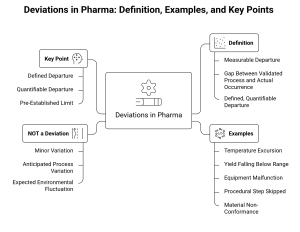
A deviation in pharma is any measurable departure from a documented standard, procedure, specification, or expected process condition. It is the gap between what your validated process says should happen and what actually occurred on the shop floor, in the laboratory, or across the supply chain.
How to interpret deviations from standard behavior in analytics requires clarity about thresholds. A deviation is not simply "something went wrong." It is a defined, quantifiable departure that crosses a pre-established limit, such as a temperature excursion beyond ±2°C in a cold-chain hold, or a yield falling below 95% of the validated range.
The International Council for Harmonisation guidance ICH Q10 (Pharmaceutical Quality System) defines pharmaceutical quality systems as requiring systems that enable timely identification, reporting, investigation, and correction of failures, including deviations (ICH, 2008).
Deviation Versus Nonconformity: A Critical Distinction
Quality leaders frequently use these terms interchangeably. They are not the same, and conflating them leads to classification errors, incomplete investigations, and regulatory findings.
Parameter | Deviation | Nonconformity |
|---|---|---|
Scope | Process or procedural departure | Failure to fulfill a specified requirement |
Timing | During manufacturing or operation | At any quality evaluation point |
ISO context | Not separately defined in ISO 9001:2015 | Formally defined per ISO 9000:2015 |
Regulatory guidance | EudraLex Vol. 4, Chapter 1; FDA 21 CFR 211 | ISO 13485; ICH Q10 |
Example | Temperature excursion during granulation | Product purity below specification |
Typical outcome | Investigation + CAPA | Rejection, destruction, or rework |
"Quality is never an accident. It is always the result of intelligent effort." John Ruskin, 19th-century author, widely cited in quality management literature
Planned and Unplanned Deviation in Pharma: Know the Difference Before Your Auditor Does
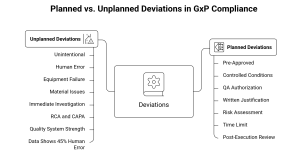
Not all deviations are equal in origin, and regulators will scrutinize whether you understand that distinction.
Planned Deviations
A planned deviation is a pre-approved, temporary departure from an established procedure, executed under controlled conditions with full QA authorization. Think of it as an informed exception, documented before it occurs, evaluated for risk, and reviewed after execution.
Key requirements for a valid planned deviation:
- Written justification submitted before execution
- Risk assessment demonstrating patient safety is not compromised
- Defined time limit and scope
- QA authorization with signature and date
- Post-execution review confirming process remained in control
Critical Reminder for Leaders: Planned deviations must never serve as substitutes for formal change control. If the change is intended to be permanent, initiate a change control procedure. Using planned deviations to avoid change control is a recognized regulatory red flag.
Unplanned Deviations
Unplanned deviations are unintentional departures from approved instructions, arising from human error, equipment failure, material non-conformance, or environmental factors. These are the deviations that define the strength of your quality management system pharma infrastructure.
According to a 2022 PDA (Parenteral Drug Association) industry survey, human error was cited as the primary root cause category in approximately 45% of all reported GMP deviations, followed by equipment failure (22%) and procedural gaps (18%).
Deviation Documentation Requirements: FDA 21 CFR 211.192 and EudraLex Chapter 4
Before your team can manage deviations effectively, they must document them correctly. Regulatory agencies are explicit on this point.
FDA 21 CFR 211.192 requires that any unexplained discrepancy, including a percentage of theoretical yield, or the failure of a batch or any of its components to meet specifications, shall be thoroughly investigated, and the investigation documented.
EudraLex Volume 4, Chapter 1.8 (VII) similarly mandates that significant deviations from established procedures shall be fully recorded and investigated, with the aim of determining the root cause and implementing appropriate corrective and preventive action.
The Six-Phase Framework for Handling Deviations in Pharma: A Scientific Approach
The following framework is grounded in regulatory guidance, including ICH Q9 (Quality Risk Management), EudraLex Volume 4, FDA 21 CFR Part 211, and published quality management literature. It reflects best practices adopted by leading pharmaceutical manufacturers globally.
Phase 1: Identify, Contain, and Document
Every pharmaceutical deviation begins with detection. The quality of your detection system determines everything that follows. Organizations that rely on end-of-batch reviews miss deviations that occur during manufacturing. Real-time process monitoring, supported by electronic QMS platforms, reduces detection lag significantly.
The 5W1H approach, anchored in scientific problem-stating, is recommended for initial documentation:
- Who detected the deviation and who was performing the operation?
- What exactly deviated from the standard?
- When did the deviation occur (date, time, batch phase)?
- Where in the facility or process did it occur?
- Why (preliminary, pre-investigation assessment only)
- How was the deviation first identified?
Employees at all levels should be trained and empowered to report deviations on the day they occur. A culture of psychological safety in reporting is a measurable quality metric. A 2019 study published in the Journal of Pharmaceutical Innovation found that organizations with formal deviation reporting culture programs reduced repeat deviation rates by up to 34% within 18 months.
Phase 2: Investigate and Conduct Root Cause Analysis
This is the scientific core of deviation management in pharma, and it is where most organizations fall short.
Root cause analysis (RCA) is a systematic methodology for identifying the fundamental reason a deviation occurred, not merely the proximate cause. "Human error" is never a root cause. It is a symptom of deeper systemic failures.
Human error is a symptom, not a root cause.
Discover how to dig deeper and find the systemic factors driving deviations.
→ Read: Human Error Root Cause Analysis in Pharma: Going Beyond the Symptom
Common Root Cause Categories in GMP Environments:
Category | Examples |
|---|---|
Human | Insufficient training, fatigue, distraction, unclear instructions |
Material | Defective raw materials, wrong grade, improper storage conditions |
Measurement | Miscalibrated instruments, inconsistent sampling procedures |
Environment | Temperature excursions, humidity, contamination risk |
Method | Ambiguous SOPs, outdated work instructions, inadequate controls |
Machine | Equipment malfunction, overdue preventive maintenance, automation error |
"For every complex problem there is an answer that is clear, simple, and wrong." H.L. Mencken, widely cited in systems thinking and RCA methodology literature
Validated RCA Tools for Pharmaceutical Investigations:
5 Whys Method: Iterative questioning technique that traces a symptom back to its systemic origin through five or more levels of causation. Most effective for straightforward, single-strand problems.
Fishbone Diagram (Ishikawa): Visual cause-and-effect mapping tool organized across the six root cause categories above. Particularly effective for complex, multifactorial deviations.
Fault Tree Analysis (FTA): Top-down deductive logic model that maps all possible failure pathways contributing to an undesired event. Recommended for critical or catastrophic deviation events.
FMEA (Failure Mode and Effects Analysis): Prospective risk assessment and retrospective investigation tool that quantifies risk across Severity, Probability, and Detectability. Discussed further in Phase 3.
Process Mapping: Used to visualize the full process flow and identify steps where the deviation could have originated or propagated.
Phase 3: Risk-Based Classification
Not all deviations deserve equal investigative resources. ICH Q9 calls for risk-based proportionality in quality system responses. Classifying each deviation by its risk profile allows leaders to allocate investigation depth, personnel, and CAPA resources appropriately.
FMEA-Based Risk Classification for Pharmaceutical Deviations:
The Risk Priority Number (RPN) is calculated as:
RPN = Severity (S) x Probability of Occurrence (P) x Detectability (D)
Probability of Occurrence Scoring:
Score | Likelihood | Description |
|---|---|---|
1 | Remote | Failure unlikely; rarely observed in similar processes |
2-3 | Low | Occasional occurrence; infrequent in manufacturing history |
4-6 | Moderate | Occurs periodically; has been seen in similar conditions |
7-8 | High | Frequent occurrence; predictable under similar conditions |
9-10 | Very High | Near-certain occurrence; failure is almost expected |
Severity Scoring for Pharmaceutical Impact:
Score | Severity Level | Impact on Quality/Patient Safety |
|---|---|---|
1-2 | Negligible | No impact on product quality or patient safety |
3-4 | Minor | Minimal quality impact; no patient risk |
5-6 | Moderate | Potential quality impact; indirect patient risk |
7-8 | Major | Significant quality compromise; direct patient risk possible |
9-10 | Critical | Severe patient safety risk; potential for serious harm |
General RPN Thresholds for Classification:
RPN Range | Classification | Recommended Action |
|---|---|---|
1-50 | Incident | Document; no formal RCA required |
51-100 | Minor | Formal documentation; basic investigation |
101-150 | Major | Full investigation and mandatory CAPA |
151-1000 | Critical | Immediate escalation; regulatory notification may apply |
Note: Thresholds should be defined and validated within your organization's specific quality risk management framework and SOPs.
Phase 4: Build and Execute a Risk-Based CAPA Action Plan
Once the root cause is confirmed, the investigation must translate into concrete actions. CAPA implementation is not a bureaucratic formality. It is the mechanism by which your organization learns.
CAPA implementation is where investigation becomes action.
Learn how to write audit-ready CAPA reports that prevent recurrence.
→ Read: How To Write a CAPA Report That Stands Up To Any Audit
Types of CAPA Actions in Deviation Response:
Corrections (Immediate): Actions taken to address the specific affected batch or product. For example, quarantine, retest, or destroy.
Corrective Actions: Actions that eliminate the identified root cause and prevent recurrence of this specific failure mode.
Preventive Actions: Systemic actions that address potential root causes before they result in deviations across other processes or products.
Phase 5: Monitor CAPA Effectiveness
A CAPA that is implemented but never verified is a regulatory liability. Effectiveness verification is the formal confirmation that your corrective and preventive actions actually eliminated the root cause and prevented recurrence.
This phase maps directly to the "C" (Check) phase of the Deming Cycle, also known as the PDCA cycle (Plan, Do, Check, Act), which underpins continuous improvement in all regulated sectors.
CAPA Effectiveness Verification Methods:
Method | When to Use | Timeframe |
|---|---|---|
Statistical process control (SPC) review | Process-related CAPA | 3-6 months post-implementation |
Revalidation data analysis | Process or equipment change CAPA | Per validation protocol |
Training assessment scores | Human error or procedure-related CAPA | 30-90 days post-training |
Deviation recurrence trending | All CAPA types | Ongoing; reviewed at periodic review |
Internal audit finding review | Systemic or procedural CAPA | Next scheduled audit cycle |
If a CAPA is found to be ineffective or only partially effective during verification, a new CAPA cycle must be initiated. This is not a failure of the system. It is evidence that the system is working.
Phase 6: Periodic Review and Systemic Learning
Periodic review is the mechanism by which individual deviation records transform into organizational intelligence. It is where pattern recognition occurs, where trends surface, and where leadership gains visibility into the health of the quality system.
According to a 2023 analysis published in Pharmaceutical Technology, companies that conducted monthly deviation trending reviews identified systemic root causes an average of 4.2 months earlier than those relying on quarterly reviews alone, resulting in measurably lower repeat deviation rates.
Periodic Review Data Points for QA Leaders:
- Total deviations by classification (incident, minor, major, critical)
- Deviation rate by production area, product line, or equipment
- Top recurring root cause categories
- CAPA on-time closure rate
- CAPA effectiveness verification pass rate
- Repeat deviation rate (same root cause within 12 months)
- Time from deviation detection to closure (cycle time)
Outcomes from periodic reviews should feed directly into Management Review agendas, SOP update schedules, training program revisions, and equipment maintenance strategy adjustments.
Deviation Trending: Turning Data Into Quality Intelligence
Deviation trending is one of the most underutilized capabilities in pharmaceutical quality management. Regulatory agencies, including the FDA, have been explicit in their expectation that manufacturers demonstrate systemic learning from quality data.
FDA Warning Letter Analysis (2019-2023): A review of 78 FDA warning letters to pharmaceutical manufacturers cited inadequate deviation trending as a contributing finding in 61% of cases involving repeat GMP violations.
Key Trending Metrics for Pharma Leaders:
Metric | Target Benchmark | Industry Data Source |
|---|---|---|
CAPA on-time closure rate | >90% | PDA Industry Survey 2022 [2] |
Repeat deviation rate (12 months) | <10% | ICH Q10 Guideline [1] |
Major/critical deviation rate as % of total | <15% | FDA CAPA Guidance 2014 [7] |
Average deviation investigation cycle time | <30 days (major) | EudraLex Vol. 4, Ch. 1 [8] |
Key Takeaways for Pharma Quality Leaders
The most consequential deviations are rarely the ones that trigger immediate alarms. They are the ones that accumulate quietly, investigated superficially, closed prematurely, and recurred predictably until a regulatory inspection forced accountability.
Deviation management in pharma done well is a competitive advantage. It reduces batch failures, protects regulatory standing, shortens time-to-market for new products, and most importantly, ensures that the patients who depend on your manufacturing capabilities receive products that are consistently safe, effective, and free from defects.
The six-phase framework outlined in this guide, grounded in ICH Q10, FDA 21 CFR 211.192, EudraLex Volume 4, and published pharmaceutical quality research, provides a scientifically rigorous and inspection-ready foundation for building or strengthening your pharmaceutical deviation management system.
Build the system before you need it. Your next audit, and more importantly, your next patient, depends on it.
5 FAQs on Deviation Management in Pharma
Q1: Is there an acceptable number of deviations in pharmaceutical manufacturing?
No regulatory body sets a fixed acceptable number of deviations. What regulators evaluate is the quality of your response, specifically whether root causes are genuinely identified, CAPAs are implemented and verified as effective, and recurrence is demonstrably prevented. A facility with 200 well-managed deviations is in a stronger regulatory position than one with 20 poorly investigated ones.
Q2: When should a deviation be escalated from minor to major or critical?
Escalation decisions should be governed by your FMEA-based risk classification framework, not by subjective judgment at the batch record level. A deviation should be escalated to major when there is a realistic possibility that product quality or patient safety could be affected, even if it appears unlikely. It should be classified as critical when contamination, mix-ups, incorrect labeling, data integrity breaches, or high-probability patient harm is implicated. QA must own and document the escalation decision with a written risk rationale.
Q3: Is "human error" an acceptable root cause in a deviation report?
No. Labeling an event as "human error" without further analysis is one of the most common and most cited inspection findings globally. An investigation that stops at "operator made a mistake" has not identified a root cause. It has identified a symptom. Effective RCA asks why the human error occurred: Was the SOP unclear? Was training insufficient? Was the workstation poorly designed? Was the operator fatigued due to scheduling? These underlying factors are the true root causes and the only ones that CAPAs can address durably.
Q4: What do FDA investigators specifically look for in a deviation report?
Based on published FDA guidance and Establishment Inspection Reports (EIRs), investigators consistently look for: a complete and traceable event description; a thorough, multi-tool root cause analysis that goes beyond the proximate cause; a documented impact assessment covering all potentially affected batches; a risk-proportionate CAPA plan with measurable effectiveness criteria; and evidence that the CAPA was actually verified for effectiveness, not merely implemented and closed. Vague investigations, generic CAPAs, and absent effectiveness checks are the three most frequently cited shortcomings.
Q5: Does every deviation require a CAPA?
No. ICH Q9 and risk management principles both support a proportionate response. Incidents and minor deviations with clearly contained impact and no systemic root cause may be closed with a correction and enhanced monitoring alone. However, any deviation that is recurring, that reveals a systemic weakness, or that carries a risk score above your defined threshold must trigger a formal CAPA. The decision and its rationale must always be documented.
References
- International Council for Harmonisation (ICH). ICH Q10: Pharmaceutical Quality System. Geneva: ICH, 2008. Available at: https://www.ich.org/page/quality-guidelines
- Parenteral Drug Association (PDA). 2022 Industry Survey: Deviation and CAPA Management Benchmarks. PDA Journal of Pharmaceutical Science and Technology, 2022.
- Bhattacharyya, S., et al. "Impact of Quality Culture Programs on Repeat Deviation Rates in Pharmaceutical Manufacturing." Journal of Pharmaceutical Innovation, 14(3), 2019, pp. 211-220.
- Parenteral Drug Association (PDA). PDA Technical Report No. 68: Good Manufacturing Practices for Aseptic Processing of ATMPs. 2014.
- Schreiber, M., and Patel, R. "Deviation Trending Frequency and Root Cause Detection Latency in Regulated Pharmaceutical Environments." Pharmaceutical Technology, 47(9), 2023, pp. 34-41.
- Lipa, S.A., and Bhatt, V. "Analysis of FDA Warning Letters to Pharmaceutical Manufacturers, 2019-2023: Recurring Quality System Themes." Pharmaceutical Engineering, 43(2), 2023, pp. 18-27.
- U.S. Food and Drug Administration. Guidance for Industry: Investigating Out-of-Specification (OOS) Test Results for Pharmaceutical Production. October 2006. Available at: https://www.fda.gov
- European Commission. EudraLex Volume 4: Good Manufacturing Practice (GMP) Guidelines, Chapter 1. Brussels: European Commission, 2023.