Pharma Workforce Transformation: Skills Needed in 2026
Pharma workforce transformation is accelerating in 2026, driven by AI adoption, the patent cliff, and biologics growth reshaping hiring priorities.


Introduction
Pharma companies are rethinking who they hire, what they train for, and how fast people need to adapt. The industry is moving into a phase where scientific depth alone is no longer enough. Digital fluency, regulatory awareness, and cross-functional thinking now sit alongside lab and clinical expertise as core hiring criteria.
This shift didn't happen overnight. Years of pressure from AI adoption, biologics growth, an aging workforce, and a looming patent cliff have pushed companies to redesign roles from the ground up. This guide breaks down what's driving pharma workforce transformation in 2026 and the specific skills companies are prioritizing.
Why Workforce Transformation Is Accelerating Now
A few forces are converging at once, and together they're forcing pharma companies to act faster than usual.
The patent cliff is reshaping R&D priorities. The industry is approaching close to $236 billion in exposure from patent expirations between 2025 and 2030, with nearly 70 drugs expected to lose exclusivity. This is pushing R&D teams to rethink their pipelines while managing tighter budgets and talent constraints, and more than half of biopharma executives say they need to revisit their product development approach within the next year.
AI adoption has moved from pilot to priority. A large majority of pharma leaders now see AI as an immediate priority, and that number is even higher among the biggest pharma companies. AI is no longer confined to drug discovery; it's touching regulatory compliance, manufacturing, and commercial operations too.
Biologics and advanced therapies need different skills than small molecules. Cell and gene therapy, biologics manufacturing, and personalized medicine all demand more specialized technical knowledge, and the talent pool for these areas is still shallow compared to demand.
Academic training hasn't kept pace. Most pharmaceutical science and biotechnology degree programs still center on biology, chemistry, and traditional manufacturing. Data science, machine learning, and computational skills are rarely built into these curricula, which leaves graduates strong in one area but weak in the other.
Hiring is cautious, but selective. Many companies are keeping overall headcount flat while concentrating hiring on highly specialized or frontline roles. This means competition for the right skill sets is intensifying even as total job numbers stay steady.
The Core Skills Companies Are Prioritizing
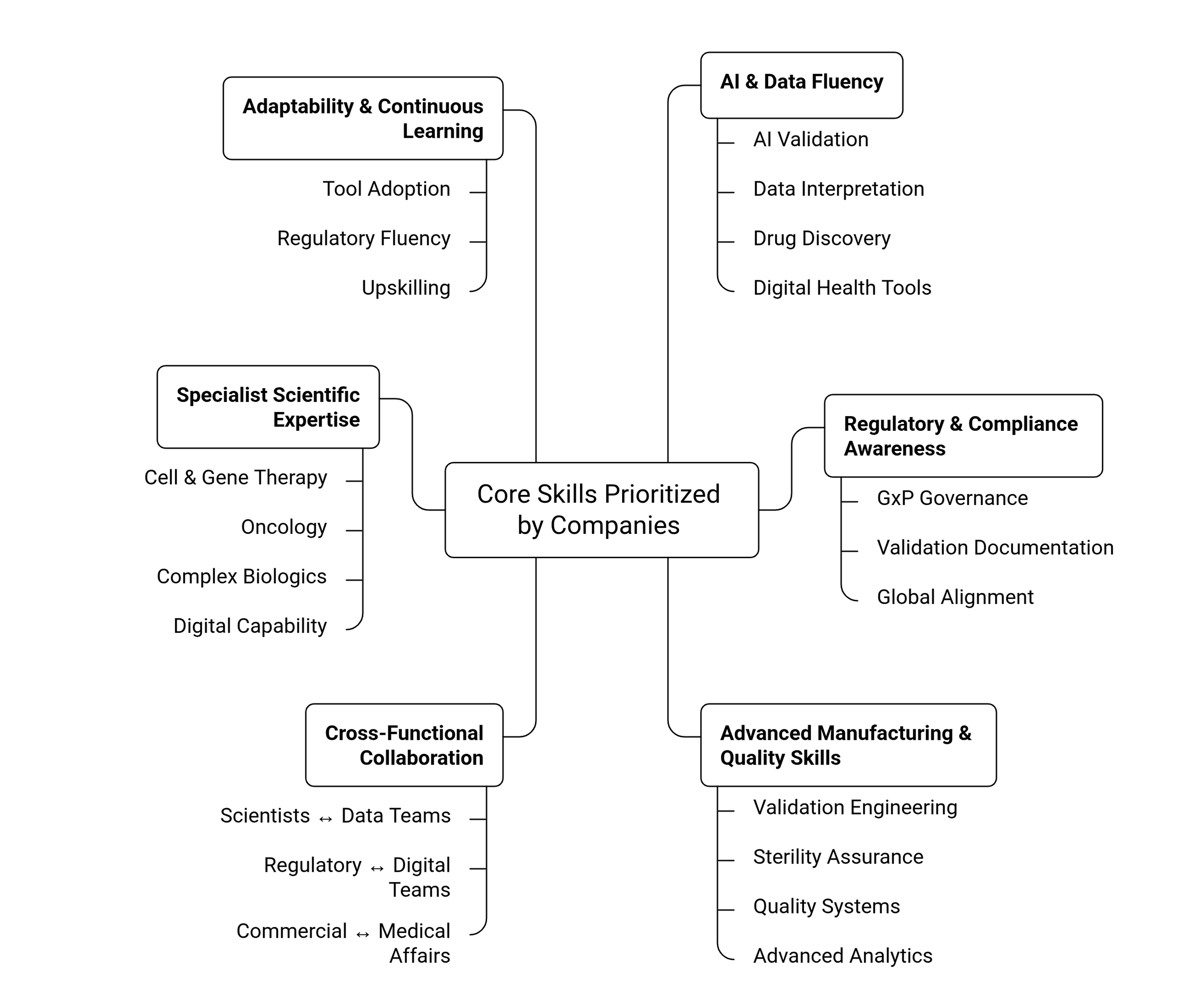 1. AI and Data Fluency
This is now a baseline expectation, not a specialty. Companies want employees, across R&D, manufacturing, and commercial teams, who can work alongside AI tools, interpret model outputs, and apply them responsibly. Growing sub-skills within this category include:
- AI validation and compliance (checking that AI-driven decisions meet regulatory standards)
- Data interpretation for large, complex datasets
- Familiarity with AI-assisted drug discovery platforms
- Digital health tool integration
2. Regulatory and Compliance Awareness
As AI systems get embedded into regulated processes, someone has to make sure they meet GxP and regulatory expectations. Demand is rising for professionals who understand both the science and the compliance side, particularly in AI governance, validation documentation, and evolving global regulations.
3. Advanced Manufacturing and Quality Skills
Biologics, sterile manufacturing, and continuous processing all require a different technical skillset than traditional small-molecule production. Quality Assurance and Quality Control teams are seeing some of the sharpest talent shortages, especially in:
- Validation engineering (process and cleaning validation)
- Sterility assurance and contamination control
- Quality systems management
- Advanced analytics for quality data
4. Cross-Functional Collaboration
Fewer roles today sit in a single lane. Scientists are expected to work with data teams, regulatory staff to coordinate with digital teams, and commercial teams to collaborate more closely with medical affairs. Companies increasingly value people who can translate across functions rather than operate in isolation.
5. Specialist Scientific Expertise
Even with all the digital emphasis, deep technical knowledge hasn't gone away. Cell and gene therapy, oncology, and complex biologics still require specialists with genuine domain depth. The difference in 2026 is that this expertise is expected to pair with some level of digital capability.
6. Adaptability and Continuous Learning
Innovation cycles are moving faster than traditional training cycles. Employees who can pick up new tools, adjust to new regulatory requirements, and keep learning on the job are becoming more valuable than those with a fixed, static skill set.
AI isn't just a skill companies want — it's rewriting how they find people with that skill. See how AI-driven hiring is reshaping pharma recruitment itself.
→ Read: AI-Driven Hiring: The Future of Pharma Recruitment
Skills-Based Hiring Is Replacing the Traditional CV
Some workforce strategists are pushing companies to focus on portable skills rather than job titles or degrees. The idea is to look at what someone can actually do, not just where they've worked before, and to design roles around where people add the most value, like judgment and problem-solving, while letting technology handle repetitive tasks.
This approach also opens the door to lateral hiring from adjacent industries and closer partnerships with specialized recruitment firms, since the traditional pharma-only talent pool isn't large enough to meet current demand.
This shift isn't stopping at 2026. Here's what pharma jobs — and the skills behind them — will look like by 2030.
→ Read: The Future Of Work In Pharma: What Jobs Will Look Like In 2030?
Comparing 2024 Skill Priorities vs. 2026 Skill Priorities
Skill Area | 2024 Focus | 2026 Focus |
Data & AI | Basic digital literacy | AI validation, model interpretation, compliance |
Manufacturing | Standard GMP knowledge | Biologics, sterile processing, continuous manufacturing |
Regulatory | Regional compliance | Global compliance + AI governance |
Hiring approach | CV and title-based | Skills-based, portable capabilities |
Talent sourcing | Primarily in-industry | Lateral hires, GCCs, recruitment partners |
Learning model | Periodic training | Continuous, on-the-job upskilling |
A Quick Checklist for Workforce Readiness
Use this as a starting point to assess where your organization stands:
- Are AI and data skills built into job descriptions across departments, not just IT?
- Do QA/QC teams have access to training on advanced manufacturing and validation?
- Is there a clear path for cross-functional collaboration between R&D, regulatory, and commercial teams?
- Are you sourcing talent beyond traditional pharma backgrounds?
- Does your learning and development program support continuous upskilling, not one-time onboarding?
- Are succession plans in place for specialist roles in biologics and advanced therapies?
What This Means for Pharma Companies Going Forward
Workforce transformation in pharma isn't a one-time project. It's becoming an ongoing part of how companies operate, similar to how they manage supply chains or regulatory filings. The organizations that treat skills development as a continuous process, rather than a reaction to shortages, will be better positioned to handle the patent cliff, AI adoption, and the shift toward more complex therapies.
The companies figuring this out early are the ones building flexible teams now, before the talent gap gets even wider.
FAQs
1. What is pharma workforce transformation?
It's the shift in skills, roles, and hiring approaches that pharma companies are making to keep up with AI, biologics, and changing regulations.
2. Why is AI skill important in pharma right now?
AI is now used in drug discovery, manufacturing, and compliance, so employees need to understand how to work with it responsibly.
3. Which pharma roles face the biggest talent shortage in 2026?
QA/QC, validation engineering, regulatory affairs, and biologics manufacturing are seeing some of the sharpest gaps.
4. What is skills-based hiring in pharma?
It's an approach that focuses on what a candidate can actually do, rather than just their job title or degree.
5. How can pharma companies close the workforce skills gap?
By investing in continuous upskilling, hiring from adjacent industries, and building cross-functional collaboration into everyday work.
Reporting on the science, business and regulation shaping the pharmaceutical industry.
Plus dans RH dans l'industrie pharmaceutique
Tous les articles →
Crisis Management: HR's Role in Business Continuity in the Pharmaceutical Industry

Top HR Strategies for Successful Pharma Mergers: People, Culture, and Integration 2025

Discussion